



Mumbai: There was a time when artificial intelligence arrived with announcements. Grand launches. Carefully rehearsed demos. The kind of spectacle designed to reassure you that everything was under control.
That phase is… over.
Now, AI doesn’t announce itself. It updates overnight.
You open your photo gallery, and suddenly your images look better than you remember taking them. You draft an email, and it politely finishes your sentence—sometimes better than you intended. You search for something, and the answer appears before the question feels complete.
No fanfare. No dramatic entry.
Just quiet integration.
And perhaps that’s what makes it more significant.
The Subtle Shift From Tool To Presence
AI used to be something you used. Now, it’s something that operates alongside you.
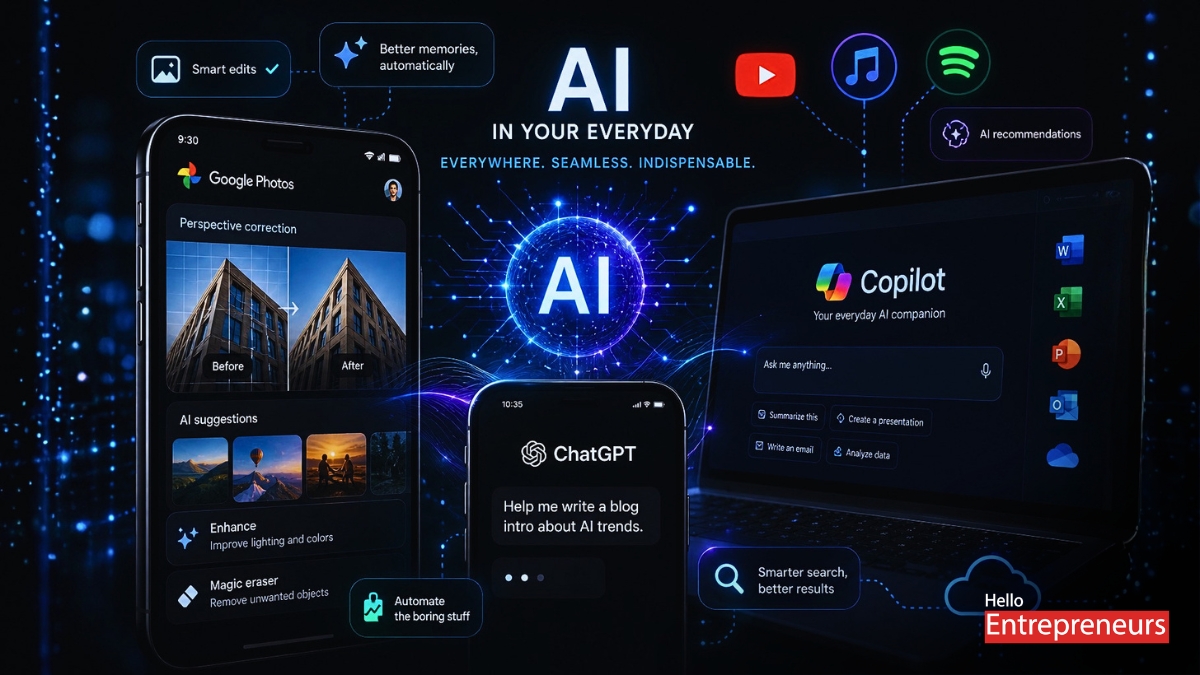
Applications like Google Photos are no longer just storage platforms. They’ve become intelligent systems:
- Automatic image enhancement
- Features like perspective correction and object removal
- Smart sorting and memory generation
Similarly, tools like Microsoft Copilot and ChatGPT are embedding themselves into:
- Operating systems
- Browsers
- Office productivity suites
The result?
AI isn’t a separate experience anymore. It’s becoming part of the default environment.
The Economics Of “Invisible Innovation”
Let’s talk scale—because this isn’t a niche upgrade.
- Tech giants are collectively investing hundreds of billions of dollars into AI infrastructure
- Data centers are expanding globally to support Artificial Intelligence workloads
- Consumer apps are integrating AI features at an unprecedented pace
Why?
Because integration is more effective than introduction.
Users may hesitate to adopt new tools. They rarely resist improvements to tools they already use.
It’s less about convincing people to try AI—and more about ensuring they don’t have to.
The Positive Case: Convenience At Its Peak
There’s no denying the advantages.
- Tasks that once required skill now require a tap
- Time-consuming processes are automated
- Creative tools are becoming more accessible
For everyday users, this means:
- Better photos without professional editing
- Faster communication with AI-assisted writing
- More efficient workflows across devices
In many ways, Artificial Intelligence is lowering the barrier to productivity.
Which, depending on your perspective, is either progress… or a subtle shift in expectations.
The Slightly Uncomfortable Reality
Of course, convenience has a cost.
And no, it’s not always monetary.
Dependency Is Increasing
- Users rely more on automated suggestions
- Manual skills may gradually decline
Privacy Concerns Persist
- AI systems require data—lots of it
- Personal information becomes part of optimization processes
Decision-Making Is Shifting
- Algorithms influence choices
- Recommendations shape behavior
None of this is inherently problematic.
But it does change the relationship between user and technology.
From control… to collaboration.
The Backstory: Why Now?
Artificial Intelligence didn’t suddenly become capable. It became deployable.
- Advances in machine learning improved accuracy
- Cloud computing made large-scale processing feasible
- Data availability enabled better training models
But the real shift?
Integration strategy.
Instead of building standalone AI products, companies began embedding AI into existing ecosystems.
Because adoption is easier when it feels familiar.
The User Experience: Effortless, Almost Suspiciously So
One of the most noticeable aspects of this transition is how seamless it feels.
- Features appear without requiring setup
- Suggestions feel intuitive
- Improvements happen automatically
It’s efficient.
It’s also… slightly invisible.
Which raises an interesting question:
If a tool improves your output without your input, who gets the credit?
You? The software? Or the system behind it?
The Industry Perspective: A Competitive Necessity
From a business standpoint, Artificial Intelligence integration isn’t optional.
It’s competitive.
- Platforms that offer smarter features retain users
- Productivity tools with AI capabilities gain market advantage
- Ecosystems become more valuable as they become more intelligent
This creates a race—not just to innovate, but to integrate faster.
Because in a landscape where everyone has access to similar technology, differentiation comes from execution.
The Sarcasm (Because It’s Earned)
There’s something almost charming about how quietly this is happening.
No dramatic takeover. No visible disruption.
Just incremental updates that collectively redefine how things work.
Because, naturally, the most effective way to change behavior is to ensure nobody notices it changing.
Subtlety, it seems, scales well.
The Creative Impact: Assistance Or Influence?
Artificial Intelligence tools are increasingly involved in creative processes.
- Photo editing
- Writing assistance
- Design suggestions
This raises a subtle concern:
Where does assistance end and influence begin?
- Are users expressing ideas, or refining suggestions?
- Is creativity being enhanced, or guided?
The distinction isn’t always clear.
And perhaps that’s the point.
The Workforce Angle: Evolution, Not Elimination
As Artificial Intelligence integrates into everyday tools, its impact on work becomes more pronounced.
- Routine tasks are automated
- Efficiency expectations increase
- Skill requirements shift toward oversight and strategy
This doesn’t eliminate roles entirely.
But it does redefine them.
Which, as history suggests, is both an opportunity and a challenge.
The Bigger Pattern: Technology Becoming Ambient
What we’re witnessing isn’t just Artificial Intelligence adoption. It’s AI normalization.
Technology is becoming:
- Less visible
- More integrated
- Increasingly essential
The goal isn’t to stand out.
It’s to blend in.
Because the most powerful systems are often the ones you don’t consciously interact with.
So, Is This A Good Thing?
As usual, the answer isn’t simple.
Pros:
- Increased efficiency
- Enhanced accessibility
- Improved user experience
Cons:
- Growing dependency
- Privacy considerations
- Subtle shifts in control
It’s not a binary outcome.
It’s a transformation.
The Final Thought: When Technology Stops Asking
The most interesting aspect of this shift isn’t what Artificial Intelligence can do.
It’s how it’s being introduced.
Quietly. Gradually. Persistently.
No disruption. No resistance.
Just integration.
And perhaps that’s the real story:
AI didn’t arrive dramatically because it didn’t need to.
It simply became useful enough to stay.
Read More: When Technology Finally Decided To Touch The Ground

