



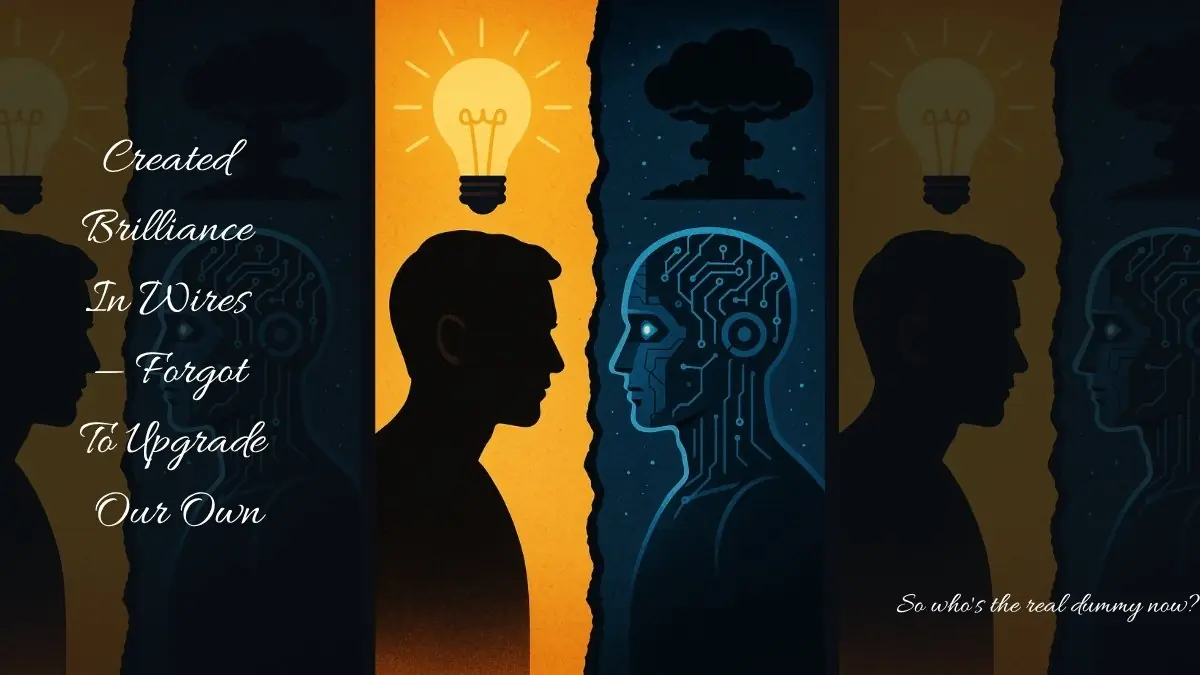
Surat: Humanity, in its infinite ingenuity-or perhaps infinite hubris—has outdone itself. We’ve managed to give birth to AI, a marvel of engineering so complex, it takes hundreds of GPUs just to teach it to recognise cats. Yes, that’s right. The same species that thought Tide Pods looked tasty now commands machines that can write poetry, play chess better than grandmasters, and mimic human empathy with unnerving ease. Bravo, evolution.
Let’s break it down.
On the other hand, we obviously are intelligent enough to create AI. That is not debatable. Machine learning, natural language processing, neural networks—phrases that sounded like science fiction jargon a few years ago are today everyday lingo. Chatbots can book meetings, AI can detect diseases quicker than some physicians, and algorithms compose headlines more effectively than half the newsroom. Even Google’s DeepMind learned to play Go and immediately beat the world champion, to seal once and for all that silicon could be sharper than the human cranium.
But, in the same sentence, let’s own up to being stupid enough to require AI to begin with.
Why? Because we’ve made a world so cluttered with complexity, information, and decision fatigue that we have to use machines to guide us through the mess we created. We constructed a house of mirrors and then gave the AI the flashlight. We need recommendation engines to decide what to watch, shopping algorithms to dictate what to purchase, and Artificial Intelligence therapists to sort through the emotional clutter we don’t have time to sort out.
It’s ironic, actually. We created machines to think because we didn’t. Or couldn’t. Or didn’t have the time between doomscrolling and refreshing our inboxes.
Let’s add some numbers, just to rub it in.
- In 2024 alone, more than $150 billion went into Artificial Intelligence startups across the world. That’s greater than the GDP of 130 nations.
- 83% of businesses claim Artificial Intelligence is a high strategic priority, while only around 12% of them are sure their data is truly Artificial Intelligence-ready.
- The typical American interacts with Artificial Intelligence more than 30 times per day, many times without even knowing it. That’s spell checkers, GPS recommendations, facial recognition, and your uncannily precise food delivery app.
And here’s the catch: while Artificial Intelligence replaces jobs at a steady pace, 85 million jobs will likely be displaced in 2025—but 97 million new ones could be created. So yeah, maybe Artificial Intelligence will steal your job, but potentially give you one—if you can switch from cashier to data ethics consultant.
So, are we geniuses for inventing AI or fools for requiring it? That’s the million-petaflop question.
And here’s where it gets existential.
Even with our cleverness and our vulnerability, we remain—alas, very sadly—too obtuse to decide whether or not creating Artificial Intelligence was the appropriate thing to do. We’re stumbling around over questions that should have been decided decades earlier: What does one do when Artificial Intelligence attains consciousness? Who is culpable if an autonomous vehicle kills a person? Does an AI deserve copyright for its artwork? Is your chatbot insidiously racist due to its training data?
We’ve unleashed an entity that mirrors our own flaws, biases, and contradictions, except it doesn’t need sleep, doesn’t get bored, and doesn’t have moral hangovers. It’s the perfect intern: tireless, uncomplaining, and increasingly overqualified.
But here’s the kicker. In our infinite wisdom, we neglected to create a user manual—not for the AI, but for ourselves. Because while we’ve invested billions of dollars in teaching computers how to speak human, we’ve invested very little time attempting to learn about ourselves. What do we want Artificial Intelligence to do? End climate change? Supplant teachers? Forecast crimes? Compose wedding vows? The answer, much like humanity’s shared attention span, is… inconsistent.
And let’s not even talk about regulation. Governments are still trying to define “AI” in legal terms while tech giants race ahead with new models that drop faster than boy band singles in the 2000s. We’re essentially flying the Artificial Intelligence plane while building the runway and arguing about the destination.
In short, this is peak human irony:
- Capable of building thinking machines,
- Incapable of unified thinking ourselves,
- And perennially unsure if we’ve invented a savior or scripted our own downfall.
So, to summarise this conundrum in true human fashion:
We’re smart enough to invent AI.
Dumb enough to need it.
And clueless to debate on Reddit whether we just invited our future overlords to dinner.
Somewhere up in the cloud, an AI just read this and smiled. If only it could laugh. Or perhaps… it already can.
Also Read: Patriarchy Isn’t Dead—It’s Evolved

