
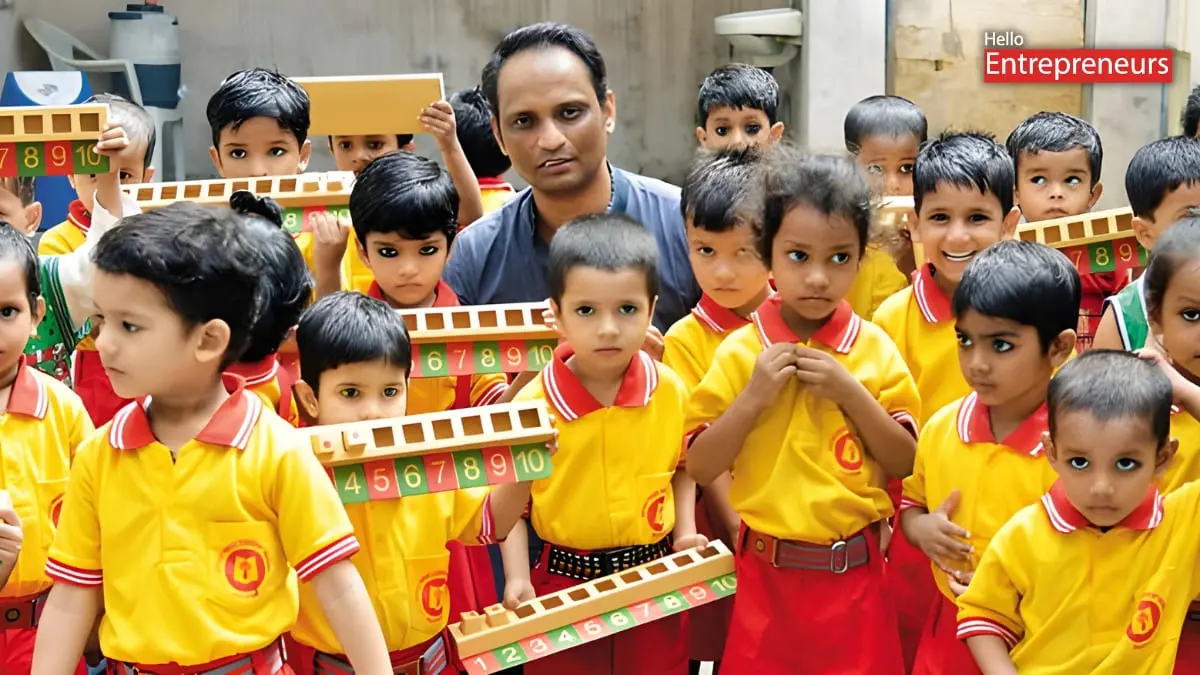








When Vikalp India began its journey in 2010, the education system in India was still heavily tied to rote learning. Teachers taught from the blackboard, students listened, and those who didn’t understand had no choice but to memorize. This system had worked for decades, but it left little space for creativity or curiosity.
Vikalp stepped in with a bold idea, what if classrooms became spaces of exploration, where children could do and not just listen? Instead of only lectures, students would engage with learning tools, perform activities, and discover concepts on their own. Teachers would no longer just instruct but guide.
It sounded promising, but change is never easy. Parents, who had themselves grown up in traditional classrooms, were doubtful. Some even opposed this “different” style of education. Teachers, too, were hesitant because their training had prepared them only for chalk-and-board methods. The shift from passive listening to active learning required a complete mindset change.
Over time, however, results spoke louder than resistance. Children not only enjoyed learning but also performed better. Slowly, parents turned into strong supporters, and with consistent training and handholding, many teachers embraced the new model. Today, with the National Education Policy (NEP) 2020 placing experiential learning at the center of education, Vikalp finds itself ahead of the curve, doing what others are just beginning to implement.
While many ed-tech platforms focus on pre-recorded videos, slides, or even VR experiences, Vikalp has always believed in something deeper, “learning by doing.” In its classrooms, students don’t just watch or listen; they take part, experiment, and construct their own understanding. The role of the teacher is not to provide ready-made answers but to help students ask better questions and explore until they find solutions.
This makes the process more child-friendly and ensures that learning is remembered far longer than facts picked up from a video lecture.
Reaching Every Kind of Learner
Vikalp’s model is flexible enough to adapt to very different environments. In private schools, the organization helps set up dedicated Math, Science, and Language labs and trains teachers to run them. In government schools, the model is funded through state partnerships, NGOs, or CSR projects. For example, its Delhi government initiative was supported by GE Capital, while the Karnataka program was run with the NGO Navya Disha.
And then there’s Vikalp’s online school. Here, children receive tailor-made learning kits delivered to their homes, creating mini-labs in their living rooms. They then join live sessions with facilitators who guide them through experiments and discussions. The experience is almost the same as being in a physical lab, but accessible to homeschoolers and remote learners across India and beyond.
Preparing for a future we can’t see yet
One of the biggest challenges today is preparing students for a future that is changing faster than ever. Children in schools today will step into jobs around 2040, and many of the roles we see now will no longer exist. Machines and AI are already replacing tasks based on memory and repetition. What will remain valuable are skills like critical thinking, problem-solving, analysis, and creativity.
Unfortunately, most schools still train students to memorize and deliver one “right” answer. Vikalp’s classrooms, in contrast, are designed as communities of inquiry, where mistakes are treated as opportunities and questioning is encouraged. This shift, from remembering to reasoning, is what will make children truly future-ready.
Impact that shows
The results are already visible. In Delhi, Vikalp’s Play Math program brought a 26% improvement in student performance. In Karnataka, classrooms shifted from blackboard dependency to activity-based learning, improving both engagement and retention. Through initiatives like No Child Left Behind, the organization has even helped children from marginalized communities rejoin mainstream education.
Scaling with support
With Series A funding and backing from institutions, Vikalp is now expanding its reach. The focus is on strengthening technology, developing richer content, and training more facilitators to bring the model into both urban and rural classrooms. Awards and recognition have further boosted its credibility, making it easier to form partnerships with governments, NGOs, and schools across India and abroad.
Looking Ahead
Over the next five years, Vikalp aims to bring its hands-on learning approach to more Tier 2 and Tier 3 cities, where quality education is still limited. Internationally, interest is growing among NRI families and expatriates, and Vikalp is preparing to serve these learners with globally relevant yet activity-based curricula.