



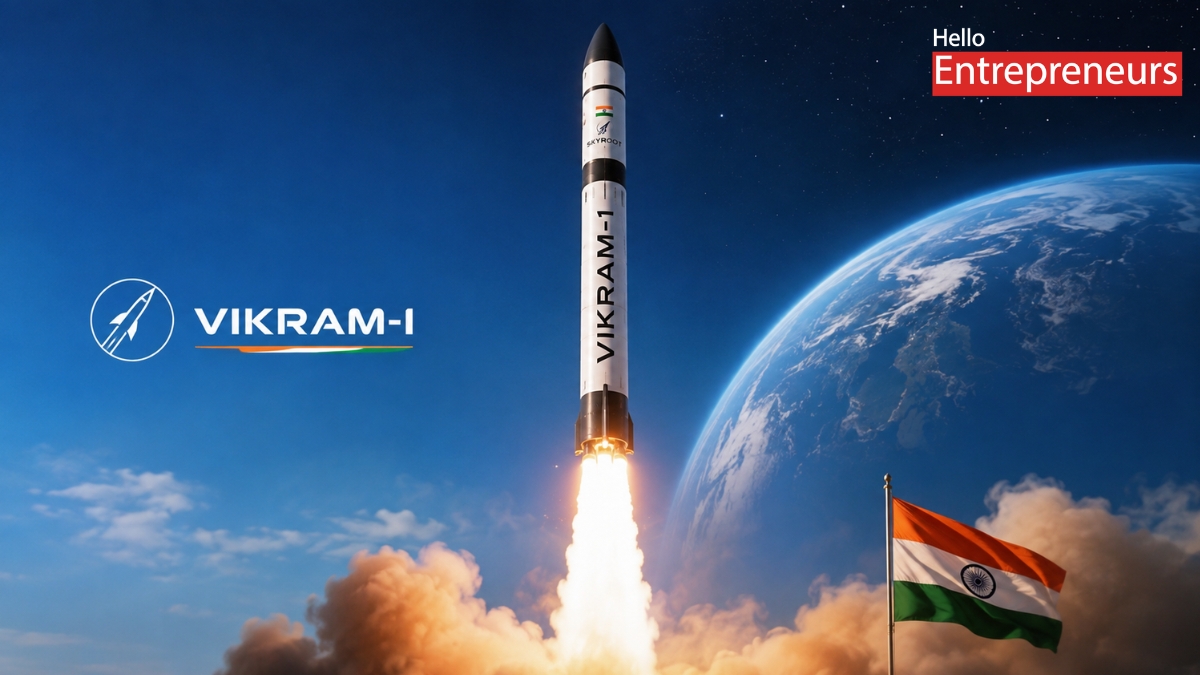
New Delhi: For decades, if you wanted to launch anything into orbit from India, ISRO was the only game in town. That changed on July 18, 2026. A 23-meter rocket called Vikram-1, built by Hyderabad-based Skyroot Aerospace, shot off from the Satish Dhawan Space Centre in Sriharikota. Seventeen minutes later, it was gliding in a 450-kilometer orbit above Earth. With that flight, India joined a rare club—now only the U.S., China, and India can say their private companies have built rockets that reached orbit.
This mission had a name: Aagaman, which means “arrival” in Sanskrit. It fits. Skyroot’s launch was the result of six years of engineering, fundraising, and some serious negotiation with a government learning to open up its space industry.
A rocket with roots
The rocket’s name, Vikram-1, is a nod to Vikram Sarabhai—the father of India’s space program. Feels pretty fitting, honestly. Skyroot’s journey echoes the scrappy, do-a-lot-with-a-little spirit that Sarabhai’s ISRO embodied back in the day. But this time, a startup held the chequebook.
Vikram-1 is no cobbled-together prototype. The thing is seven stories tall, built with an all-carbon-composite frame. Its first three stages run on solid fuel. The last stage—an in-house 3D-printed liquid engine—takes over to tweak the payload’s final orbit. It’s designed to loft 350 kilograms to low Earth orbit. Perfect for the small satellite market, which Rocket Lab’s Electron has quietly owned out of New Zealand and the U.S. for years.
That’s not by accident. Skyroot studied Rocket Lab’s playbook. SpaceX too—those early Falcon 1 days, shaky but determined, finally making orbit on attempt four back in 2008. Vikram-1? It hit orbit on its first go. Skyroot’s founders haven’t stopped grinning about it.
The big day
Launch day didn’t roll out without problems. With five minutes to go, a technical snag showed up and delayed everything by 35 minutes. But at 12:05 p.m. Indian Standard Time, Vikram-1 finally launched. The three solid-fuel stages did their job one after the other. Then the liquid engine kicked in for six more minutes, putting the payloads into orbit.
The cargo mix was both practical and symbolic:
– SCOPE, built by Skyroot itself
– SOLARAS S3, a nanosat from another Indian startup, Grahaa Space
– Embrace, a robotic debris-capture experiment from Cosmoserve Space
– A tech demo from Germany’s DCUBED
– Cosmic Bloom, an art piece made with lab-grown diamonds, plus a gold rocket paying tribute to Indian space pioneers
Seventeen minutes after takeoff, Mission Control called it: “The Vikram-1 Aagaman mission is a grand success.” The engineers—some who’d been at this for years—finally exhaled.
Why this is bigger than one flight
Sure, it’s tempting to sum this up with a headline—“Indian Startup Reaches Orbit, Congrats!” But the real story sits behind that. Vikram-1 didn’t come out of nowhere. ISRO opened up its test stands, provided motor-casting facilities, and let Skyroot use its launch pad. IN-SPACe, a brand-new government agency, steered the whole regulatory process. None of this even existed back in 2020.
That’s what matters. The U.S. didn’t get SpaceX overnight—it took NASA contracts, the COTS program, and the willingness to let startups fail in public. India seems to be speeding down the same road, condensing a process that took America more than a decade. Skyroot’s chairman, Pawan Kumar Chandana, says they want to go fast; they plan to launch monthly someday, working out of two sites in Hyderabad.
Investors have noticed. Skyroot raised $60 million just before this launch, aiming to crank out more Vikram-1 rockets and start on something bigger: Vikram-2. That’s how this business works—prove your rocket flies, then raise cash for the next, even bigger one.
The long road to a quick flight
None of this happened overnight. Skyroot’s founders were two ex-ISRO scientists who started up in 2018. Their first milestone came in November 2022, when their suborbital booster Vikram-S reached 88 kilometers—far short of orbit, but still the first private Indian rocket to touch space. Vikram-1 grew right out of those early lessons.
There’s a human side here too, tucked behind all the tech. Before the launch, former ISRO chairman S. Somanath took an honorary spot as advisor at Skyroot. He didn’t have to. That sent a quiet but clear message—India’s space veterans don’t see Skyroot as a rival, but as the next torchbearer for the nation’s space dream.
Maybe Vikram-1 turns into India’s Falcon 9 or Electron. Maybe not. One perfect launch is no guarantee that building a monthly rocket pipeline will be easy; most launch companies stumble on the road from “it worked once” to “it works every time.” But that July morning, for the first time, an Indian company did what only ISRO could do—and nailed it on the very first try.

