



Kabhi kabhi jeetne ke liye kuch haarna bhi padta hai … aur haar kar jeetne waale ko baazigar kehte hai
This Shah Rukh Khan dialogue has been often quoted with those who managed to snatch victory from the jaws of defeat, and one man has managed to do just that, though he didn’t live long enough to see it in front of his eyes.
This man has made his name in the annals of history and is widely cited as an example to emulate. His name is Tulsi Tanti, the founder of Suzlon Energy, the wind energy provider who became the biggest company of its kind, only to lose it all and guide the company towards the same status, though he, sadly passed away before he could see it for himself.
The start
It all started in 1995, when Tulsi Tanti was running a modest family textile business in Gujarat. To fix the high electricity bills eating away his profits, he bought two wind turbines that offered clean, reliable power. Then came the realisation: Setting a windmill was too complex for most companies,despite many of them facing the same challenge- unreliable power.
Over time, Tanti created Suzlon Energy, a ‘plug-and-play’ model that did everything- buy land, build turbines on them, secure grid clearances, build towers and manage lifetime maintenance.
The model proved successful. A decade later, Suzlon went public, with the company raising Rs.1,500 crore with the IPO being oversubscribed almost 40 times.
The debt fuelled ambitions, and subsequent downfall
Encouraged by the demand and riding on the easy availability of cheap loans, Tanti spend $1.6 billion to acquire REpower (later Senvion) in 2007 with an intention to conquer the European and North American markets.
But then came a challenge that he hadn’t hoped for.
The 2008 recession.
This forced power companies to halt capital spending and expansion, with global demand for massive wind turbines evaporated overnight.
Besides this, Suzlon had to pay its Foreign Currency Convertible Bonds (FCCBs) at a time when its revenues dried up and the weakening Rupee not helping. Worsening the situation the German lenders had set up conditions prohibiting Suzlon from using REpower’s cash flows to service its debt back home.
Along with that, the company had to spend millions of dollars to repair cracked turbine blades in the US, harming its reputation.
By 2012, Suzlon defaulted on a massive $209 million FCCB repayment—marking India’s largest convertible bond default at the time. The stock, once a market darling trading above ₹390, crashed into penny-stock territory at under ₹3.
Sacrificing Ego to save the company
At this juncture, many promoters would fight the banks to buy time or lose control of their companies. But Tanti chose a different path: he did everything to save Suzlon Energy- giving up equity, selling prize assets and giving up control to keep Suzlon breathing. This meant:
- Selling the Crown Jewel: In 2015, Tanti sold Senvion to Centerbridge Partners at a steep discount to pare down immediate debt.
- Bringing in a White Knight: He got Sun Pharma’s Dilip Shanghvi on board, who acquired a ~23% stake to inject fresh confidence and equity.
- Repeated Financial Engineering: Over a decade, Suzlon underwent four rounds of debt restructurings. For Tulsi Tanti, this meant diluting his family’s promoter holding, converting the unsustainable debt into equity and optional convertible debentures (OCREPs).

The Final Act
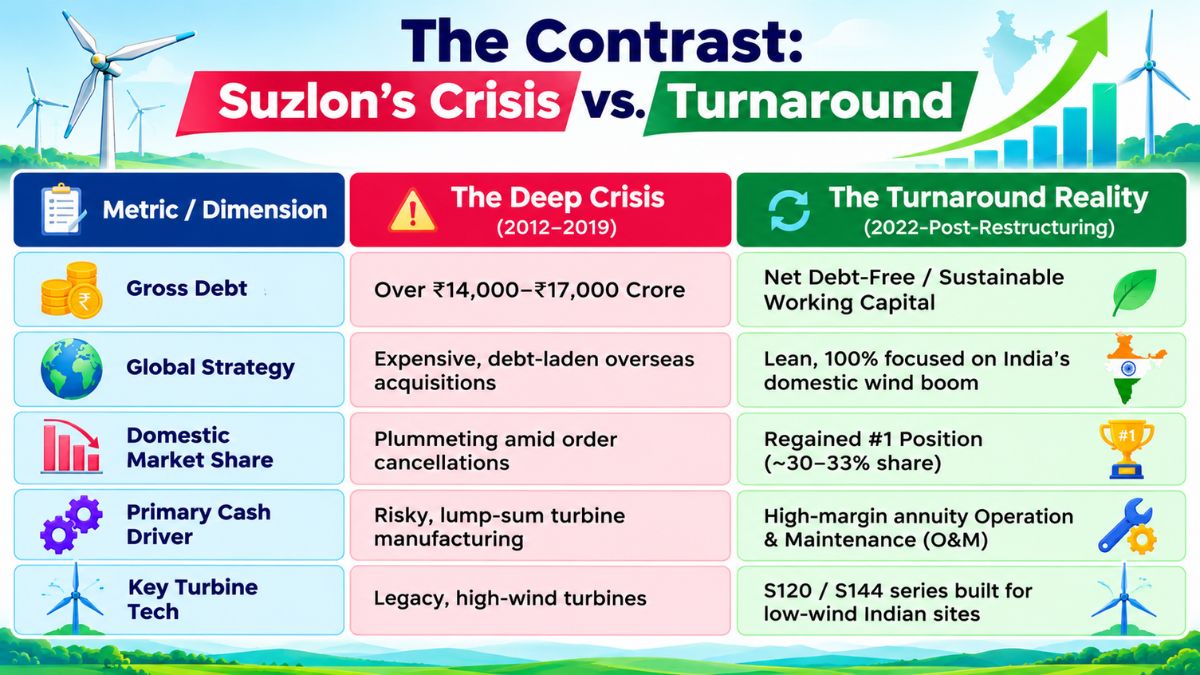
While doing all of this, Tanti realised how India’s best wind sites were already taken, making its products obsolete. To address this, Suzlon’s core engineering team designed next gen turbines like the S120, S144 and, more recently, the S75 series aimed at generating power even in low wind conditions.
To generate consistent revenues, Suzlon also parallely built a massive Operation & Maintenance (O&M) business, servicing over 14 GW of turbines across India. This service arm helped the company get consistent revenues that insulated it from volatile turbine sales.
When doing this, lady luck blessed the company, with the Indian government setting an aggressive target of 500GW of non-fossil capacity. Taking the opportunity head on, Tulsi Tanti bagged contracts from the likes of NTPC, Adani and Tata, helping it regain its #1 market position in India.
In late September 2022, Tulsi Tanti finalized a crucial ₹1,200 crore rights issue to set the stage for a debt-free future. Just days later, on October 1, 2022, he suffered a sudden cardiac arrest and passed away at age 64.
He didn’t live to see the stock reclaim multi-year highs or the company declare itself net debt-free, but his unrelenting 14-year fight saved 10,000+ green jobs and preserved an indigenous manufacturing champion.
Tulsi Tanti lost his wealth, his peak promoter stake, and his overseas empire—yet by keeping his company alive against all odds, he proved that in the business world, haar kar jeetne wale ko hi Baazigar kehte hain.

