



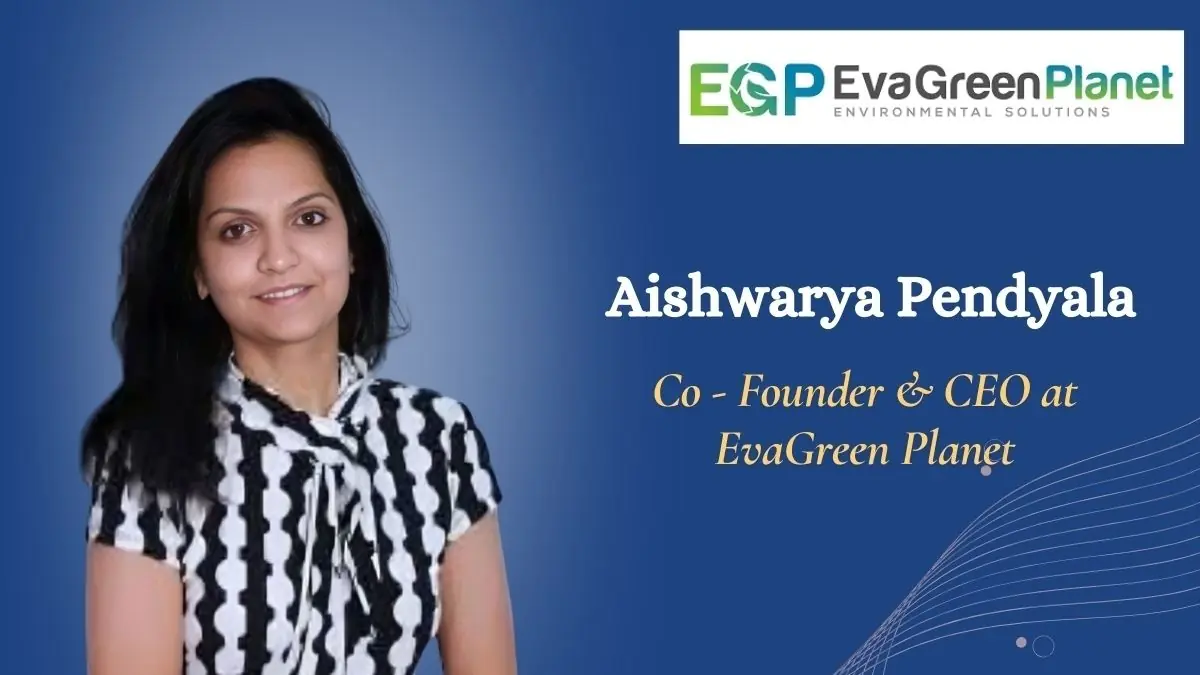
Aishwarya Pendyala
Nashik: In an era where conscious consumption and responsible innovation are reshaping global markets, EvaGreen Planet Jalna stands at the forefront of a movement that blends sustainability with real-world impact. Leading this vision is Aishwarya Pendyala, Co-Founder & CEO, whose cross-continental journey has shaped a unique and powerful mission: to redefine sustainable living through renewable energy solutions that are accessible, community-driven, and deeply transformative.
Born in India and raised in Kenya, Aishwarya’s life reflects a rich tapestry of cultures and experiences. After more than three decades abroad, she returned to India to create her own “Swades story”—a purpose-driven path rooted in environmental responsibility and national progress. Today, she leads EvaGreen Planet Jalna with a commitment to addressing some of the world’s most pressing challenges: waste management, fossil fuel reduction, and soil health restoration. At the heart of her mission is the development of women-led Compressed Biogas (CBG) plants across Asia, empowering local communities while driving measurable climate action.
What sets EvaGreen Planet Jalna apart is its ability to make sustainability both meaningful and attainable. Aishwarya believes that the strength of any organization lies in its people, and she fosters a culture of collaboration, innovation, and empowerment—ensuring that everyone within the company contributes to a larger global purpose. Her background in strategic finance across North America strengthens her ability to align long-term sustainability goals with robust business strategy, enabling the company to scale responsibly and effectively.
EvaGreen Planet Jalna is more than just a renewable energy venture; it is an environmental solutions company focused on propelling communities forward while preserving the planet for future generations. The company diverts organic waste to produce clean, renewable Compressed Biogas (CBG) and chemical-free fertilizers—closing the loop on organic residue and advancing the principles of the circular economy. As India pushes toward a net-zero future, the company plays an active role in decarbonizing key sectors and supporting national and global sustainability commitments.
The demand for CBG in India is surging, driven by a progressive government mandate requiring 5% of natural gas to be replaced with CBG. While numerous players—ranging from established biofuel companies to emerging startups—are entering the market, the supply still falls significantly short of national demand. This gap not only highlights the immense growth potential but also positions EvaGreen Planet Jalna as a key catalyst in accelerating the country’s green energy transition.
What truly differentiates EvaGreen Planet Jalna is its holistic and integrated approach. While many producers focus solely on biofuel output, the Jalna plant is engineered to solve three major environmental challenges simultaneously:
Waste Management: Transforming organic waste into valuable resources, reducing landfill pressure, and reinforcing circular economy systems.
Climate Action: Replacing fossil fuels with clean, renewable CBG, directly cutting greenhouse gas emissions and mitigating climate change.
Soil Regeneration: Producing enriched organic fertilizers that restore soil health and support sustainable agriculture.
This triple-impact model positions EvaGreen Planet Jalna as a transformative force—not only in renewable energy production but also in community upliftment, climate resilience, and long-term ecological stewardship.
In a competitive landscape where sustainability often feels costly, exclusive, or disconnected from local realities, Aishwarya Pendyala is redefining the narrative. Under her leadership, EvaGreen Planet Jalna proves that conscious living and clean energy can be mainstream, accessible, community-powered, and profoundly impactful. Together, they are charting a path toward a greener future—one where innovation meets responsibility, and sustainability becomes a culture shared by all.

