



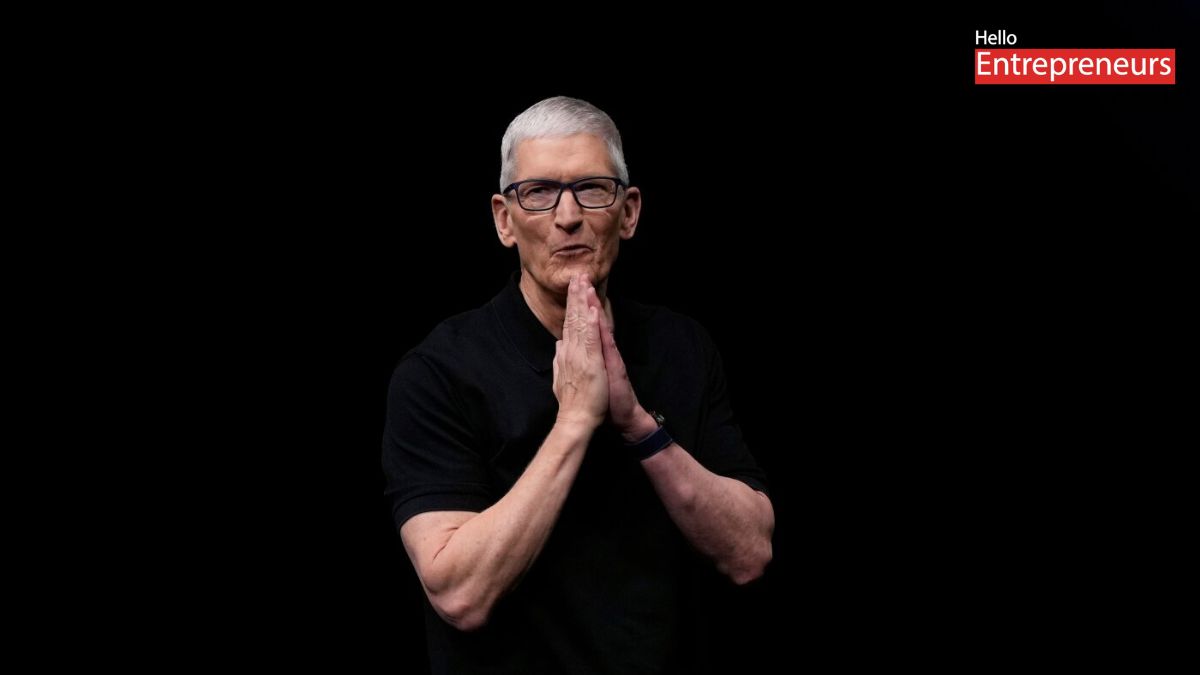
New Delhi: One of the biggest changes in leadership is currently occurring at Apple with Tim Cook set to leave the CEO role later this year and have a new role of executive chairman. Cook, who took over the company over 10 years ago, is not leaving as quickly as it might have been perceived but is passing the baton in a more planned manner at a moment when the tech giant is in a new transition. He has clarified that his move is not motivated by health issues, but time and necessity to have new leadership in place because the industry is rapidly changing.
Stability and huge financial growth have characterized Cook during his tenure as he was able to build on the foundation of Steve Jobs. During his tenure, Apple enhanced its ecosystem, increased its services and remained among the most valuable companies in the world. In this case, though, with John Ternus coming in, the transition represents an Apple bias towards continuity. Ternus, who is also an insider due to his involvement in hardware engineering, will be walking into the job with an understanding of the DNA of the company, but at a time when expectations are changing radically.
AI Battle
The most significant challenge that is going to be faced is not only leadership but technology, specifically artificial intelligence. As firms such as Google and OpenAI continue to demonstrate great progress with their AI tools, Apple is beginning to appear more and more as a straggler in the field. This has increased more so because competitors are still entering with more advanced chatbots, generative AI platforms, and highly integrated AI ecosystems that are transforming the way users engage with technology.
Apple is not slower in AI because of its inability to do it, it is because of its alternative philosophy. User privacy has always been a priority at the company, and restricts the type of large-scale information gathering that modern AI systems thrive on. As rivals pursue models aggressively by training on large datasets, Apple is pursuing a more conservative path, emphasizing on-device processing and controlled environments. This strategy ensures safety of the users, but also makes it less powerful in terms of its ability to compete in the race of generative AI.
The second reason is the traditional approach at Apple as to wait until the technology is completely developed and then issue it. It has been a successful approach in the past as the company is able to perfect the products before launching them in the market. Nevertheless, AI is developing particularly rapidly, and it is possible to become irrelevant with excessive delays. Whereas Google and OpenAI are proud to release first versions and refine them as they go, Apple has kept its mouth shut and created the perception that it is lagging.
There exists the problem of visibility as well. Apple has been adding AI silently to its devices, such as optimizing its photography, battery life, and system performance, but they are not very obvious. Conversely, competitors are presenting AI as the marquee feature and letting their progress become more noticeable and easier to the masses. Consequently, even in instances where Apple is being innovative, it is not necessarily credited with it.
The change of leadership, therefore, is at a critical time. Apple is undergoing one of the largest strategic challenges in years as Tim Cook recedes and John Ternus is about to assume the helm. The company ceases to be a hardware or ecosystem powerhouse competing, it is now engaged in a high-stakes game to shape the future of artificial intelligence.
Nevertheless, Apple has a history that it is not to be ruled out. There are numerous times when the company has late ventured into markets only to transform them completely. How well it can replicate that in AI will be determined by how fast it can change without losing the values that constitute it. The following chapter of Apple will not be simply about new leadership, but about demonstrating that it can continue to lead in the world that is getting more and more dominated by intelligent machines.