



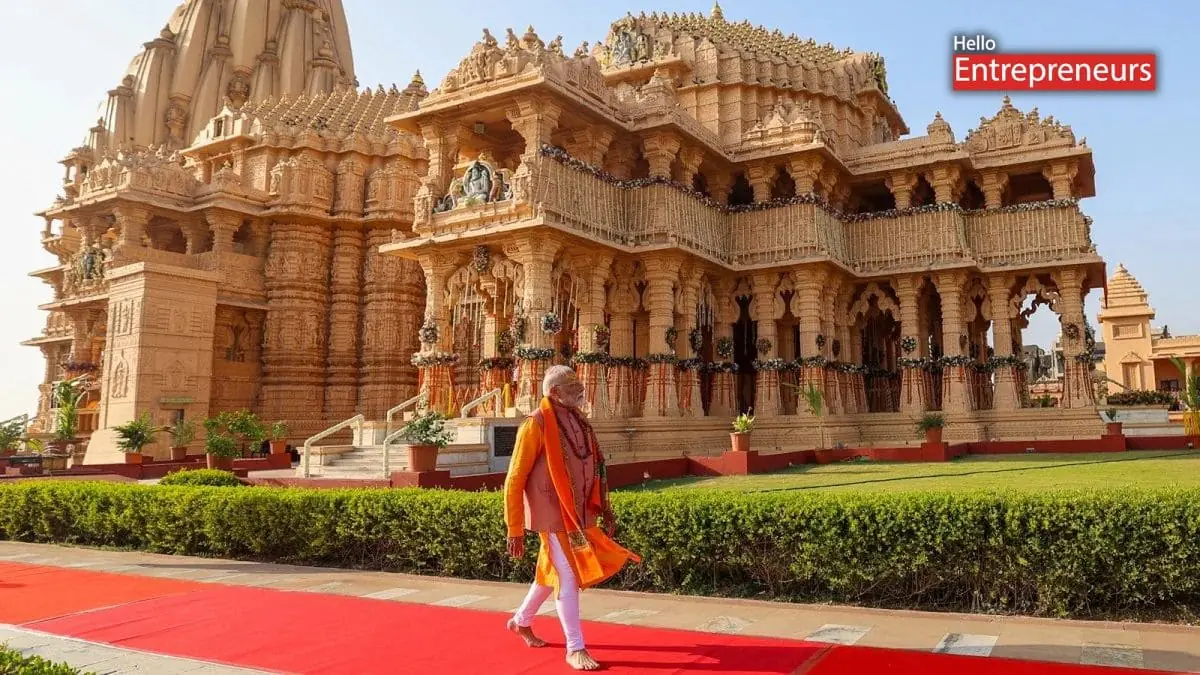
Gandhinagar: Exactly 1000 years have passed since the attack on the Somnath Temple by the invading Muhammad Ghazni. This attack by a foreign invader was a blow to India’s identity. A special book was mentioned in an article written by Prime Minister Narendra Modi on the completion of 1,000 years of the attack on Somnath. Now, people in the country, be it entrepreneurs, businessmen, corporates or common people, have taken to the Google search engine to know more about this book.
This book is ‘Somnath: The Shrine Eternal’ written by Kanaiyalal Maneklal Munshi in 1951! This book has given an introduction to the historical and religious importance of the temple of Lord Shri Somnath. Due to the mention made by the Prime Minister, this book is currently at the center of discussion and reading, so it will be interesting to know about this book.
Munshi, the luminary of Gujarat’s identity, does not need to be introduced to Gujaratis. Apart from being a politician, he was also a good writer. The focus of his books has been on subjects including history and culture. Gujaratis do not have a special habit of reading books written in English. A lot has been written about Gujarat and the history of Gujarat in English too, in which Kanaiyalal Munshi can also be considered a hero.
By reading books written by him like Patanni Prabhuta, Jai Somnath, Gujarat No Nath, Bhagn Paduka, Krishnaavatar Bhag 1 to 7, one can know interesting details of religious figures along with the history of Gujarat.
In the book Somnath – The Internal Shrine, Kanaiyalal Munshi has given a historical and archaeological introduction to the temple of Lord Shri Somnath. He has called the Somnath temple a symbol of India’s identity. Why is this temple important for the cultural heritage of India? One can get an idea of it by reading this book. At present, Somnath Swabhiman Parv is being celebrated at Somnath, it is also important to know about this book.
This book has been published under the ‘Books University’ series of Bharatiya Vidya Bhavan, the main objective of which is to combine the basic values of Indian culture with modern knowledge.
Munshiji wrote the first edition of this book in May 1951 on the occasion of the restoration of the Somnath temple and the consecration of the Jyotirlinga. The author himself admits that he prepared this book in a very short time without claiming to be an academic scholar, but as a very devout person and a historical enthusiast. So that the history of Somnath can be presented to the people.
The purpose of this book is to provide higher education and culture. Through this book, an attempt has been made to establish the dignity and moral order of man, so that man can become a true part of God.
The book is mainly divided into four parts. The first part contains the mythological stories and history of Somnath; the second part is the ‘Romance in Stone’ i.e. the architecture carved in stones; the third part contains the evidence found through archaeological excavations; and the fourth part gives details of the writings of Muslim historians and various inscriptions.
The author has described Somnath as the ‘Lord of Soma’ and has discussed the historical importance of the Prabhas region. The temple has remained invincible even after many destructions, like the ‘Phoenix’ bird rising from the ashes. The book also mentions the holy place of the cremation of Lord Krishna.
This book contains a detailed history of the invasions of Somnath. The story of the difficult period from the destruction by Mahmud of Ghazni in 1025 to the time of Alauddin Khilji and Aurangzeb is found here. Munshiji has presented this destruction not only as a demolition of the building, but as a blow to the national soul.
An important part of the book focuses on the modern revival of Somnath. The resolution that Sardar Vallabhbhai Patel made with the sea water in the courtyard of the dilapidated temple on 13 November 1947, has been described by K. M. Munshi was the restoration of India’s pride.
The book also includes a report on the scientific excavations carried out by B. K. Thapar. In this section, the ancient architecture of the temple has been linked based on the layers, inscriptions and statues of ancient temples found in the subsoil of the earth, which is extremely useful for students of history.
The new editions of the book have also told about the progress of the construction of the new temple. The new temple has been named ‘Kailas Maha Meru Prasad’, which is 155 feet high. The book has many drawings and photographs. Which show the artistic magnificence of Somnath.
‘Somnath: The Shrine Eternal’ is not just a book of history, but it is a symbol of the unwavering faith of the Indian people. According to Munshiji, Somnath is the ‘Anant Jyoti’, which connects India with its cultural roots from generation to generation and inspires people to live with self-respect.
Just as the Ganges River, despite taking many bends and emerging from the mountains, maintains its sanctity by reaching the sea, in the same way, the history of Somnath has also remained ‘endless’, maintaining its dignity despite the struggles, which is accurately depicted in this book.

