









New Delhi [India], December 22: India didn’t tweak MGNREGA. It replaced it. The Viksit Bharat G RAM G Act 2025 is a hard reset for rural employment, designed for today’s villages, not 2005 nostalgia.
Rural employment has always been more than wages. It’s stability, dignity, and survival when agriculture falters. For nearly two decades, MGNREGA carried that load. It delivered scale, inclusion, and a legal right to work. But systems age. Villages changed faster than the law governing them.
Enter the Viksit Bharat G RAM G Act 2025. This is not cosmetic reform. It is statutory surgery.
A Long Arc of Rural Employment Policy
India’s rural employment story didn’t begin with MGNREGA. Since Independence, wage employment programmes evolved in fits and starts, tracking poverty, population pressure, and seasonal distress.
The Rural Manpower Programme in the 1960s was basic relief. The Crash Scheme for Rural Employment in the early 1970s followed. By the 1980s and 1990s, schemes like the National Rural Employment Programme and the Rural Landless Employment Guarantee Programme tried scale, then merged into Jawahar Rozgar Yojana. That later became Sampoorna Grameen Rozgar Yojana.
Add-ons like the Employment Assurance Scheme and Food for Work filled seasonal gaps. Maharashtra’s Employment Guarantee Act of 1977 changed the game by asserting a legal right to work. That idea eventually went national with MGNREGA in 2005.
MGNREGA’s Real Achievements and Real Limits
MGNREGA mattered. It guaranteed 100 days of unskilled work to rural households. It stabilised incomes. It built assets. It brought women into the workforce in serious numbers.
Between FY 2013-14 and FY 2025-26, women’s participation rose from 48 percent to over 58 percent. Aadhaar seeding expanded rapidly. Electronic wage payments became nearly universal. Geo-tagged assets multiplied. Individual household assets increased.
Field staff kept the machine running, often under brutal constraints. That deserves credit.
But facts don’t care about sentiment. Structural problems hardened. Monitoring uncovered works that didn’t exist on the ground. Expenditure often didn’t match physical progress. Machines replaced labour where they shouldn’t. Digital attendance was bypassed. Misappropriation crept in. After the pandemic, very few households actually completed 100 days of work.
MGNREGA improved its plumbing. The architecture still leaked.
Why a New Law Was Inevitable
Rural India in 2025 is not rural India in 2005. Poverty fell from 27.1 percent in 2011-12 to 5.3 percent in 2022-23. Digital payments are routine. Livelihoods diversified. Migration patterns changed. Welfare coverage expanded.
An open-ended, demand-driven wage scheme built for a different era stopped fitting reality. Incremental reform wasn’t enough. The system needed a new spine.
That’s where the Viksit Bharat G RAM G Act 2025 steps in.
What the Viksit Bharat G RAM G Act 2025 Delivers
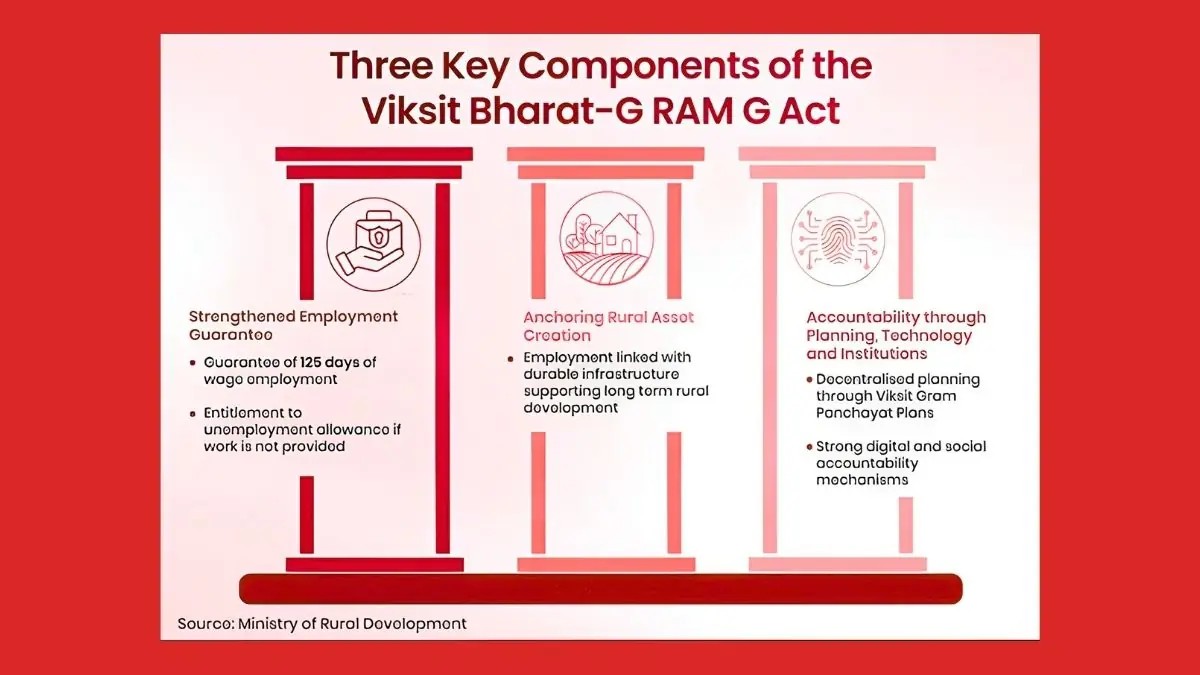
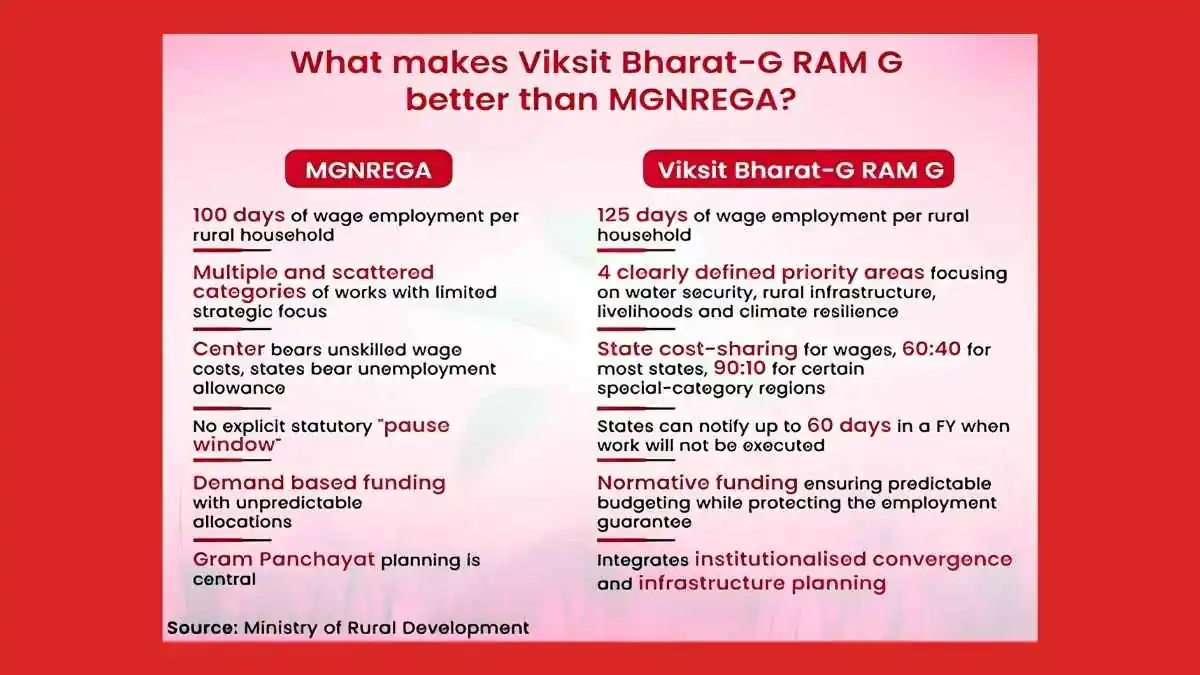
The headline change is simple. The guarantee rises from 100 days to 125 days of wage employment per rural household each financial year. More income security. Period.
There’s also discipline. A cumulative 60-day no-work window allows states to pause public works during peak sowing and harvesting. Farmers get labour when they need it. Wage inflation stays in check. Workers still receive 125 days across the remaining 305 days.
Wages must be paid weekly, or at worst within a fortnight. Delays are no longer casually tolerated.
Employment is now tightly linked to infrastructure creation across four priority verticals. Water security through water-related works. Core rural infrastructure. Livelihood-related infrastructure. And special works for extreme weather mitigation.
Every asset feeds into the Viksit Bharat National Rural Infrastructure Stack. No silos. No duplication. Planning flows bottom-up through Viksit Gram Panchayat Plans, spatially aligned with PM Gati Shakti.
MGNREGA vs Viksit Bharat G RAM G Act
This is where the upgrade becomes obvious. The old system focused on demand. The new one balances demand with planning, accountability, and outcomes.
Administrative expenditure rises from 6 percent to 9 percent. That’s not bloat. It’s realism. Better staffing, training, remuneration, and technical capacity mean fewer ghost works and tighter execution.
The Act professionalises delivery instead of pretending goodwill is a substitute for systems.
The Financial Architecture Shift
One of the biggest changes is structural. The scheme moves from a central sector model to a centrally sponsored one. Rural employment is local by nature. The financing now reflects that.
States share cost and responsibility under a normative allocation framework. Planning becomes predictable. Budgeting becomes rational. Legal entitlement to work or unemployment allowance stays intact.
The estimated annual outlay is Rs.1,51,282 crore, including state share. The Centre’s share is about Rs.95,692 crore. Cost sharing follows a 60:40 ratio for most states, 90:10 for North Eastern and Himalayan states, and full central funding for Union Territories without legislatures.
States were already paying part of the bill earlier. This just aligns incentives with accountability. Additional disaster assistance and stronger oversight reduce long-term fiscal leakage.
Why Normative Funding Beats Demand Chaos
Demand-based funding sounds noble. In practice, it wrecks budgeting. Normative allocation uses objective parameters. States know what they’re getting. Planning improves. Employment guarantees remain legally enforceable.
Predictability is not the enemy of rights. It’s their backbone.
What Rural India Gains
This is where the Viksit Bharat G RAM G Act 2025 earns its keep.
Households gain higher earnings from 125 guaranteed days. Consumption rises locally. Distress migration eases. Assets created actually support livelihoods.
Water-related works strengthen irrigation and groundwater recharge. Roads and connectivity improve market access. Storage, markets, and production assets enable diversification beyond farm labour. Climate resilience improves through flood control, soil conservation, and water harvesting.
Farmers benefit from assured labour availability during peak seasons, better irrigation, storage, and connectivity, and controlled wage pressures.
Labourers gain predictable work through Panchayat Plans, digital wage security, tangible assets they helped create, and a mandatory unemployment allowance if work isn’t provided within 15 days. Liability rests with states. Rates and conditions are rule-based, flexible yet enforceable.
Governance and Monitoring That Actually Bites
The institutional framework is unambiguous.
Central and State Gramin Rozgar Guarantee Councils guide policy and accountability. Steering Committees drive strategy and convergence. Panchayati Raj Institutions lead planning and execution, with Gram Panchayats handling at least half of total works by cost.
District Programme Coordinators and Programme Officers manage compliance, payments, and audits. Gram Sabhas conduct social audits with full access to records, at least twice a year.
Transparency Is No Longer Optional
The Centre now has enforcement teeth. It can investigate complaints, suspend fund releases, and order corrective action where irregularities surface.
Technology plays backup, not theatre. AI tools and biometric authentication flag anomalies early. GPS and mobile-based monitoring track works in real time. MIS dashboards publish weekly data. Public visibility is baked in.
This isn’t surveillance for its own sake. It’s protection of public money.
Conclusion
The Viksit Bharat G RAM G Act 2025 marks the end of half-measures in rural employment policy. MGNREGA laid the foundation. It expanded inclusion and digitisation. But its structure aged poorly.
The new Act keeps what worked and discards what didn’t. More days of work. Clear planning. Stronger accountability. Infrastructure that lasts. Governance that enforces.
Rural employment is no longer treated as relief spending. It’s a strategic tool for growth, resilience, and dignity. That’s how you build Viksit Bharat 2047.