



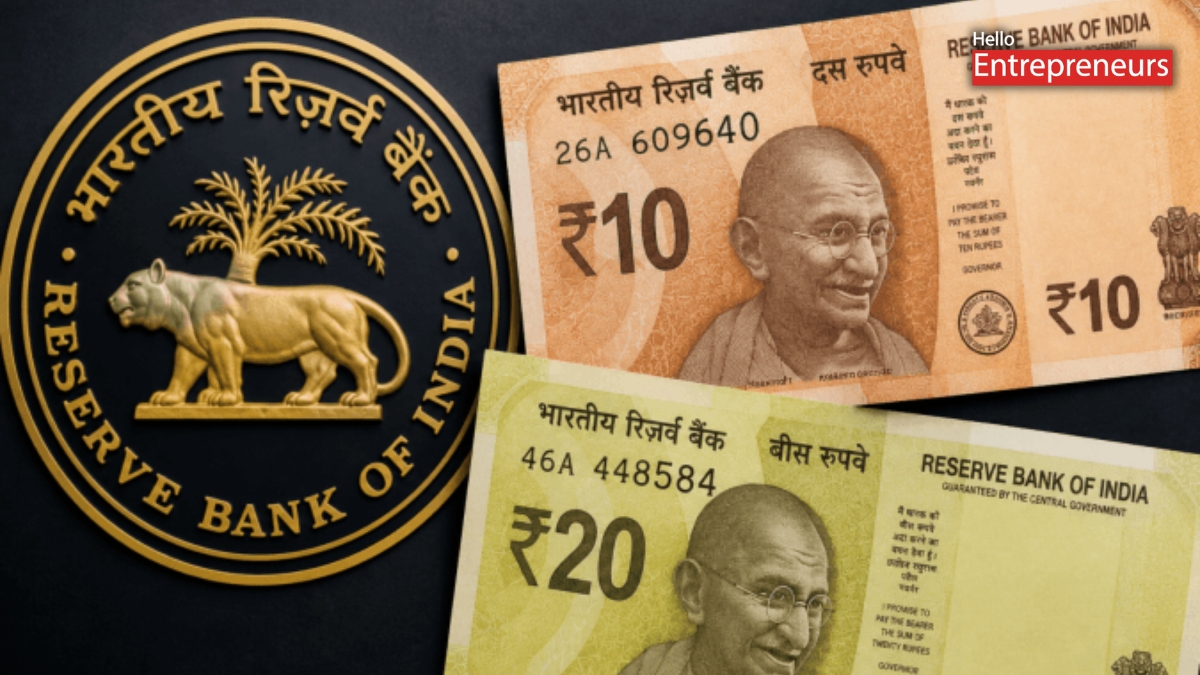
New Delhi: Major change in the use of cash by Indians, as the Reserve Bank of India (RBI) is making ready to introduce polymer currency notes. If the current process of testing the new notes is successful, RBI Governor Sanjay Malhotra has clarified that it plans to launch them in the early part of FY27-28. Currently the pilot is underway on ₹10 and ₹20 notes, which are the high-denomination banknotes used by many people and are likely to wear out quickly.
Each polymer note produced is produced using a special plastic polymer, whereas a paper banknote has a different composition of various paper types. The notes become more durable, resilient, and difficult to destroy when following these notes. Polymer currency is already used in countries like Australia, Canada, the United Kingdom, New Zealand, and Singapore, which have embraced its durability and advanced security technologies. Some countries like Australia, Canada, New Zealand, United Kingdom and Singapore already employ polymer currency due to its durability and advanced security features.
How Will India’s New Notes Look?
The overall design of the Indian currency is likely to be familiar to most people. The people are likely to remain the same, as well as important design features such as the portrait of Mahatma Gandhi, denomination numbers, etc. The content of the note will however be entirely different.
The notes on the polymer substrate generally present a smooth but slightly shiny surface. They’re frequently provided with clear windows, Windows that can’t be reproduced by the counterfeit, color-changing inks and other protection measures. The improved designs now make the notes more pleasing to the eye and enhance protection from counterfeit notes, as well.
By emulating the design of Australia and Canada, there is a possibility of printing polymer notes in distinctive designs with brighter colors, and also making them more durable so that they can be used for years without losing their printing crispness.
Why Is RBI Switching to Polymer?
The durability is one of the main reasons. Lower denomination notes, with value of ₹10 and ₹20 are exchanged several times throughout the day. This hampers their durability and value, and therefore reduces their number in circulation.
Paper banknotes do not last for as long as polymer banknotes, which may endure two to five times longer. Though they are more expensive to make, they last longer before the need for replacement which, over time, cuts printing and replacement costs. They also exhibit greater water, dust, humidity and day to day wear resistance due to their versatility and capabilities, which suits Indian climate.
One of its other significant benefits is security. Polymer notes also are equipped with sophisticated anti-counterfeating colors and contents making it very difficult for criminals to produce fake money. This might boost confidence in the cash economy in India.
What Other Countries Have Experienced
In 1988, Australia was the first country to use polymer banknotes, and the country has since phased out its entire paper note range and has replaced it with polymer banknotes. Other countries that’ve gone the same route as Canada are the U.K., New Zealand, and other Asian and Middle Eastern nations. These countries have reported a decrease in counterfeit notes, the durability of their notes and lesser replacement costs.
What Happens Next?
The RBI has pointed out, however, that polymer notes are still in the stage of extensive tests under various weather conditions, usage etc, before going into nationwide use. Legal tender will still be in use in the course of all paper currency, and polymer and paper notes are anticipated to co-exist for the transition period.
If the pilot succeeds India will see one of the biggest enhancements to the country’s cash system in decades. Digital payments keep increasing, but millions of Indians still make payments using cash every day. Polymer notes are stronger and more secure, and they could greatly improve the safety and efficiency of cash transactions for years to come.

