



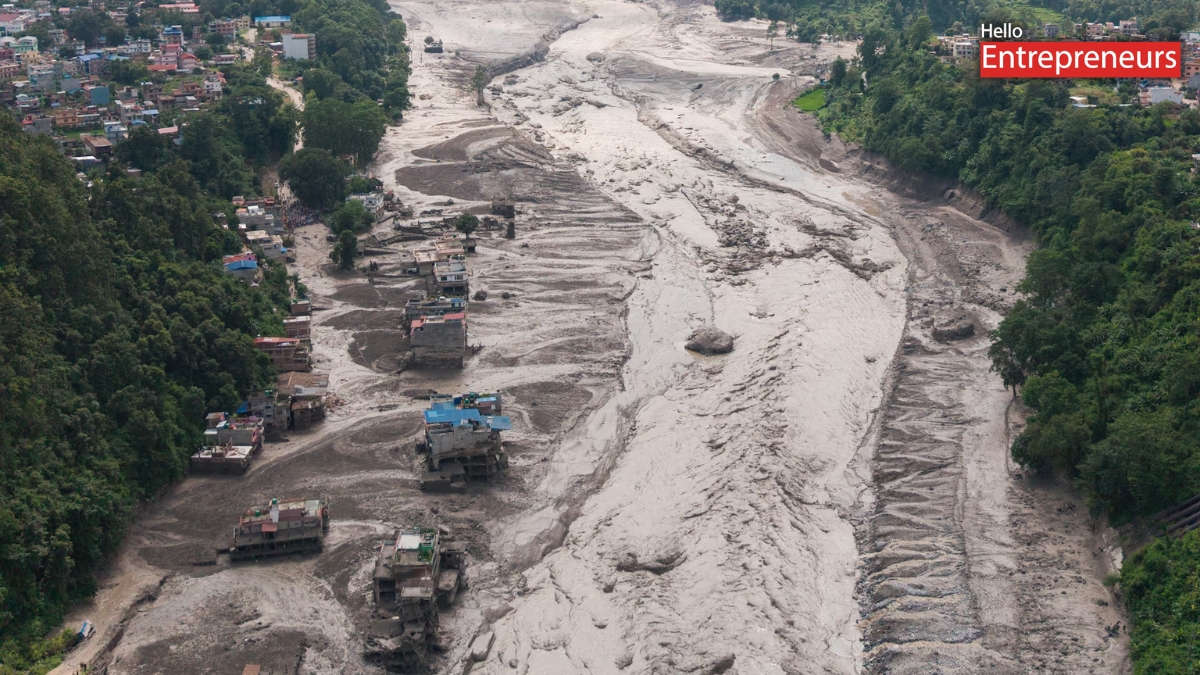
New Delhi: A flash flood in Nepal has left many dead and a few more missing in the nearest vicinity to the country’s border with Tibet, with devastating effects. It also severely affected hydro-power project locations, roads, bridges and local villages.
But early reports and social media postings have left people confused; claiming that a dam collapsed and was responsible for the deadly flood. Several reported disaster was rather than associated with the collapse of a glacier or ice rocks, causing a vast quantity of water, mud and rocks to rush down.
The area of Bhotekoshi/Lhende Khola in Rasuwa district, just on the Nepal-Tibet border, was affected by the flood. The powerful flow swept through settlements and infrastructure in its path. Moreover, multiple hydropower schemes in the region were impacted.
The Upper Trishuli-1 hydropower project, one of the major projects affected by the disaster, is the affected project. South Korean firms, such as Doosan Enerbility and Korea South-East Power (KOEN) are deeply involved in the project. Doosan Enerbility has played a part in engineering, procurement and construction for the project and KOEN is one of the South Korean companies associated with the project.
The sudden flooding affected workers at the hydropower projects. Several workers who participated in reconstruction activities in the hydropower sector from South Korea were reported missing after the disaster. Rescue personnel have been combing through the rubble to look for any missing persons and to determine the extent of the damage.
Other projects that were impacted included the Langtang Khola 20-MW hydropower project. Multi Energy Development Pvt. Ltd. is promoting the project, and initially it was reported that around 60 workers, engineers in particular, were missing when the flooding hit the project area.
The disaster has started to worry about the safety of the hydropower infrastructure in the hilly region of Nepal. The country has many hydropower projects as a result of its rivers and high mountains. Meanwhile, these projects might be in danger from landslides, flash floods, and other natural hazards.
By separating flood and hydropower infrastructure damage is much important. No definite evidence exists currently that a large artificial dam broke and caused the catastrophe. Instead of scientists have suggested a natural glacial or ice-rock breakage as the cause of the sudden flood.
Rescue and recovery efforts are ongoing, with the death toll changing over time. At least hundreds of people have already been reported dead or missing in the Nepal and Tibet regions.
The search is now underway for the missing and damage to hydropower projects and other infrastructure. It will also be crucial to conduct a detailed investigation to determine the nature of the flood and the impacts of individual hydropower facilities.
For the time being, evidence suggests that it was a natural glacial event prior to a devastating flash flood, but not a confirmed dam failure.

