



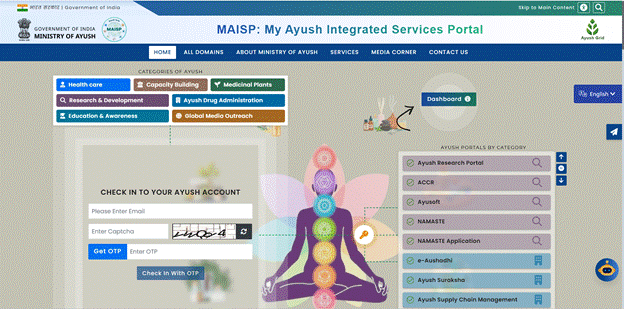
New Delhi, September 19: Building on the digital foundation laid by Ayush Grid, the Ministry of Ayush is now advancing Artificial Intelligence as the next frontier for Ayurveda and the wider Ayush sector. The Ministry has been exploring AI across healthcare, research, education, information services and investment facilitation, with an emerging ecosystem that includes both specialised AI applications and broader collaborations with national AI initiatives.
At the citizen-facing level, the MAISP Chatbot is designed to make Ayush-related information, including Ayurveda, readily accessible through a conversational interface. The ARP Research Assistant, a GenAI-based assistant, extends the Ayush Research Portal, helping researchers navigate Ayurveda and other Ayush literature more effectively. The eLMS Chatbot introduces AI-based Student Life Cycle Management for Ayurveda and other Ayush education institutions, while the e-CHARAK Chatbot functions as a medicinal-plant trade assistant, connecting conversational AI with the ecosystem that underpins Ayurvedic pharmacology. Yoga Saarthi serves as a yoga recommendation AI chatbot, and Nivesh Saarthi serves as an AI assistant for investment in the Ayush sector. Together, these chatbots demonstrate the expansion of Ayush Grid from digital portals towards interactive, intelligent and user-oriented AI services.
At the IndiaAI Impact Summit 2026, the AI Impact Casebook on Health, developed in partnership with the World Health Organization, featured a dedicated snapshot from the Ministry of Ayush titled “AI-driven Decision Support for Ayurveda: A Retrieval-Augmented Generation (RAG) Approach.” The inclusion of this Ayurveda use case in a global health AI casebook underscores the potential of Generative AI and RAG to strengthen evidence-based Ayurvedic knowledge and the wider digital transformation of traditional medicine.
The Ministry’s broader AI ecosystem is being advanced through participation in the IndiaAI Innovation Challenge, with a focus on developing AI-enabled solutions tailored to the Ayush sector. Key use cases include voice-based Electronic Health Records, disease-trend detection, and personalised treatment-support solutions, aimed at leveraging Artificial Intelligence to enhance healthcare delivery, clinical insights and patient-centric care across Ayurveda and other Ayush systems.
On 11 July 2025, the WHO, ITU and WIPO jointly released a technical brief, Mapping the Application of Artificial Intelligence in Traditional Medicine, examining how AI can support traditional medicine while highlighting the importance of responsible, evidence-informed and culturally appropriate approaches, including for Ayurveda.
The Ministry of Ayush has collaborated with IndiaAI and the Digital India Bhashini Division (DIBD), MeitY, creating opportunities to explore artificial intelligence, language technologies, digital health and advanced computing for the Ayush ecosystem. Ministry artefacts are now available on AI Kosh to support wider AI research and dissemination in the Ayush and Ayurveda domains. Through the Bhashini collaboration, Ayush Grid portals, including those serving Ayurveda practitioners, students and citizens, are now available in 22 scheduled languages of India, enabling wider participation and reach across the country’s linguistic diversity.
With AI assistants alongside collaborations involving IndiaAI and Bhashini, the Ayush ecosystem is moving further towards intelligent and citizen-centric digital services. The intent is not to replace traditional Ayurvedic knowledge with technology, but to use Artificial Intelligence to strengthen, connect and amplify that knowledge, making it more discoverable, evidence-based and accessible to citizens in India and around the world.

