



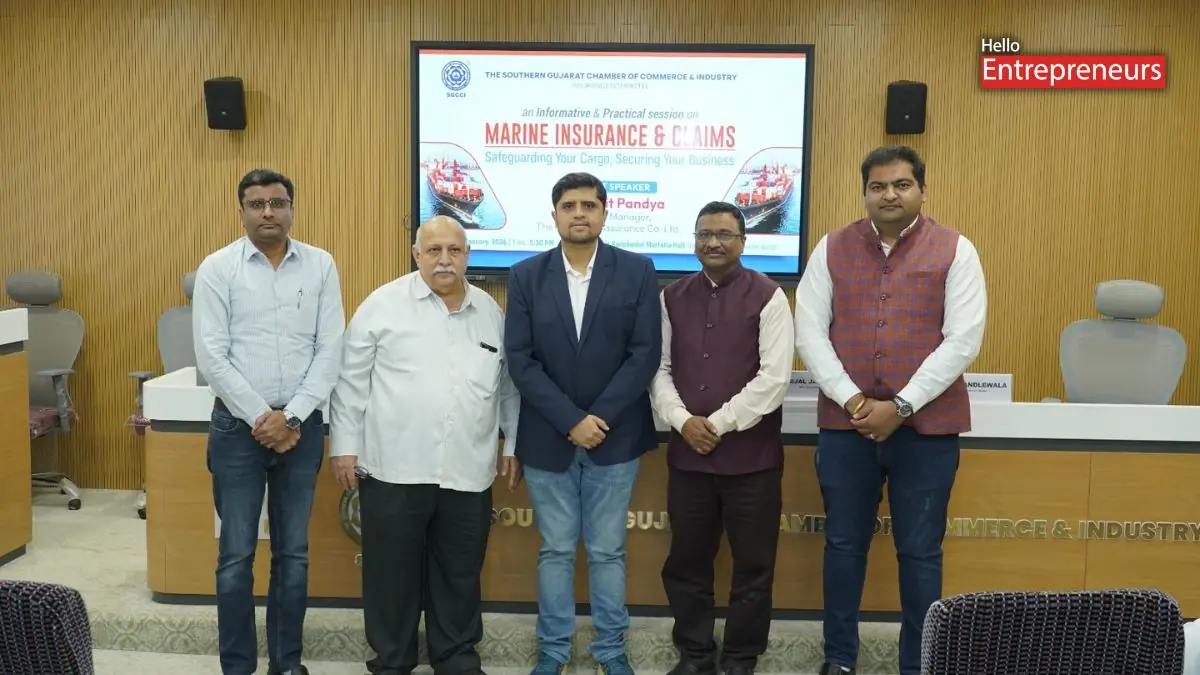
Surat: ‘Insurance is a contract of trust, it is the duty of every insured to follow the principle of ‘Utmost Good Faith‘, said Punit Pandya, divisional manager of the New India Assurance Company limited at a seminar on ‘Marine Insurance and Claims: Safeguarding Your Cargo/Securing Your Business’ organised by the Southern Gujarat Chamber of Commerce and Industry (SGCCI).
Pandya said that the government is continuously making efforts to increase the coverage of insurance in the country. Marine insurance has been in existence since the beginning of international trade. The Parliament has also passed a special act for marine insurance. He also discussed its important provisions.
He said that many international conventions also affect it. He stressed on the duties of the insurer for smooth settlement of insurance and said that insurance is a contract and ‘utmost good faith’ is its basic principle. According to this principle, both the insured and the insurance company should not hide any important details from each other. In particular, it is imperative for the insured to disclose all the true facts related to the risk. Providing correct information about the nature of the cargo, packaging and route of travel is part of ‘utmost good faith’. If any important information is hidden, the insurance company has the right to reject the claim.
He explained with an example that when a ship, its cargo or crew members are in serious danger during a sea voyage, and a specific cargo is deliberately abandoned or an additional expense is incurred to save everyone from that danger, then that loss is not considered to be the loss of just one person. That loss is shared among all stakeholders (the ship owner and all cargo owners). It is called the ‘General Average Contribution’. If you have a proper marine insurance policy, the insurance company pays the share you have to pay under the ‘General Average’.
Marine policies do not cover only cargo. He gave the example of the 2021 blockage in the Suez Canal and explained that when a ship or cargo is in serious danger during a sea voyage (e.g. the ship hits a rock or is about to sink due to engine failure), the amount paid in return for the service provided by a third party or company to save it is called salvage charges. Salvage charges are covered in a marine insurance policy. If you have the right insurance, the insurance company pays these charges on your behalf. He also explained the types of marine policies, coverage, transit clause, when the coverage starts, how long it continues, what is not covered, the importance of spot surveys, etc.

