



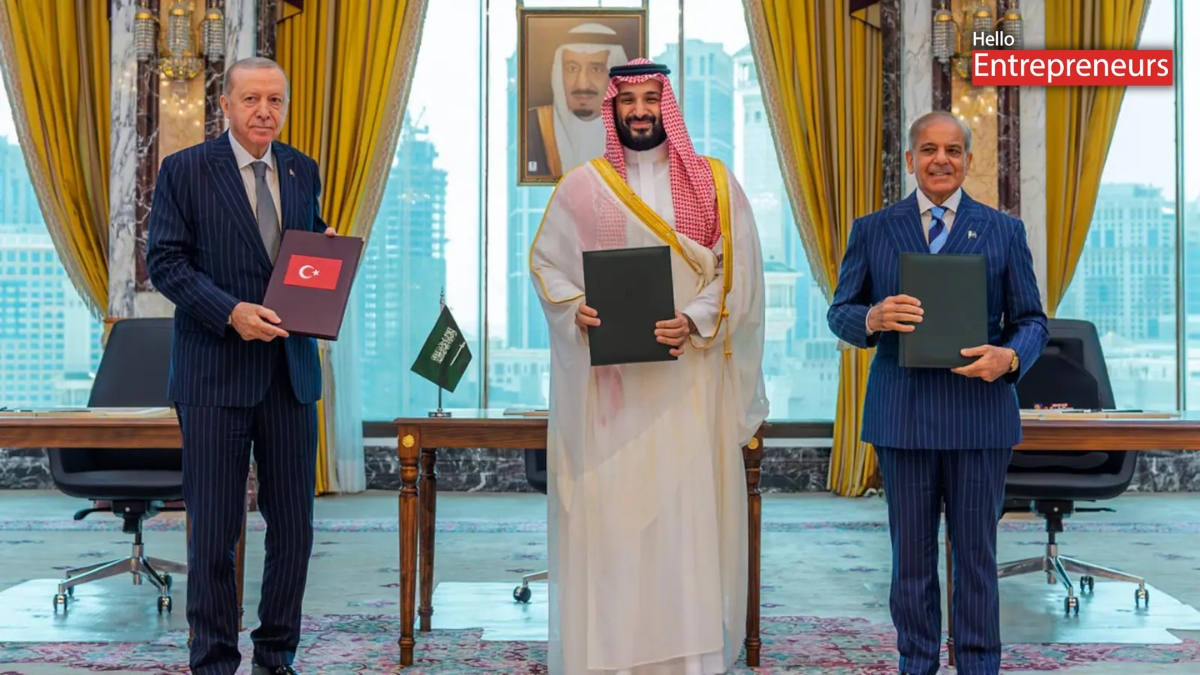
New Delhi: India is keenly observing a new security pact that has been inked by Saudi Arabia, Turkey and Pakistan in West Asia. The deal is being negotiated at a time of escalating tensions and uncertainty about U.S. involvement in Middle East security in the region.
The three countries have agreed that an attack against one will be regarded as an attack against all under the Mecca Joint Defence Agreement. But Turkish Foreign Minister Hakan Fidan explained that the accord is in the same sense as a mutual defence pact among NATO nations, and that it is not against Iran or any specific nation. The alliance might be able to grow, and Egypt has been suggested as a potential new member.
The creation is significant for India primarily because of the presence of Pakistan in the new grouping. Pakistan’s military is strong and the nation is nuclear power, while Turkey has a pumping defence industry and expertise in modern warfare including drones. Saudi Arabia, on the other hand, has the financial capabilities to finance significant defence investments and military relations.
New Delhi is especially interested in Turkey’s involvement. According to experts cited reports, Turkey has provided Pakistan with military assistance, including drones. Closer ties between the Defence departments of Pakistan and Turkey could result in more sophisticated armaments, drones and electronic warfare systems being brought to Pakistan, Defence analysts have warned.
Saudi Arabia is a more complex situation, though. India has strong economic relationship with Saudi Arabia and heavily relies on the Kingdom for energy. Millions of Indians reside and work in Saudi Arabia as well. The Saudi capital, Riyadh, has also expressed its interest in large investment in India. Saudi Arabia cannot afford for tensions between India and Pakistan to escalate into a full-blown military war, due to these connections.
Perhaps the real question is on shifting power dynamics in Western Asia. Gulf countries are seeking other security guarantees that they are not as confident in the degree of action the U.S. will take on their behalf. The new pact can be interpreted not just as a military deal, but as an effort on the part of regional nations to build up for an unknown future.
India is also beefing up ties with Israel, UAE, Greece and Cyprus. The Indian establishment has so far rejected any official declaration of a counter-alliance, but there is a high degree of coordination with those nations, which is important due to various reasons, including its Indian-Middle East-Europe Economic Corridor and Defence Cooperation.
The new Saudi-Turkey-Pakistan alliance does not necessarily translate to a triangular threat for New Delhi. However, it complicates the already complex security environment. India will have to be careful in its relations with Saudi Arabia and other Gulf nations in the backdrop of Pakistan and Turkey’s increasing defence cooperation.

