




Mumbai: India just pulled off what most economies only dream about, adding nearly 17 crore jobs in six years while slicing unemployment nearly in half. That’s not a blip. That’s a shift.
Jobs Are Back, and India Means Business
Let’s skip the small talk. Between 2017–18 and 2023–24, India created a staggering 16.83 crore jobs, pushing total employment to 64.33 crore. That’s not just a statistic, it’s a statement. A six-year rally that turned the labour market from cautious optimism to full-blown acceleration.
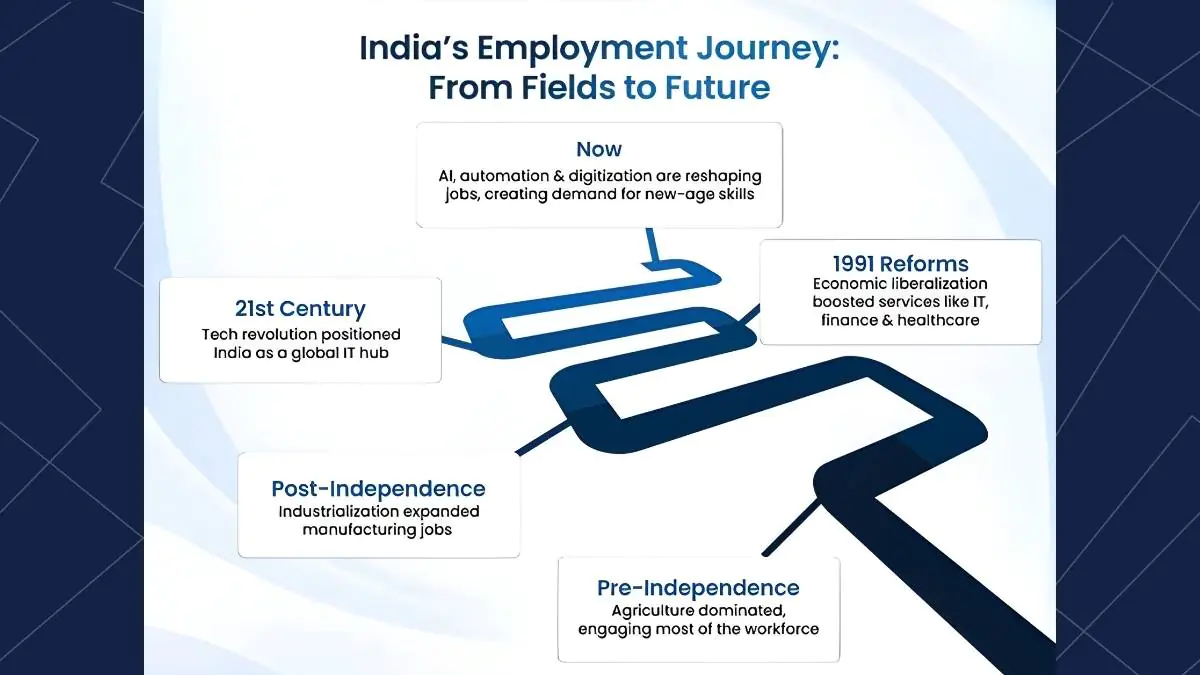
The unemployment rate, once hovering at 6%, crashed to 3.2%, its lowest in years. And the momentum isn’t fading. With a digital, automated, and sustainable economy firing on all cylinders, India is shaping up as the world’s next employment engine, not just a manufacturing hub or outsourcing pitstop.
What’s Driving This Boom
A few smart bets paid off. Youth-focused policy. Aggressive skill-building. Industrial reform. And a relentless march toward formalisation.
The Periodic Labour Force Survey (PLFS) data shows that between June and August 2025 alone, the Labour Force Participation Rate (LFPR) nudged up from 54.2% to 55%. The Worker Population Ratio (WPR) followed suit, jumping from 51.2% to 52.2%.
That’s a fancy way of saying: more Indians are working, earning, and contributing to GDP, and fewer are sitting on the sidelines waiting for opportunity to knock.
Formal Jobs: From Side Note to Centre Stage
Back in 2018–19, the EPFO added around 61 lakh new subscribers. By 2024–25, that number doubled to 1.29 crore. Since tracking began in 2017, more than 7.73 crore Indians have entered the formal workforce.
And July 2025 alone saw 21 lakh new additions, 60% of them between 18 and 25. Translation: India’s youth aren’t just looking for jobs anymore; they’re taking charge of them.
The formalisation drive, with payroll data, digital onboarding, and social security expansion, has quietly rewritten how work is measured in India. This isn’t your father’s informal economy anymore.
The Self-Employment Surge
Here’s another curveball: self-employment rose from 52.2% in 2017–18 to 58.4% in 2023–24, while casual labour dropped. The gig economy and startup wave made entrepreneurship mainstream.
Blame (or thank) digital India. With e-commerce, fintech, and ed-tech leading the charge, a generation of creators and solopreneurs emerged who prefer independence over job titles.
Show Me the Money: Wages Are Rising
Numbers don’t lie; casual labour wages rose from ₹294 to ₹433 per day between 2017 and 2024. Salaried workers saw a bump too, from ₹16,538 to ₹21,103 monthly.
It’s not Silicon Valley-level money yet, but it’s proof of economic muscle. Higher pay, better security, and a broader middle class, that’s the trifecta that signals an economy maturing fast.
Women: From Margins to Mainstream
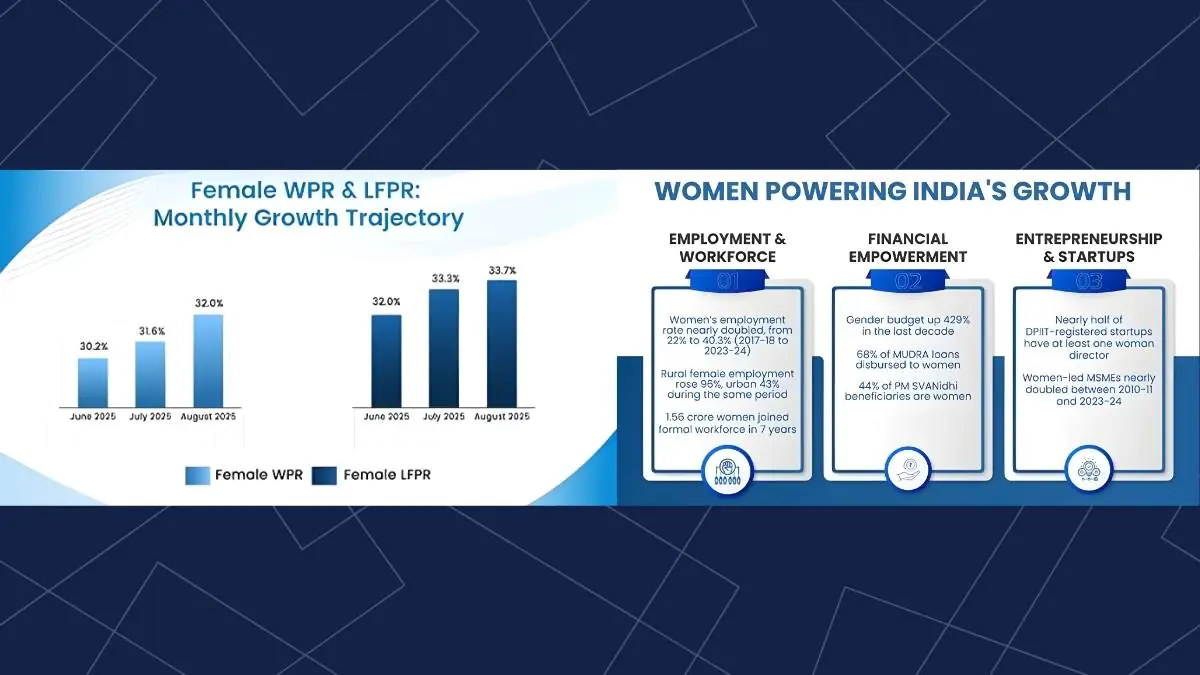
This is the real headline inside the headline. 1.56 crore women joined the formal workforce in seven years.
Female Labour Force Participation Rate nearly doubled, from 23.3% to 41.7%. The Worker Population Ratio jumped from 22% to 40.3%.
And the latest PLFS data shows steady month-on-month gains. August 2025 clocked a female LFPR of 33.7%, up from 32% in June.
This isn’t tokenism. This is a transformation. From Namo Drone Didi to Lakhpati Didi, government schemes are turning social programs into profit engines. Two crore women have already hit the Lakhpati benchmark. And that’s before you count the quiet revolution in startups, banking, and agritech led by women founders.
Gig Nation: India’s Freelance Frontier
The gig economy is the new backbone of urban employment. As of 2025, India’s gig workforce stands at one crore, expected to balloon to 2.35 crore by 2030.
The government’s e-Shram portal has already registered 31 crore workers, giving them visibility, identity, and access to benefits once reserved for salaried employees.
From delivery partners to digital consultants, India’s gig scene is formalising, fast. It’s not the Wild West anymore. It’s structured, tracked, and protected.
The Startup & GCC Effect
The startup story is no longer an underdog tale; it’s a jobs engine. With 1.9 lakh DPIIT-recognised startups and 118 unicorns, India’s ecosystem has created over 17 lakh jobs.
Then come the Global Capability Centres (GCCs), 1,700 and counting, employing over 2 million people in data analytics, AI, cybersecurity, and digital commerce. India is well on its way to becoming the GCC capital of the world by 2030.
These aren’t call centres; they’re innovation labs serving Fortune 500s. Every new GCC hub equals hundreds of high-skilled, high-paying jobs, the kind that keep talent at home instead of chasing visas abroad.
Skill India: Turning Ambition into Assets
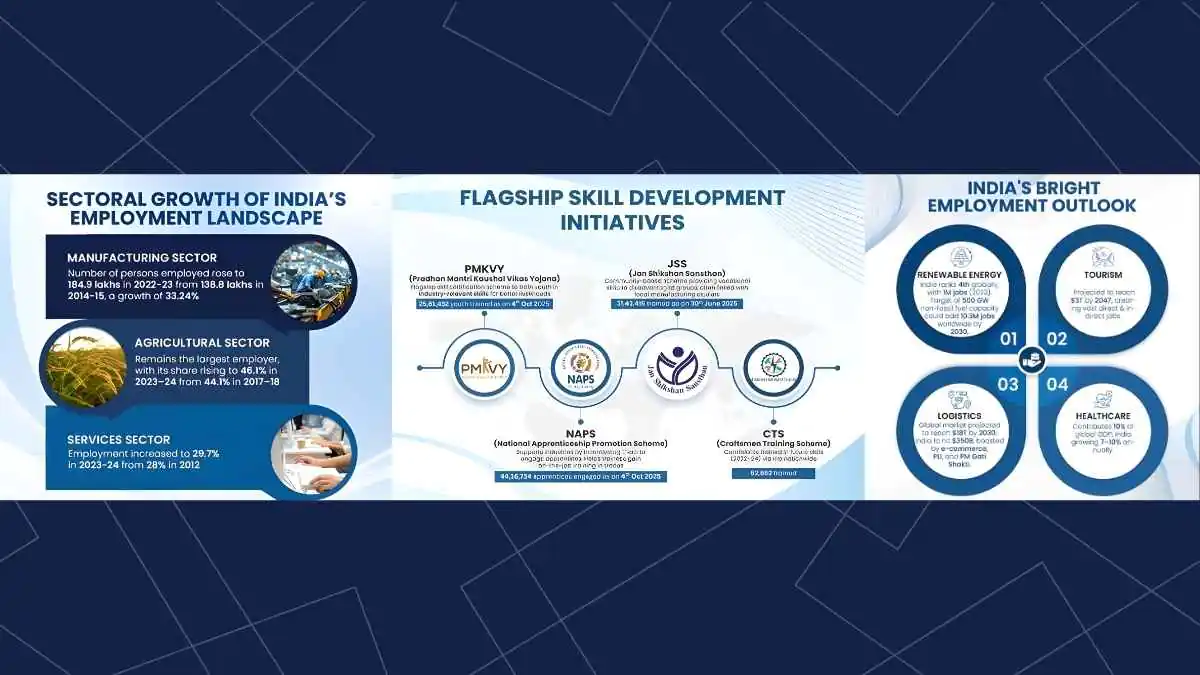
Credit where due, the Skill India Mission has quietly powered much of this momentum. With reskilling, upskilling, and a nationwide training grid, it’s creating workers who can compete globally.
From the Rozgar Melas (11 lakh placements in 16 months) to PM Vishwakarma (30 lakh artisans registered), the government’s programs are plugging gaps that once slowed job creation.
The ITI Upgradation Scheme alone aims to modernise 1,000 institutes and skill 20 lakh youth. Meanwhile, the Employment Linked Incentive Scheme targets 3.5 crore new jobs in just two years.
That’s not vision, that’s velocity.
Women’s Empowerment: Policy with Profit Potential
Women-focused initiatives have turned social welfare into smart economics.
- Namo Drone Didi: equipping 15,000 women-led SHGs with agri-drones.
- Mission Shakti: securing women through skill and safety.
- Lakhpati Didi Scheme: 2 crore women earning ₹1 lakh+ annually.
Add Bank Sakhi, Bima Sakhi, and Krishi Sakhi, and you get the picture: empowerment that pays. These aren’t charity drives; they’re revenue models with a human face.
Rural Growth, Real Gains
In rural India, the employment shift is tangible. The agriculture sector still anchors jobs, but new opportunities in renewable energy, logistics, and digital services are spreading fast.
The MGNREGA budget, ₹86,000 crore for FY 2025–26, is the highest ever. But more important is the exit story: people are moving from MGNREGA safety nets to stable private work. That’s evolution, not dependency.
The Sustainability Twist
The next frontier? Green jobs. As industries pivot toward eco-friendly growth, India’s clean energy sector is emerging as a double win, reducing emissions and creating livelihoods.
From solar tech installers to EV supply chain specialists, the workforce of the future will be skilled, digital, and sustainable.
India’s challenge isn’t employment anymore, it’s alignment: ensuring every new job supports a greener, smarter economy.
India’s Employment Flywheel Is Spinning
Add it all up, and the math speaks for itself:
- 64.33 crore employed
- 3.2% unemployment rate
- 17 crore jobs in six years
- Women’s participation up 18 percentage points
This isn’t an accident. It’s the compound effect of policy, innovation, and hustle.
The story of India’s workforce is no longer about finding work; it’s about shaping it.
Also Read: 5 Recent Big Startup Raises Fueling Bold Tech Bets – 2025

