


Surat, August 13: Sarvajanik University established the Sarvajanik College of Liberal Arts (SCLA) with the aim of providing quality education in the liberal arts. The newly established constituent college offers Honours programmes in Psychology and Economics and seeks to create an academic environment that encourages critical thinking, interdisciplinary learning, and holistic development.
Sarvajanik Univeristy organized a 2 day inaugration programme on August 6-7 of the SCLA building at the T&TV Campus in Nanpura on August 6 and7.
The inauguration ceremony saw Shri Ashish Vakil, the President of the Sarvajanik University and the Sarvajanik Education Society preside as the chief guest with Dr. Kiran Pandya, Provost, Sarvajanik University; Shri Kishor Desai, Vice Chairman-1, Sarvajanik Education Society; Shri Ajit Shah, Vice Chairman-2, Sarvajanik Education Society; Mr. Nickey Christie, Chairman, Working Committee, SCLA attending the event.
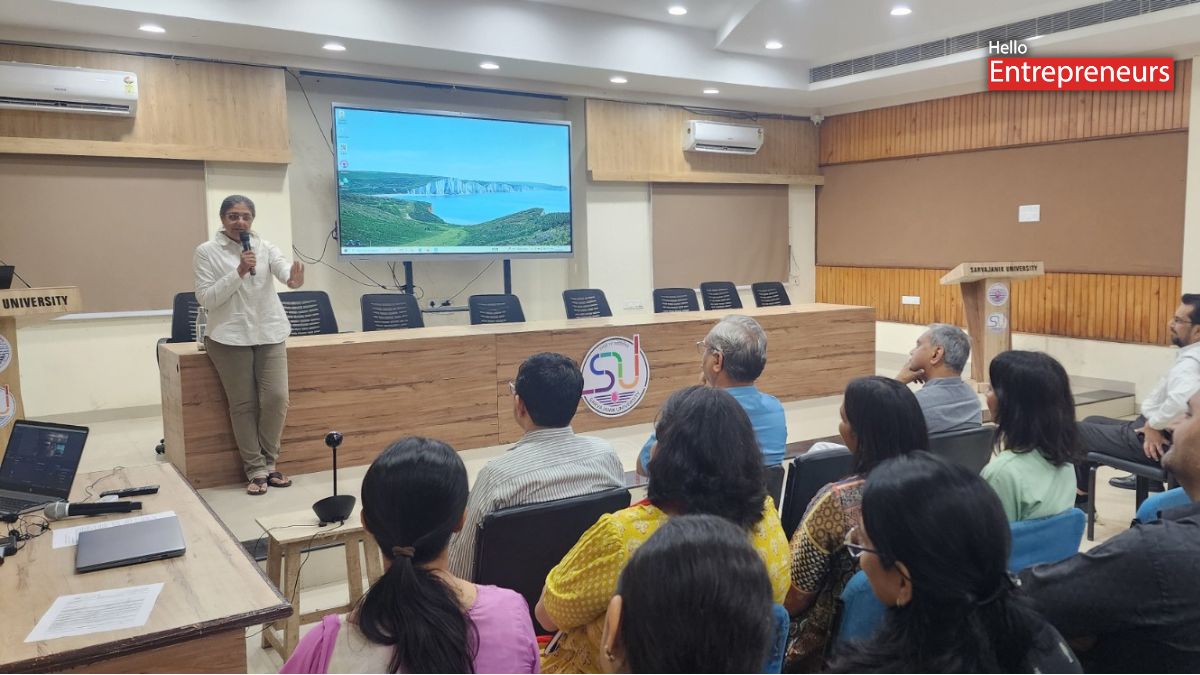
Dr Smruti Bulsari, a researcher at Oxford Univeristy and an ex-student of Sarvajanik University, was invited for a lecture on ‘Behavioural economics: Applications in Healthcare’.
In an interaction with Hello Entrepreneurs before the lecture, Dr Bulsari explained how behavioral economics has helped address healthcare concerns:
“ In the UK, one of the major nudges, rather choice architecture, that helps boost engagement in organ donation registrations in the health systems, is the radio button that says ‘I sign in for organ donation- yes or no’. When people see that question, yes is already ticked, they don’t take the efforts to say no. An estimated 70% say yes to organ donation as many don’t take an effort to say no for various reasons,”
Dr Bulsari explained the concept of choice architecture, where such default options shape outcomes as these are read as implicit advice, and how an initial number helps people judge risk (by anchoring) much better than statistics do.
Besides this, she discussed key concepts such as Dual Process Theory, Prospect Theory, Present Bias, heuristics, choice architecture, social norms, and libertarian paternalism. Focusing on healthcare, she illustrated how behavioral insights can be used to address non-communicable diseases and promote healthier lifestyles, using dementia as a case study to explain how evidence-based interventions can encourage positive health decisions while balancing ethical considerations in public policy.
The session was attended by select members of civil society, faculty members, and more than 150 students from constituent colleges of Sarvajanik University, providing them valuable insights into the growing role of behavioral economics in healthcare, public policy, and economic decision-making.
Dr. Jayesh Desai emphasized that the lecture reflected the educational philosophy of the newly established college. He noted that the session not only introduced students to the applications of behavioral economics but also demonstrated that students educated in Surat can aspire to institutions such as Oxford University through proper career planning, dedication, and perseverance.

