



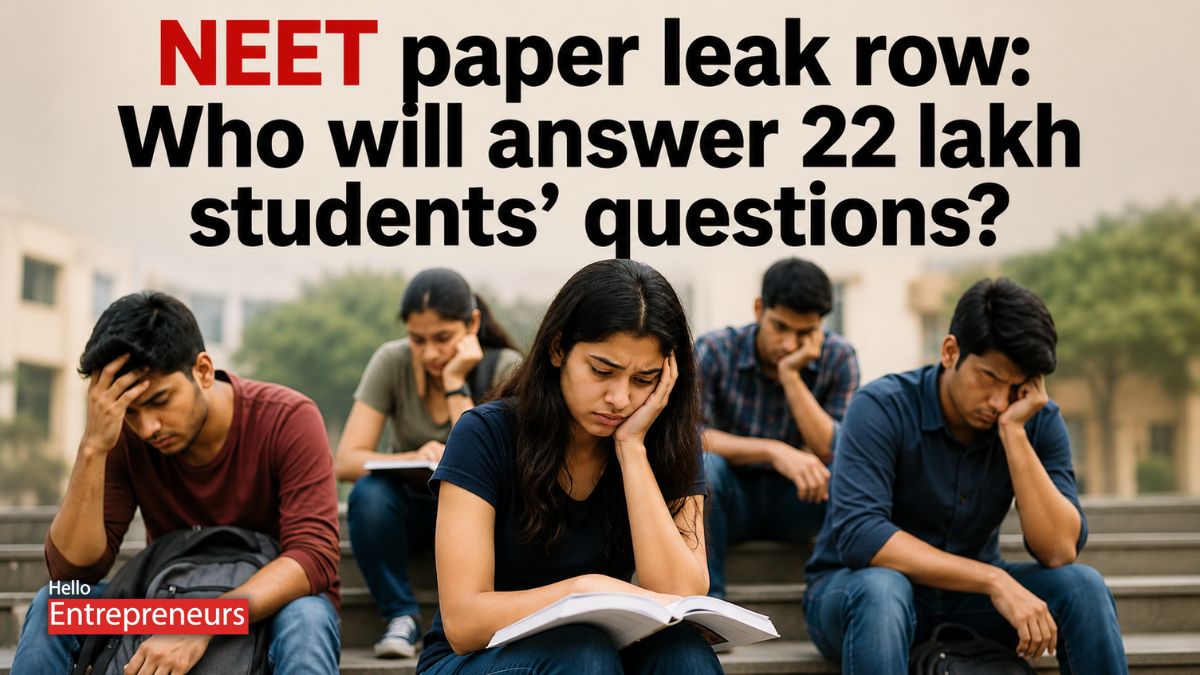
New Delhi: The NEET-UG 2026 paper leak scandal again sheds light on the major shortcomings of the competitive examination system in India and poses serious questions about the transparency of the exam and exam security as well as the future of lakhs of medical aspirants. The start of a “guess paper” going around among students has now become a nationwide investigation that has linked coaches, businessmen, counselling agents and digital networks, as well as interstate paper leak mafias.
The controversy surrounding the May 3 exam date for NEET-UG 2026 grew to epic proportions as the exam was ultimately cancelled by the National Testing Agency (NTA), impacting over 22 lakh students nationwide in India. The cancellation caused a lot of the candidates who have been preparing for one of the toughest entrance exams in the country for years to get angry, panic and disappointed.
The first big break in the case, investigators said, was made May 2, nearly 45 hours before the examination. One student who was studying in Kerala has reportedly shared a question paper with his father in the Rajasthan district of Sikar. The father, who is said to be operating a hostel for NEET aspirants, realized that the questions were from a “guess paper,” which was being circulated among students. He notified the authorities and the NTA and initiated the investigation.
The Rajasthan Police Special Operations Group (SOG) soon found out that there was one so-called “guess paper” with almost 400 questions which was already being sold to the students in several states. Later on, it was found that a significant amount of questions related to Biology and Chemistry were similar to the actual NEET examination paper. Police sources say that the students were allegedly paying as much as Rs 10 lakh to Rs 25 lakh to get access to the leaked material.
This investigation later went on to show the network was extended to Rajasthan, Maharashtra, Haryana, Kerala and Uttarakhand. The leak of the paper, authorities believe, was not some amateur affair by a handful of students, but an organised interstate racket with contacts of the coaching staff, MBBS counselling agents, businessmen and digital distribution groups.
Among the most important names that came up in the investigation were of Shubham Khairnar, a student of BAMS from Nashik, Maharashtra. He was reportedly made a “high ranking distributor” in the network by police. Investigators claim Khairnar had bought the leaked paper for Rs 10 lakh and sold it for Rs 15 lakh to the buyers in Haryana, earning a profit of nearly Rs 5 lakh. He is believed to have established connections with NEET aspirants and admission agents through his previous experience as a “career counsellor”.
The investigation also revealed a bigger network based in Pune, Ahilyanagar, Jaipur and Gurugram. Police arrested two Ayurveda doctors, a beauty parlour owner and an engineering student in the case. Investigators claim that one of the accused received the hard copy and couriered the same to Nashik before it was photographed and then distributed digitally using encrypted platforms.
Beauty parlour owner from Pune Manisha Waghmare was also under investigation. She had previously made some efforts through unofficial channels to get a medical seat for her daughter and police believe that she was dealing in money in connection with the illegal admissions of her daughter. Investigators reportedly traced financial transactions worth of Rs. 9.99 lakhs with regard to the transactions made by multiple students and parents.
The CBI is also investigating into the involvement of the Jaipur-based Biwal family, which investigators believe played a key part in the distribution network in the state. The leaked papers were reportedly sent via the coaching networks of students in the vicinity of Sikar and Jaipur and courier services and WhatsApp groups.
The investigation has a new focus, as coaching centres have become bigger subjects of inquiry. No national coaching chain has been formally identified as yet, but police are investigating a number of coaching-related people and institutes. Maharashtra police have begun investigating a private coaching institute after it was revealed that 42 of the 45 questions in one of its mock papers were similar to the actual NEET paper in Latur district. Investigators are now seeking to find out if the institute had prior access to this leaked paper or if the similarities was a coincidence.
Investigators are also looking into Sikar’s coaching ecosystem that is seen as one of India’s biggest NEET and JEE preparation centres. A network of coaching counsellors and MBBS admission agents was said to have passed on the leaked papers. One of the coaching counsellors from Sikar is alleged to have bought the “guess paper” for nearly Rs 5 lakh and shared it with the students using WhatsApp groups.
Earlier, it was also found that the technical distribution network was connected to the employees of the couriers, the local printing shops, the Telegram groups and even a suspected “shadow server” operated in a small IT set up in Nashik. The papers were scanned with portable high-definition scanners, not mobile phones, so that they could not be detected and their image quality would not be compromised, investigators say.
Investigators say the paper leak network supposedly operated in several phases. The original paper has been suspected to have leaked from a hard copy. Then it was sent from state to state like from Rajasthan to Maharashtra and from Maharashtra to Haryana. The paper later came out on a PDF document and was sent in encrypted Telegram and WhatsApp groups. The students reportedly paid anywhere from Rs 2 lakh to Rs 28 lakh with respect to level of access and timing of delivery.
The Central Bureau of Investigation (CBI) has now officially been handed over the probe. There have already been a few raids in Jaipur, Gurugram, Pune and Nashik. Accused have been rounded up and evidence sought include digital devices, financial records and data on communication. The operation could be a massive paper leak operation that has come under the umbrella of an “organised paper leak mafia” in various states, investigators have thought.
During questioning some accused have also made explosive allegations, saying that “big people” are being spared while smaller operators are picked up by the cops. But NTA sources and authorities have not confirmed the involvement of any government officials at the senior level, NTA brands or major national coaching brands to date.
This controversy has sparked outrage over students and parents nationwide in India. Many of those who have been preparing for this examination for years with a genuine effort are now saying that they feel betrayed by an examination that they had prepared for years properly. Protests by student groups in various cities have called for tougher treatment of perpetrators and more reform in the exam system.
The frequent instances of paper leaks are eroding the credibility of merit selection in India, say education experts. Such a scam has an iniquitous effect on students who can pay big money to get their papers leaked and also on the hardworking aspirants, who end up losing spirit and money, critics claim.
The incident has also seriously affected the credibility of the NTA. At the national level, many students are now doubting the security and fairness of the exams. Medical associations and education experts have called for substantial changes like the complete computerization of NEET exam, making digital security system much more robust and enhancing the monitoring system of NEET during the transportation of question papers and printing.
The paper leak incident of the 2026 NEET exam has become more than just a scam on the exam. It has come to symbolize a system that is failing to produce results because students believe that the reverence of money and connections may be more important than hard work. The government and the investigative body are still continuing their investigation and are promising that they will take action, but the process of gaining the trust of the students might be much harder than solving the case.