



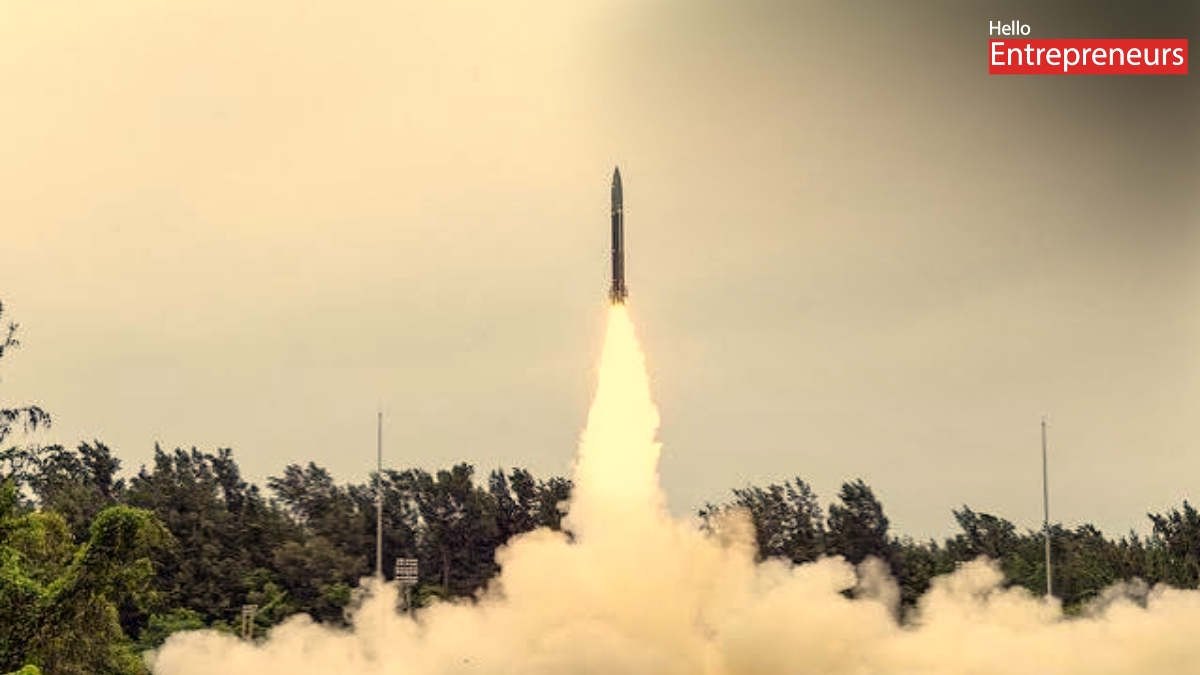
India’s homegrown Pralay missile just wrapped up another big test, pushing it closer to joining the armed forces for real. The Defence Ministry announced that the latest trial, held off the Odisha coast, checked all the boxes — and honestly, they sound pretty confident that the missile’s induction is right around the corner.
DRDO carried out the test from Dr APJ Abdul Kalam Island at about 11:10 am on November 5. All the instruments at the Integrated Test Range in Chandipur tracked the flight and confirmed the missile’s performance.
What’s special about this particular trial is that it wasn’t just another test — it was a user evaluation, with senior DRDO officials, industry experts, and armed forces personnel all watching closely. These trials are almost always the last step before the military signs off. It’s not just about whether the missile flies straight; they want to see if it’s easy to handle, launch, and operate in real-world conditions.
Defence Minister Rajnath Singh called the successful test “another significant milestone in strengthening India’s indigenous defence capabilities.” He’s optimistic that Pralay, with its advanced tech, will boost the military’s ability to deal with new threats.
So what’s Pralay all about? It’s a short-range, surface-to-surface missile running on solid propellant, meant for conventional payloads. Its range is said to be between 150 and 500 km, with a warhead capacity of 500 to 1,000 kg.
The missile is a bit different from typical ballistic weapons — it can change course mid-flight, which makes it much tougher for enemy air defences to shoot down. Pralay’s mobile launcher is another big deal. If you can move the missile around by road, it’s less likely that the whole system gets taken out in one enemy strike. Earlier tests also showed it can be fired in salvos, meaning several missiles can shoot from the same launcher.
DRDO’s Research Centre Imarat in Hyderabad led Pralay’s development, with help from other DRDO labs. Bharat Dynamics Limited stepped in as the production partner and actually builds the missile.
Over the years, the programme moved through all the usual phases — early flights to check basic performance, then more trials for minimum and maximum ranges. One test even showed two Pralay missiles shot in quick succession from a single launcher. The latest user evaluation was the last big hurdle: proving the whole system works for the armed forces who’ll actually use it.
Inducting Pralay would give India a solid, non-nuclear option for deep strikes at both tactical and operational levels. The missile’s maneuverability, fast response, and mobile setup let it hit high-value targets quickly without relying so much on aircraft or cruise missiles.
It also fits into India’s push for homegrown missile tech. DRDO isn’t just building prototypes; they want these systems to go into regular production, working alongside Indian defence companies. Pralay’s tie-up with Bharat Dynamics Limited shows the plan is for mass production, not just a one-off science project.
Some details are still up in the air. The Defence Ministry hasn’t said exactly when Pralay will be inducted or which branch gets it first, and we don’t know how many missiles are lined up for the initial order or where they’ll deploy them. Until that’s official, Pralay isn’t fully operational.
But the government’s clearly signaling that the missile’s ready for the next step. Their language around this test is pretty direct, suggesting Pralay’s days as an experimental project are over.
Right now, Pralay stands out as one of India’s most important homegrown missile programmes. It’s a maneuverable, medium-range weapon built for battlefield strikes, and all it needs is the final nod to move from the test range to active duty.

