



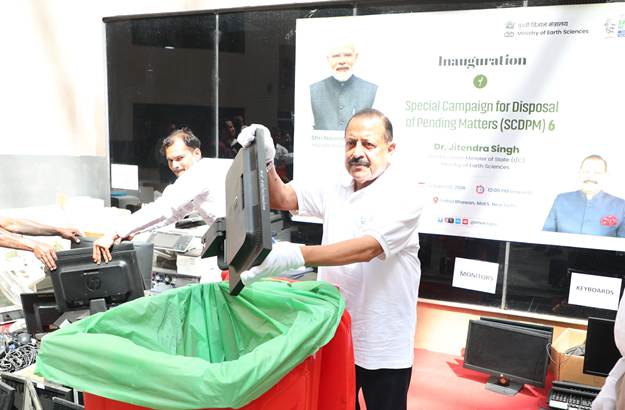
New Delhi, October 2: Swachhata has evolved from an appeal for cleanliness into a sustained culture of good governance, efficient utilisation of public resources, reduction of pendency and responsible management of waste, said Union Minister of State (Independent Charge) for Science & Technology and Earth Sciences and Minister of State in the Prime Minister’s Office, Department of Atomic Energy, Department of Space, Personnel, Public Grievances and Pensions, Dr. Jitendra Singh, While launching the Implementation Phase of Special Campaign 6.0 today.
Recalling Prime Minister Shri Narendra Modi’s call for Swachhata from the Red Fort in 2014, Dr. Jitendra Singh said the initiative gradually transformed into a people’s movement and subsequently became an institutional practice across Government offices. He said the campaign has continuously acquired new dimensions, from toilets and cleanliness to disposal of old files, redundant furniture, e-files and electronic scrap, thereby linking Swachhata with administrative efficiency, optimum use of public space and productive management of resources.
Dr. Jitendra Singh began the day by participating in the launch activities of Special Campaign 6.0 at the venue designated by the Department of Administrative Reforms and Public Grievances (DARPG). He participated in Shramdaan, plantation under the ‘Ek Ped Maa Ke Naam’ initiative, and the symbolic commencement of weeding out old records, besides honouring Safai Mitras by distributing safety kits and sweets.
Smt. Nivedita Shukla Verma, Secretary, DARPG; Smt. Rachna Shah, Secretary, DoPT; and Dr. Surendrakumar Bagde, Director General, National Centre for Good Governance (NCGG), were among the senior officers present. DARPG is the nodal department for the Special Campaign.
The Minister thereafter proceeded to CSIR Headquarters, where he took forward Special Campaign 6.0 across the scientific and technological ecosystem. Dr. Jitendra Singh led a mass cleanliness drive, participated in the Swachhata Signature Campaign and plantation drive, and felicitated Safai Mitras. Dr. N. Kalaiselvi, Director General, CSIR and Secretary, DSIR; Prof. Umesh V. Waghmare, Secretary, Department of Science & Technology (DST); and Dr. Rajesh S. Gokhale, Secretary, Department of Biotechnology (DBT), along with senior officials from DST, DBT and CSIR, participated in the programme. The activities at CSIR included review and disposal of obsolete records and scrap, workplace improvement and effective management of office spaces, with emphasis on Jan Bhagidari.
Speaking during the launch activities, Dr. Jitendra Singh recalled how the Swachhata movement, after its initial focus on sanitation, gradually entered Government offices and addressed the large accumulation of files and records that were no longer required but continued to occupy valuable space. He recalled that the exercise subsequently evolved into a dedicated annual campaign from 2 October to 31 October, with each successive campaign adding new dimensions. From physical files and discarded furniture, the exercise has expanded to e-files and e-scrap, reflecting the changing nature of Government workplaces and the growing need for responsible management of electronic assets.
Dr. Jitendra Singh said the experience of the Special Campaigns has demonstrated that systematic disposal of redundant material can create both financial value for the public exchequer and usable space for Government offices. Over the last five years, ₹5,102.91 crore has been generated through disposal of e-waste and scrap, while more than 1,049.54 lakh square feet of office space has been cleared and put to productive use. More than 180.48 lakh files have also been closed or weeded out and 24.20 lakh cleanliness sites identified and cleaned across the country.
The Minister said the space released through the campaign can subsequently be put to productive use, including creation of green areas and restoration of spaces that had remained blocked or underutilised. He said the annual campaign serves as a renewed commitment to a practice that should continue throughout the year, while the repeated campaigns have helped make Swachhata part of the working culture of Government institutions.
The Minister subsequently visited the Ministry of Earth Sciences, where e-waste and obsolete equipment from Prithvi Bhavan and Mausam Bhavan were taken up for disposal under Special Campaign 6.0. Dr. Srinivasa Kumar Tummala, Secretary, Ministry of Earth Sciences, was present during the programme and briefed the Minister on the items identified for disposal.
The inventory comprises 705 items in all. Dr. Jitendra Singh said the exercise at the Ministry of Earth Sciences is part of a wider campaign across the scientific ecosystem, with similar activities being undertaken by institutions under Earth Sciences, CSIR and DST. He said more than 100 science institutions have commenced the campaign from 2 October, taking the message of Swachhata and responsible disposal of obsolete material across the country’s scientific institutions.
The Minister also connected the campaign with the larger Waste-to-Wealth dimension of India’s scientific ecosystem, where the objective goes beyond disposal of waste to developing technologies that can convert waste into useful products, materials, energy and new economic opportunities. The CSIR portfolio includes technologies for municipal solid-waste management, recycling of plastic waste, recovery of critical metals and rare earth elements from e-waste, recycling of lithium-ion batteries, biomethanation, conversion of agro-waste into biodegradable products, wastewater resource recovery and utilisation of industrial waste for value-added products. These technologies have been transferred to industry and other organisations for application and further development.
Dr. Jitendra Singh said the experience of Special Campaigns demonstrates how a cleanliness initiative can progressively become an instrument of administrative reform, resource optimisation and institutional efficiency. In the scientific ecosystem, this approach is being extended further through technologies that enable waste to move through a larger value chain, from identification and disposal to recovery, recycling, innovation and wealth creation.
The Implementation Phase of Special Campaign 6.0 will run from 2 October to 31 October 2026, following the preparatory phase undertaken by Ministries and Departments during September. The campaign focuses on Swachhata, reduction of pendency, review and weeding of records, efficient utilisation of office space, scientific disposal of e-waste and redundant material, and improved record management across Government offices. The campaign is being implemented as a whole-of-government effort, with institutional goals across Ministries and Departments.

