



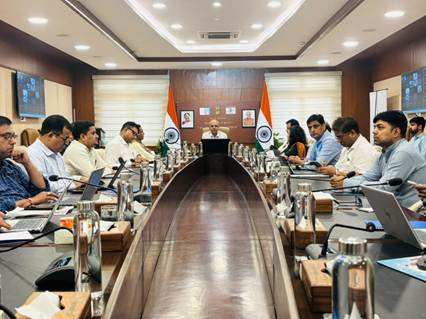
New Delhi, October 1: The Department of Drinking Water and Sanitation (DDWS), Ministry of Jal Shakti, convened the second follow-up review and convergence meeting yesterday to accelerate saturation of drinking water coverage in tribal areas under the Pradhan Mantri Janjati Adivasi Nyaya Maha Abhiyan (PM-JANMAN) and Dharti Aaba Janjatiya Gram Utkarsh Abhiyan (DA-JGUA). The meeting was chaired by the Secretary, DDWS and attended by senior officials of the National Jal Jeevan Mission (NJJM), Ministry of Tribal Affairs (MoTA), State Rural Water Supply/Public Health Engineering Departments, State Tribal Welfare Departments and other concerned stakeholders.
The meeting was held as part of the follow-up process initiated after the Departmental Summit, where States and Union Territories had committed to achieving saturation of drinking water coverage in all eligible PM-JANMAN and DA-JGUA villages. Progress on these commitments was reviewed and States were advised to translate the commitments into time-bound action through closer coordination between Water Supply/PHE and Tribal Welfare Departments, ensuring that no eligible tribal village or habitation remains left out.
A dedicated provision of ₹5,000 crore under JJM 2.0 has been earmarked to address drinking water gaps in PM-JANMAN and DA-JGUA villages. In this context, the review focused on four priority areas: harmonisation of data between Tribal Welfare Departments and JJM databases, identification of uncovered villages and habitations, preparation of technically sound proposals and joint validation and certification of coverage. States and UTs were urged to complete these activities expeditiously and submit validated proposals for consideration.
Addressing the participants, Shri Ashok K.K. Meena, Secretary, DDWS emphasised that regular reviews of PM-JANMAN and DA-JGUA villages should be undertaken through District Water and Sanitation Mission (DWSM) meetings chaired by the Deputy Commissioner/District Magistrate. He underscored that the DWSM should serve as the principal platform for inter-departmental coordination, validation of survey findings and identification of genuine coverage gaps requiring intervention.
The Ministry of Tribal Affairs has undertaken a State-wise SurveySetu exercise, including household-level verification of Functional Household Tap Connection (FHTC) status. States were advised to present SurveySetu findings jointly before the DWSM through representatives of Water Supply Departments, Tribal Welfare Departments and the survey agency. Any discrepancies identified during the exercise are to be resolved through consultation and field verification, wherever required, so that a final validated database is available at the district level.
The meeting reiterated that the objective is not only to create new infrastructure but to achieve complete saturation and certification of all eligible PM-JANMAN and DA-JGUA villages. States were therefore advised to accord equal priority to certification of villages that have already achieved saturation and ensure that all eligible settlements are accurately reflected in the JJM-IMIS before submission of proposals.
States and UTs were advised to identify left-out habitations based on SurveySetu findings and validate them through the DWSM mechanism. The Rural Water Supply/PHE and Tribal Welfare Departments have been asked to jointly prepare proposals supported by self-assessed DPR Checklists duly authenticated by competent authorities. Proposals should clearly establish the justification for inclusion, avoid duplication, incorporate validated LGD codes and contain complete technical and financial details.
The Technical Division of NJJM also emphasised the need to improve the quality and completeness of DPR submissions. States were advised to ensure realistic population projections, adherence to prescribed service levels, adequate provisions for source sustainability and water security, and reasonable per-FHTC costs supported by appropriate technical justification. Particular attention was drawn towards accurate completion of DPR Checklists and proper authentication of all corrections and revisions.
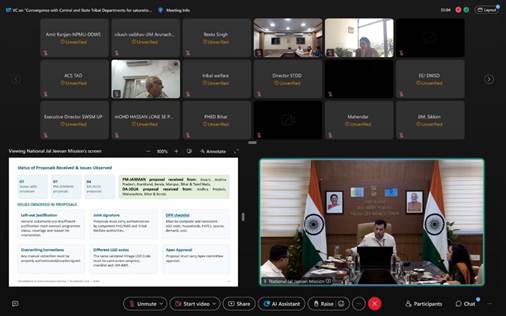
Shri Kamal Kishore Soan, AS&MD, NJJM said that the importance of joint ownership at the State level was also reiterated. State RWS/PHE and Tribal Welfare Departments will jointly prepare and present proposals before the Joint Committee co-chaired by the Secretary, DDWS and Secretary, MoTA. At the district level, the DWSM chaired by the DC/DM will serve as the key platform for validation and decision-making, with participation of the survey agency and concerned State departments.
During the meeting, State-wise progress and observations on proposals already received were reviewed. Andhra Pradesh, Maharashtra, Jharkhand, Kerala and Manipur were advised to address specific observations relating to LGD code validation, DPR documentation, service levels and per-FHTC costs. Bihar, Tamil Nadu and Assam were requested to take action on observations already communicated by DDWS. Several States also shared timelines for submission of proposals, with Ladakh, Madhya Pradesh, Uttar Pradesh and Chhattisgarh indicating that proposals covering identified PM-JANMAN and DA-JGUA villages would be submitted during October 2026.
As part of the agreed way forward, States and UTs will establish a common validated database through harmonisation of PM-JANMAN, DA-JGUA, SurveySetu and JJM-IMIS records. Jointly validated proposals, along with duly signed DPR Checklists and requisite approvals, will be submitted for consideration by the Joint Committee co-chaired by the Secretary, DDWS and Secretary, Ministry of Tribal Affairs. District administrations have also been advised to validate SurveySetu findings through DWSM meetings and communicate any additions or deletions identified during district-level verification to the State Government and DDWS.
The meeting reaffirmed the collective commitment of DDWS, MoTA, State Water Supply/PHE Departments, Tribal Welfare Departments and district administrations towards ensuring saturation of functional drinking water services in all eligible PM-JANMAN and DA-JGUA villages. Through data harmonisation, district-level validation, joint planning, timely submission of proposals and certification of saturation, the initiative aims to ensure that every eligible tribal village and habitation is provided with reliable and sustainable drinking water services.

