



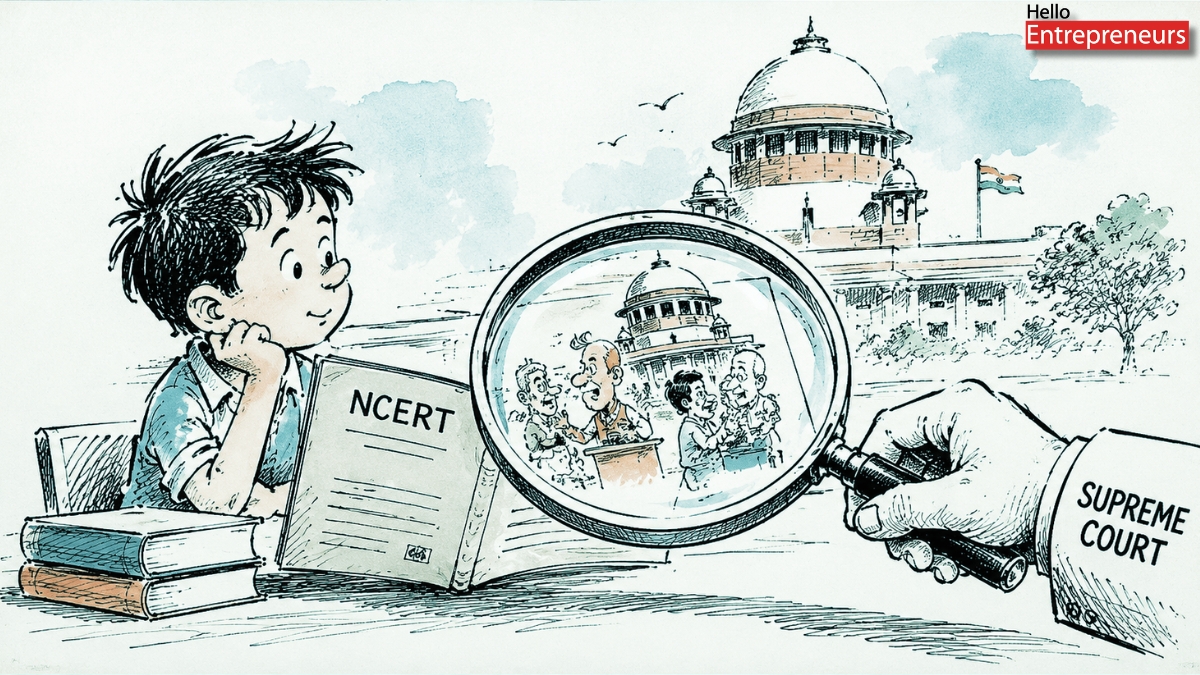
New Delhi: Education is never static. It is a concept that changes with society, culture and politics and the emotional maturity of every new generation who will be the adopters of knowledge. Looking at the above, the Supreme Court’s decision to constitute a high-level committee to examine the use of cartoons and satirical illustrations in NCERT textbooks, shouldn’t be understood as a move to censor; rather it should be considered as a responsible exercise.
This decision was taken after the apprehensions, on the part of the Solicitor General, that political and institutional satire in school textbooks may have an unintended influence on students. Accordingly, the apex court decided to set up a committee led by former Supreme Court judge Justice Indu Malhotra, along with senior advocate K K Venugopal and academic expert Prakash Singh.
The debate arises in different directions on an initial level, in which one side is concerned about limiting creative freedom and the other about youth susceptibility, but ultimately, things are not that black and white. Visual pedagogy has always been a unique component of education. Satire and caricatures are not just decorative elements used to brighten up the pages of textbooks. They are interpretative tools. In political science, civics, and history, a biting cartoon can do a better job than a thousand pages of conventional prose in simplifying concepts, rousing curiosity and instigating analytical thinking.
The Supreme Court itself, in an earlier judgment, pointed out that satiric remark could comprehend complex ideas in a unique and instantaneous way. This could be greatly helpful in the classroom when a student, for example, is confronted with fundamental questions about the constitution, parliamentary debate or the workings of the judiciary.
But there’s a valuable caveat at the Solicitor General’s concern: Cognitive readiness. Satire is complex, often multiple-layered. It needs irony, exaggeration, implied criticism. Adults can generally differentiate those from disrespect and hostility. Children — especially middle-schoolers — are developing those nuances. And without some context, some graphic interpretations of democratic institutions might be confusing.
This concern is heightened when the judiciary, constitutional authorities, politicians, or national actors in question. The question isn’t whether children must be able to engage critical thinking, they must be, but how educational material needs to be crafted so that it’s pedagogically educational critique, not casual dismissal.
That’s a huge difference.
While some critics will characterise the review as an attempt to weaken academic freedom, in any serious education system, content review is far from unusual. Textbooks aren’t ideological tracts, they’re the building blocks of a learning process. They’re about doing more than informing; they’re about responsible interpretation across different ages and social contexts.
Understood that way, that committee — lawyers, educators, curriculum specialists with the National Judicial Academy — is actually encouraging. It doesn’t seem so much as about removing the gag reflex of humour from classrooms, but about responsible visual pedagogy.
The larger issue here goes beyond cartoons. It goes to a deeper philosophical question about modern education. What is the desired balance that a society is aiming to teach? How do we teach democratic consciousness while preserving dignity of the institution? Democracies prosper from people questioning authority and simultaneously from their faith in a constitutional democracy. This is not an easy question. Educational content must be descriptive enough so that we do not lose clarity and dignity but also think enough so that we do not become dull.
That is a difficult balance. But it is that very balance which a mature education system should be aimed at.
Once again, it is an exercise which is quite important under the Supreme Court. It rightly acknowledges that textbooks are not truly static items but living instruments for civic understanding and so on. If done well it will only end up improving NCERT content which is so often the very best in the world but is still too saturated, not age-appropriate and not intellectually advanced enough.
In a real sense, education is not about making smart students but about making smart citizens, which is young people who can question a society but not dismiss the very institution they are part of. And, this review, which continues, will be a useful step toward that balanced approach to making the very best in knowledge but also so much thought, responsibility and engagement.

