


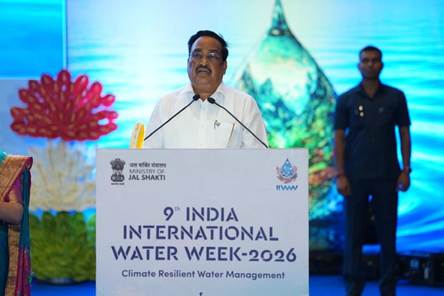
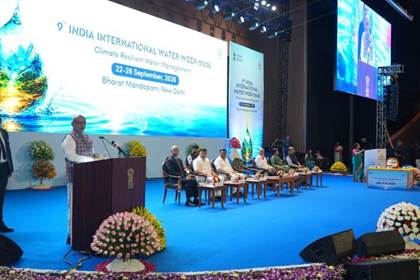
New Delhi, September 22: The Hon’ble Vice-President of India Shri C. P. Radhakrishnan inaugurated the 9th India International Water Week (IIWW) 2026 at Bharat Mandapam, New Delhi, today in the presence of Union Minister of Jal Shakti, Shri C R Patil, Ministers of State for Jal Shakti Shri V. Somanna and Shri Raj Bhushan Choudhary. Secretary, Department of Drinking Water and Sanitation Shri Ashok K.K. Meena, Secretary, Department of Water Resources, River Development and Ganga Rejuvenation Smt. Archana Verma, and Chairman, Central Water Commission Shri Anupam Prasad and representatives from India and abroad, Ambassadors, global water leaders, senior officials, representatives of international organisations, experts, researchers, industry, innovators and other stakeholders were also present.
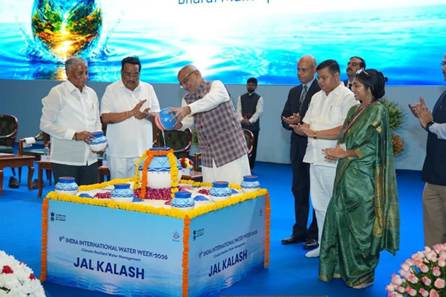
Organised by the Ministry of Jal Shakti, Government of India, from 22 to 26 September 2026, the five-day event is being held on the theme “Climate Resilient Water Management.” The ninth edition marks an important milestone as the event, organised in its earlier editions as India Water Week, has evolved into India International Water Week, reflecting its growing global engagement and the increasing importance of international cooperation in addressing shared water challenges.
The Netherlands and Germany are participating as partner Countries, along with 14 States as partner States and two Central Ministries as partner Ministries. The event brings together governments, international and multilateral organisations, research and academic institutions, industry, civil society, start-ups, innovators and young professionals. It provides a comprehensive platform for policy dialogue, technology demonstration, knowledge exchange, networking, business tie-ups and new collaborations.
Addressing the inaugural session, the Vice-President emphasised the growing challenges to water security posed by climate change, urbanisation and increasing pressure on natural resources. He called for integrated and sustainable management of water through innovation, efficiency and collective action. He underscored the critical role of interlinking of rivers in addressing spatial and temporal variations in water availability. He appreciated the various interventions undertaken by the Ministry of Jal Shakti and applauded the achievements made. Recalling his tenure as Governor of Jharkhand, the Vice-President noted that rural tap water coverage in the State rose from about 7% to 37% under Jal Jeevan Mission. He described the Mission as a transformative programme that has significantly expanded access to potable drinking water in rural households.
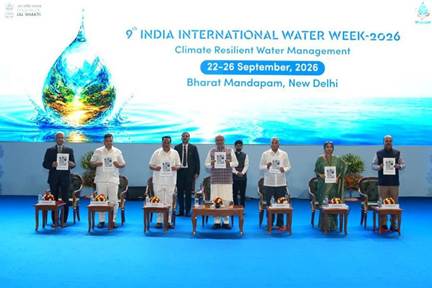
He also highlighted the significance of cooperative arrangements among States for sharing and management of inter-state river waters. He called upon the participants to use IIWW 2026 to exchange knowledge, strengthen partnerships and translate deliberations into concrete action. He also launched two important publications, namely, “Sustainable Urban River Management Framework” and “AI and ML Driven Integrated Reservoir Sediment Management.”
Union Minister of Jal Shakti, Shri C R Patil, said that water security and climate resilience must go hand in hand, as many of the impacts of climate change are increasingly being experienced through water. He highlighted India’s Water Vision@2047 and major interventions including Pradhan Mantri Krishi Sinchayee Yojana, Jal Jeevan Mission, Jal Sanchay Jan Bhagidari, Namami Gange, Atal Bhujal Yojana, NAQUIM, the Ken-Betwa Link Project, Dam Rehabilitation and Improvement Project and the National Hydrology Project. The minister added that Jan Bhagidari is our biggest strength where we learn from each other and share experiences to advance water management. He underlined the transformative potential of research and development, Artificial Intelligence, Machine Learning, remote sensing, GIS, real-time sensors and advanced modelling, while stressing that technology must work together with strong institutions, local knowledge and community participation.
Welcoming the participants, Smt. Archana Verma, Secretary, Department of Water Resources, River Development and Ganga Rejuvenation, said that IIWW has evolved into an important multidisciplinary global platform for dialogue, knowledge sharing, technology demonstration and partnerships. She stressed that climate resilience needs to be integrated into the planning, financing, development, operation and management of water resources and infrastructure. She expressed confidence that the deliberations would lead to actionable recommendations, scalable solutions, exchange of best practices and stronger partnerships.
The inaugural session also recognised the contribution of grassroots Water Warriors. Mrs. Ram Kumari from Chhindwara, Madhya Pradesh was recognised for mobilising women and communities around drinking water availability and water conservation, including efforts that helped improve drinking water access for around 225 families. Shri Sitaram Madavi of Gadchiroli, Maharashtra, who has worked for over two decades on water conservation, rural development and agricultural sustainability, was recognised for developing wells, farm ponds and other water conservation interventions that have contributed to improved groundwater availability and irrigation access.
Following the inaugural session, a high-level Ministerial Plenary on “Country Perspectives on Climate Resilient Water Management” brought together perspectives from India and international partners. The session focused on the need to move beyond reactive water management towards systems capable of anticipating risks, adapting to change and recovering from climate extremes. Discussions covered climate-informed infrastructure, flood and drought management, digital hydrology and early warning, nature-based solutions, water-use efficiency, institutional capacity and international cooperation.
Opening the Ministerial Plenary, Shri C R Patil highlighted India’s cooperation with countries including Venezuela, the Netherlands and Denmark. He also emphasised the important role of multilateral and international institutions such as the World Bank and IUCN. He called for deeper collaboration in Artificial Intelligence, Machine Learning, information technology, remote sensing, joint research, capacity building and demonstration projects, stressing the need to move from exchanging knowledge to creating knowledge together and from responding to water crises to building resilience before crises occur.
Addressing the Ministerial Plenary, Secretary, Department of Drinking Water and Sanitation Shri Ashok K.K. Meena said that under the Jal Jeevan Mission, we have learnt that resilience is not merely about creating infrastructure; it is about ensuring reliable and sustainable water services over time, with communities playing a central role in planning, operation and long-term sustainability. The Secretary added that this must be supported by effective greywater management, groundwater recharge, and protection of water sources. Through the Decision Support System, he said that the department is enabling districts and Panchayats to identify vulnerable sources and prioritise such interventions. Every drop of water has a journey and every drop has value; Our collective responsibility is to ensure that this journey remains sustainable and the hydrological cycle remains unbroken for future generations.
Addressing the Plenary, the Vice Minister of Drinking Water and Sanitation, Venezuela, Ms. Yesenia Carolina Moreno Gerdel, emphasised the critical importance of protecting water sources, particularly during natural disasters such as earthquakes. She underscored that access to water is a fundamental human right and highlighted water as an essential source of life, peace and prosperity. Danish Ambassador to India H.E. Rasmus Abildgaard Kristensen, Ambassador of the Kingdom of the Netherlands to India Ms. Marisa Gerards, South Asia Regional Director World Bank Ms. Mara K. Warwick, Water Global Director IUCN Mr. James Dalton also participated in the Ministerial Plenary.
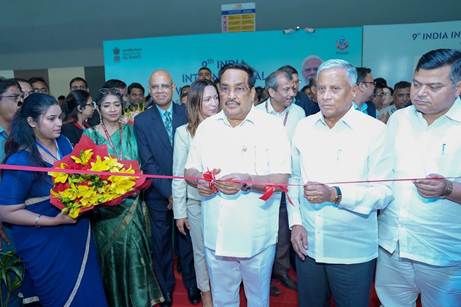
The Day One programme also included the inauguration of the international exhibition, which is being organised from 22 to 25 September. The exhibition provides a dedicated interface for governments, technology providers, research institutions, industries, start-ups and other stakeholders to showcase technologies, products and practical solutions for sustainable and climate-resilient water management.
Later in the day, the Global Water Leaders’ Plenary I on ‘Integrated Management of Water, Food & Energy’ highlighted the interdependence of water, food and energy systems and the importance of an integrated Water Food Energy nexus for climate-resilient development. The deliberations focused on water and resource security, irrigation efficiency and water productivity, micro-irrigation, solar-powered irrigation, digital monitoring, precision agriculture, data-driven decision making and stronger coordination among institutions.
The Global Water Leaders’ Plenary II on the Global River Cities Alliance focused on sustainable management of urban rivers and building climate-resilient river cities. The deliberations highlighted integrated policy frameworks, global knowledge exchange, Urban River Management Plans, technological and institutional innovations and opportunities for development agencies and public and private sector solution providers to cooperate on river-centric urban development. The session also included the launch of five Urban River Management Plans.
The Second International Water, Sanitation and Hygiene (WASH) Conference 2026, being organised concurrently with IIWW 2026, further strengthens the focus on drinking water, sanitation and hygiene in the context of climate change. The Conference brings together policymakers, practitioners, experts, development partners and other stakeholders to deliberate on climate-resilient WASH services, sustainability of drinking water sources, water quality, sanitation, wastewater management, technology and community participation. It provides an important platform for sharing experiences, innovations and scalable solutions towards achieving sustainable and resilient WASH services and advancing the objectives of SDG 6.
As part of the Conference, three thematic sessions were rganized covering key dimensions of climate-resilient WASH service delivery. The sessions focused on (i) Water Supply Systems: Operations & Maintenance, Infrastructure and Source Sustainability; (ii) Water Quality, Safety and Emerging Contaminants; and (iii) Climate Resilience, Nature-Based Solutions and Sanitation. The deliberations brought together policymakers, practitioners, researchers, development partners and sector experts to share their research papers for strengthening sustainable and resilient WASH systems.
Beyond formal deliberations, India International Water Week 2026 is designed as a platform for networking, institutional and business tie-ups, technology partnerships, joint research, knowledge exchange, capacity building and collaboration among governments, international organisations, academia, industry, start-ups and communities. Through its Ministerial and Global Water Leaders’ Plenaries, Country Forums, Water Leaders’ Forums, Practitioners’ Forums, Thematic Forums, Startup and Youth Forums, international exhibition and the concurrently organised Second International WASH Conference 2026, the event aims to translate dialogue into actionable recommendations, enduring partnerships and scalable solutions for a water-secure and climate-resilient future.
Day One concluded with Country Forum I on “Joint Indo-Danish Solutions for Sustainable Water Management.” The forum reflected the growing role of international cooperation in developing technology-enabled, efficiency-focused and data-driven water solutions. It explored opportunities in urban flooding and stormwater management, climate-induced extremes, digital decision-support systems, space technology, drones, robotics and advanced survey solutions. The broader objective was to facilitate cross-border partnerships, joint ventures, co-innovation, investment opportunities and stronger industry-academia-government linkages.
The discussions on the opening day conveyed a common message: climate-resilient water management requires integration across sectors, institutions and geographical boundaries; greater use of science, data and emerging technologies; strong institutions and community participation; and sustained international cooperation. IIWW 2026 seeks to take this agenda forward by connecting policy with practice, research with implementation and innovation with investment.

