



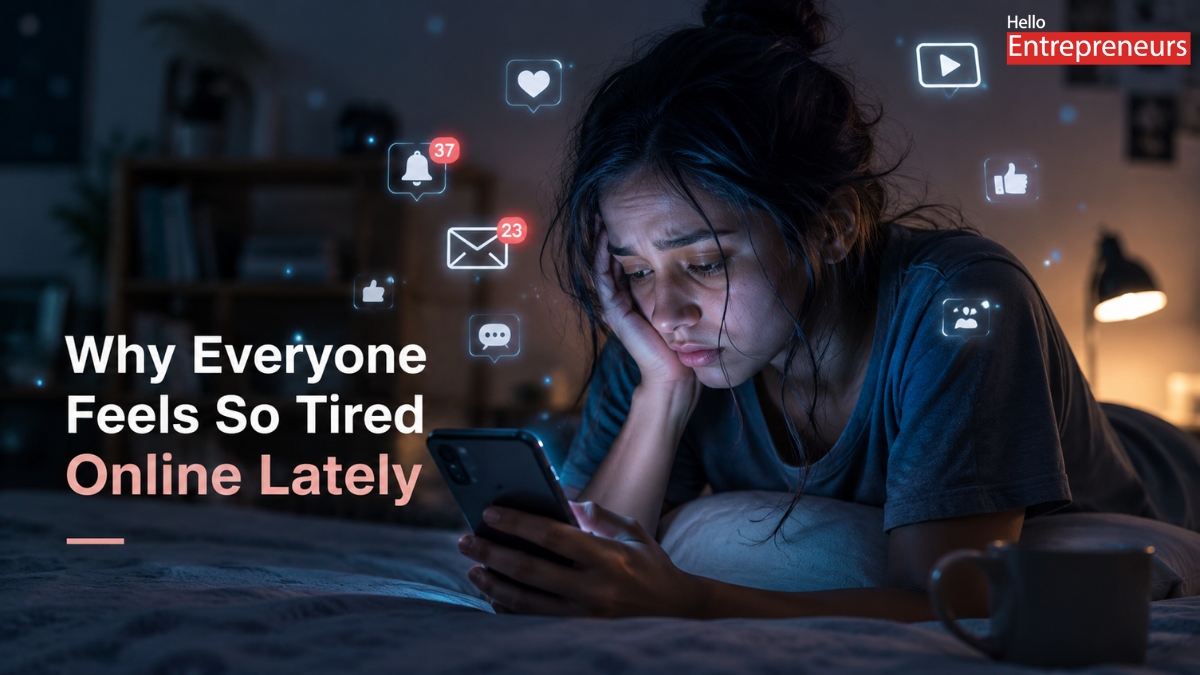
New Delhi: A few weeks ago, I watched a friend flip her phone facedown on the table, sigh, and confess, “I didn’t do anything today, but I feel like I ran a marathon.” She hadn’t gone anywhere—just spent the morning scrolling news, replying to a bunch of group chats, half-watching a livestream, and refreshing this app that reminds her how few steps she actually took. That was her whole marathon: mostly just moving her finger.
If you’ve felt that same weird kind of exhaustion—the one that’s got nothing to do with being physically active—trust me, you’re not crazy, and you’re definitely not alone. Being online right now feels heavier than it used to. Here’s why.
The Feed Never Ends
Back in the day, the internet felt like it had boundaries. You checked your email, closed the tab—you were done. Now that finish line is gone. Instagram Reels, TikTok, YouTube Shorts—they’re all set up so there’s always another video, and the next one is designed to reel you in just a little more. Even Netflix auto-plays the next episode before you can decide if you actually want it.
So that “I’ll just check for five minutes” turns into forty. Nobody planned those forty minutes. Most of us don’t even enjoy all of it. But quitting feels harder than just letting the feed roll.
Everybody’s Always Performing
Think about how many apps expect some kind of curated version of you. You’re supposed to be clever, photogenic, opinionated—and all before lunch. Every LinkedIn post has to sound impressive. Every Instagram story needs to look effortless. On Twitter, you have to be witty enough to stand out but not so bold you get roasted. Even in group chats with friends, there’s that subtle pressure to keep up, respond fast, and be “on.”
Compare that to chatting with your grandma, where you can just talk. Online, nearly every interaction feels like it’s happening in front of an audience—even if it’s a tiny one. Keeping up the act across five or six platforms all day drains you. It’s emotional labor, but nobody really calls it that.
Notifications: The Constant Background Buzz
Take a second and look at your phone: how many apps have a little red dot or a number badge pinging for your attention? Slack for work, WhatsApp for family, even your banking app throws tiny alarms about stuff you did yourself. News apps push “urgent” alerts about things you can’t fix. It’s nothing big—just constant. But together, they keep your brain stuck in this jittery “I need to deal with something” mode from morning to night.
Scientists studying attention say your nervous system isn’t great at telling apart genuinely urgent alerts and trivial ones. The brain gets jolted by all of them. Multiply that by 80-ish notifications a day, and no wonder people feel fried by dinnertime—even if they can’t pinpoint what did it.
Comparison Is Global Now
Used to be, you compared yourself to neighbors, classmates, coworkers—regular people right around you. Now the internet is your comparison pool. That twenty-five-year-old on LinkedIn doesn’t just see one colleague’s promotion—they see hundreds, sometimes thousands, all in one sitting. New parents don’t just see their friend’s tidy nursery. They see endless feeds of picture-perfect baby rooms.
It isn’t really about vanity. It’s just math. All those highlight reels, streaming in nonstop, make normal life feel like it’s not enough—even when nothing has actually changed.
Bad News Travels Fast—And Never Stops
“Doomscrolling” is so normal now it’s actually in the dictionary. Wars, disasters, political fights, public outrage—they pour in, minute by minute, with no time to process what happened before the next thing takes over. People used to read the paper in the morning and be done with bad news for the day. Now it’s there at 2 a.m., refreshed constantly, with comment sections full of strangers arguing.
Being informed is important, but living inside a never-ending crisis cycle is something else entirely. It’s exhausting, even though no single article ever feels like “too much.”
Work Has Moved Into Your Pocket
For a lot of us, the online spaces that once were just for connection double as our offices now. Slack messages ping at 9 p.m. Email is just a swipe away from Instagram or texts with your mom. Zoom calls pile up next to inbox triage, all on the same screen. There’s no physical line between working and being “off.” The commute that used to separate work from home is gone for anyone remote or hybrid, and your phone doesn’t know it’s Saturday night, either.
What Actually Works
This doesn’t mean deleting every app and running off to a cabin. For most people, that’s not realistic—or even possible. Small tweaks make a bigger difference: turn off nonessential notifications, pick one or two news apps instead of five, set a hard cutoff for work messages, and carve out some no-screen stretches in your day—even if it’s just ten minutes.
The tiredness people are talking about isn’t some moral failing. It’s a totally reasonable reaction to an environment designed to capture as much of our attention as possible, for as long as possible. Calling it out helps, strangely enough—it’s the first real step toward feeling less wiped out by it.

