



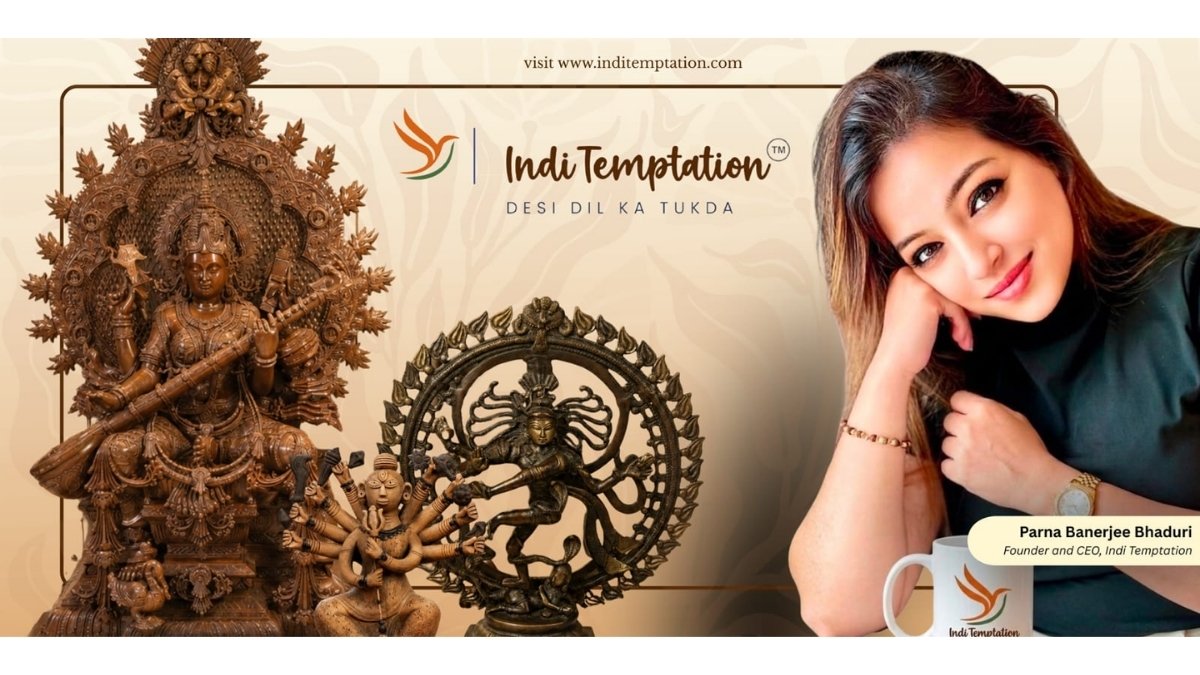
New Delhi: Some journeys begin with ambition. Others begin with a quiet promise. For Parna Banerjee Bhaduri, founder of IndiTemptation, that promise was to ensure India’s artisans are remembered as much as their craft. In this conversation, she shares the story behind a brand built on heritage, purpose, and heart.
Interviewer: What inspired you to start IndiTemptation?
Parna Banerjee Bhaduri: It didn’t start with a business plan. It started with a quiet ache I carried for years. I grew up in a small suburban lane in Kolkata, where the air smelled of wet clay and dye, and where art lived in doorways and courtyards. We didn’t have much, but beauty was everywhere—on a handwoven sari, in a wooden toy, in the patient hands of people who shaped stories for a living.
Much later, as a teacher, I learned to listen—really listen. I met artisans whose skills took my breath away. They carved, stitched, and painted with a grace that felt almost sacred. And yet, their names were never spoken. Their work traveled far, but their identities disappeared behind layers of intermediaries. That erasure haunted me. The craft remained, but the creator was forgotten.
I didn’t imagine I could fix a system so large. I only wondered if I could hold up one small lantern. Could I build a space where the hands were seen, the names were remembered, and the dignity was restored? So I saved. Fifteen years of tiny acts of faith—salary tucked away, dream guarded like a flame cupped in a storm. No big investors. Just my family’s belief and a stubborn hope that heritage deserves a home that calls it by its name.
Interviewer: How has IndiTemptation found its place in the global market?
Parna: People aren’t just buying a bowl or a painting—they’re reaching for belonging. We see it in the messages we receive, in the way customers pause over a story. Roughly 68% of them tell us that the cultural roots behind a piece matter to them deeply. When we share an artisan’s journey—the village morning light, the hours of sanding, the ritual of dyeing, the song sung while weaving—something shifts. An object becomes a memory you can hold.
That’s how we found our place. We didn’t try to be everything to everyone. We chose to be honest about who we are: a bridge. Between a potter’s wheel in a small Bengal town and a mantelpiece in Toronto. Between a grandmother’s lullaby and a new life in Paris. When that bridge is real, markets follow. What really carries us forward isn’t strategy—it’s resonance.
Interviewer: How do you balance that emotional heartbeat with the data needed to run a business?
Parna: Data is a compass; it is not the sea. It helps us steer without ever confusing the map for the journey. We know, for instance, that about 74% of our visitors come to us on their phones—so we make that experience smooth, respectful of their time. We learned that the Indian diaspora in North America returns to us during Durga Puja, Diwali, and even Christmas—not only to buy, but to feel close to home. The numbers pointed to that shore; the stories carried us there.
But the heartbeat stays in charge. I’ll look at heat maps in the morning and a weaver’s calloused fingers in the afternoon, and I remind myself: the graph doesn’t cry when a shipment is delayed, the artisan does. So we let data whisper directions, and let the craft decide the speed. We won’t rush a hand-painted motif to please a chart. Some things, like reverence, cannot be optimized.
Interviewer: Sustainability and social impact seem woven into your core. How do these shape your vision?
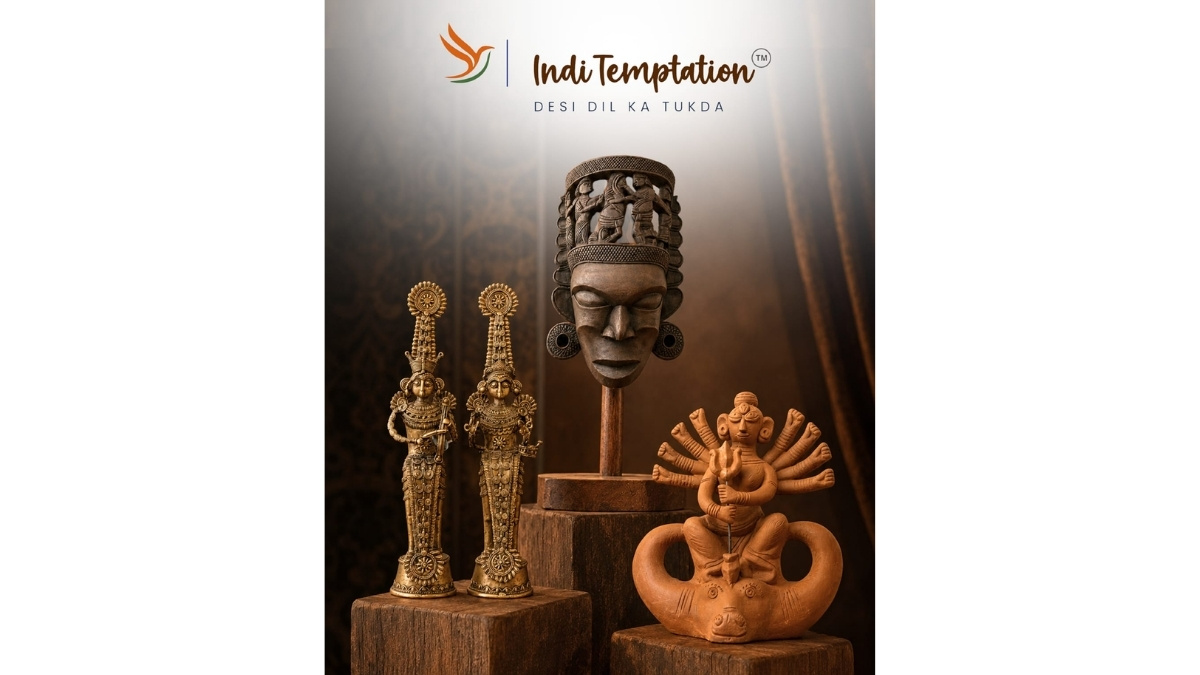
Parna: For our artisans, sustainability was never a trend—it was simply the way their grandparents lived. Coconut shells become ladles; old saris become quilts; natural dyes stain palms the color of marigolds. When you support that lineage, you aren’t just “being green.” You are choosing to live with more humility.
And then there is the project that holds my softest place: Innocent Hands. We showcase art created by underprivileged and differently-abled children. I have watched a child, who had been spoken over for years, hold up a painting and wait—just wait—for someone to see it. When that child’s work is chosen, when it finds a home, something inside them straightens. Every child deserves that moment when the world says, “I see you.” If IndiTemptation can deliver even a few of those moments, then it is not just a business. It is a promise kept.
Interviewer: What have been your hardest challenges, and what would you tell someone starting out?
Parna: Growing slowly with limited resources feels like walking barefoot across a long, hot road. Handmade doesn’t obey calendars. Clay cracks. Monsoons cancel dye days. A single missing ferry can unravel a timeline you guarded for months. There have been nights when logistics turned into knots and I lay awake, counting worries like beads. Doubt can be loud.
But then my phone lights up: a message from a woodcarver whose work reached a home in Seattle, a photo of a lamp casting the same pattern of light in a new country. In those moments, the exhaustion hums into silence. I remember that every delay, every scar, is part of a story worth telling.
To anyone beginning without big backing: let slow be your strategy, not your shame. Save a little, build a little, learn a lot. Hold onto your grit like a prayer. You don’t need perfect conditions to start—only a reason that refuses to leave you. I was just a middle-class girl from suburban Kolkata who didn’t want our heritage to be an afterthought. If all you have today is a quiet conviction, guard it. Feed it. Keep walking.
Because one day, a stranger across an ocean will turn on a lamp you helped travel there, and the room will bloom with a pattern that belongs to your home. In that light, all the waiting will make sense. And you will know: the hands were never forgotten. They were only waiting to be found.
Website: www.inditemptation.com
Contact: +91 81003 84587

