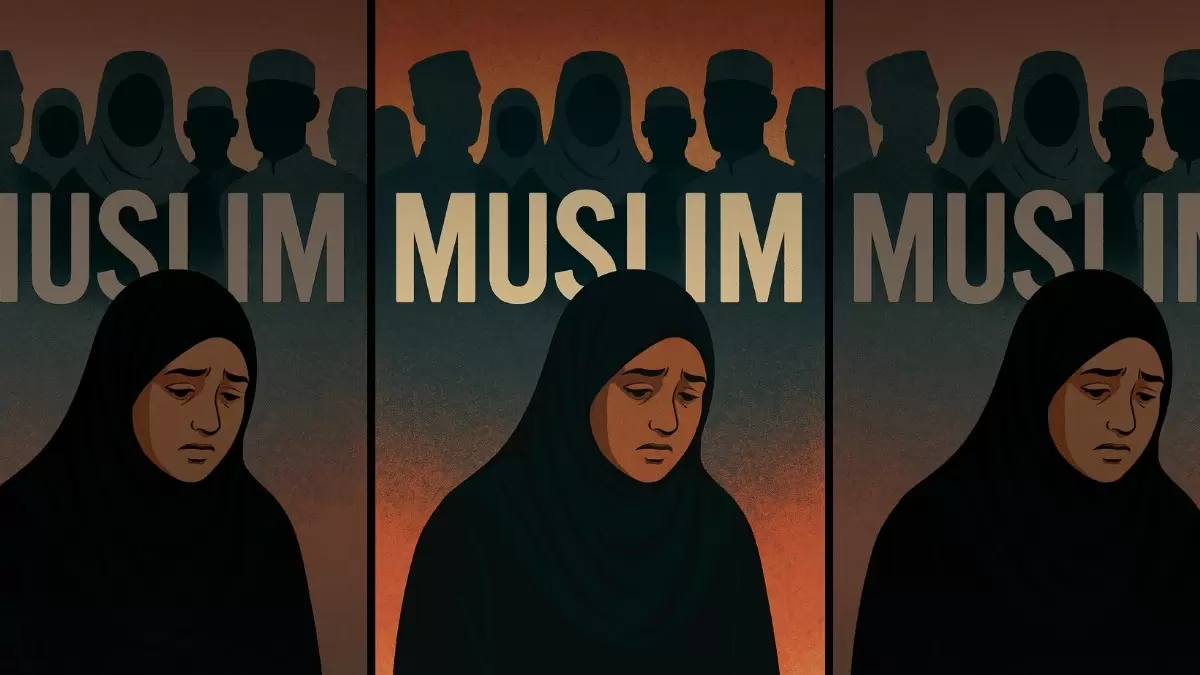








Mumbai: “Men are only loved if they provide,” a familiar refrain surfaces in the turbulent churn of public conversation. Said with such strong conviction, it could also be registered as a trademark online. But when the same logic is applied to several oppressed identities—including Muslims—it begins to show an embarrassing parallel. Tracking the internet response to the Pahalgam terror attack, a young writer recently observed this.
She received an avalanche of comments after sharing about the event: “Not all Muslims, but always a Muslim.” Not because of its originality, but rather because it reflected something she, as a woman, had said countless times about men—“Not all men, but always a man” stopped her in her tracks.
She suddenly realised, if only momentarily, what it must feel like for a man who has never mistreated a woman to be constantly painted with the same brush. And in that flutter of compassion, a question arose: Does terrorism really have a religion?
The Numbers Do Not Tell Lies
The story that ties Islam directly to terrorism is not only overdone but statistically ridiculous. On Earth today, over 2.2 billion Muslims live, 26.4 per cent of the global population. That comes close to one in four persons living. Still, just 0.0002% of Muslims worldwide have ever participated in extreme violence, according to a 2021 Centre for Strategic and International Studies study.
That comes to less than one in 500,000. You are therefore more likely to be struck by lightning, win a lottery, or die from a vending machine.
Still, the response is almost Pavlovian when an assailant’s name sounds somewhat like Mohammad or Ahmed. One asks about religion. One points the community at fault. The worldwide Muslim count turns into a footnote to the deeds of an unhinged few.
On the other hand, when a terrorist happens to be non-Muslim, we usually hear euphemisms: “lone wolf,” “mental health crisis,” “isolated incident.” The variation? Name, skin tone, and handy scapegoating—a matter of taste.
What then about safe Muslim nations?
If Islam encouraged violence naturally, then logic would say that its strongholds would be the most dangerous. Still, cities like Dubai routinely rank among the safest in the world. The 2023 Numbeo Crime Index shows Dubai to be safer than cities in the United States, Latin America, and even some areas of Europe.
A focused minority
It is not only about impressions. Actually, Muslims suffer the most among all the religious groups worldwide. More nations than any other religious group, a 2022 Pew Research Centre study revealed they experience the highest degrees of government restrictions and social conflicts.
The irony is thus strong: whether by political scapegoating, systematic oppression, war, or forced displacement, the same group most accused of violence is disproportionately the victim of it.
Why Do Peaceful Muslims Not Clearly define Islam in the Media?
Why not the billion-plus peaceful Muslims who pray, fast, work, and raise families without ever carrying a weapon if a terrorist can represent an entire religion? Media psychology holds the key to the response: violence sells. There is not a trend in a silent prayer. One finds that a terrible headline does.
One man therefore becomes a billboard for a billion when he acts in terror. But a billion silently living with dignity and compassion vanish in the noise.
Outside of Religion: Into Pattern Recognition
People search for patterns. It provides a false sense of organisation. But when those trends are based on prejudice, they cause more damage than any clarity could ever accomplish. It is lazily wrapped in the appearance of common sense—blaming 2.2 billion people for the actions of a few. It is not logical.
The first person who gave this some thought was not supporting the radicals. She was challenging the reflexive discrimination that develops every time society favours stereotypes over facts.
An Appeal for Reason-Based Criticism
Perhaps it’s time to pause the next time someone posts anti-Muslim propaganda or makes another reductionist comment. Better still, enquire. Alternatively, participate a little more deeply. Examine the data. Talk with people rather than about them.
Since this is not about defending a faith. It’s about standing up for reason.
The Actual Learning Objective
Empathy means realising that people are more than just their labels; it does not imply mindless support. It means realising that a lazy shortcut to dehumanisation is “not all, but always”.
Thus, when someone says “always a Muslim,” consider whether “always a man” would feel fair to you.
Should it not, you have already started your path towards empathy. And in this hyperconnected, hyperpolarised society, that’s rebellion rather than mere kindness.
Also Read: Unconditional Love Is More Myth Than Reality