




Mumbai: There was a time when internet stories had to pass through gates—studio approvals, production houses, carefully curated pitches delivered in rooms where silence felt expensive. Creativity existed, of course, but it needed permission. It needed structure. It needed someone in a suit to nod.
Now, it needs attention.
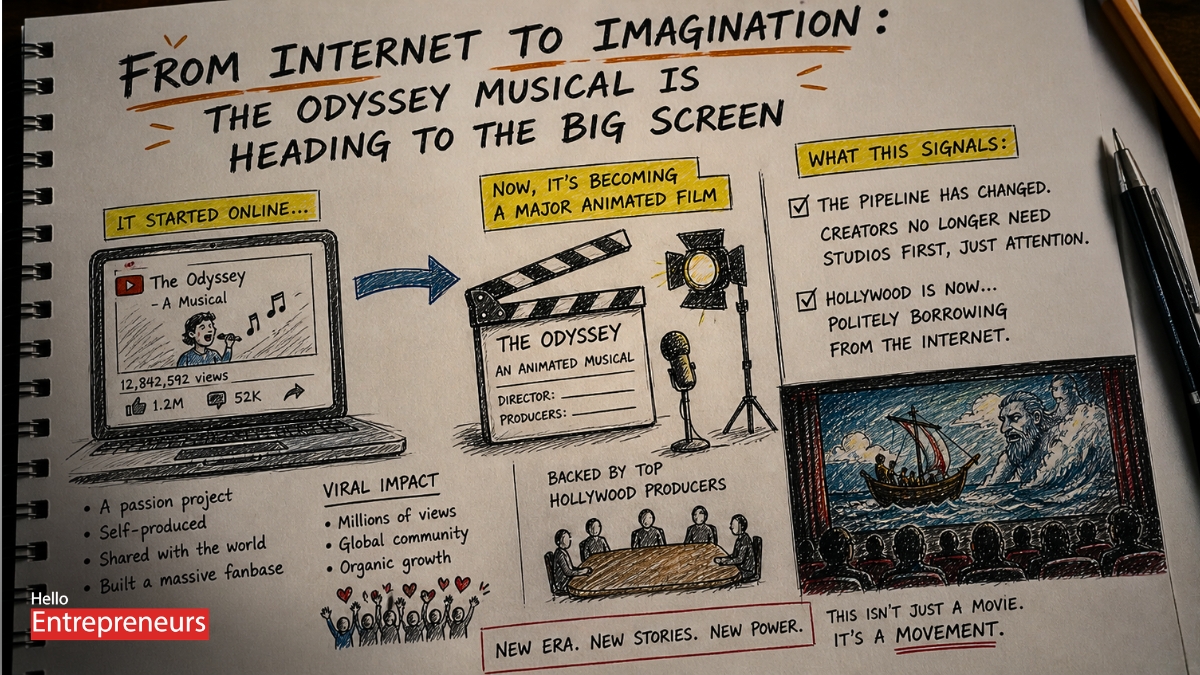
The latest development, a viral musical inspired by The Odyssey being adapted into a full-scale animated film with major backing, isn’t just another success story. It’s a quiet announcement.
The system didn’t collapse. It adapted.
And somewhere between hashtags and headphones, the internet became the new audition room.
The Moment Stories Stopped Waiting
What makes this transition fascinating isn’t just the outcome, it’s the origin.
- A digital-first musical project
- Built without traditional studio infrastructure
- Distributed across platforms before being “discovered”
What followed feels almost inevitable:
- Millions—then billions—of streams
- A rapidly expanding fanbase
- Industry attention arrived slightly late, but decisively
The story didn’t climb the ladder.
It bypassed it.
The Backstory: When Distribution Became Democratised
To understand this shift, you have to rewind slightly.
- Social platforms removed barriers to entry
- Audio and video tools became accessible
- Audiences began curating their own content ecosystems
Creators no longer needed studios to distribute their work.
They needed:
- Visibility
- Consistency
- Engagement
Which, as it turns out, can be more powerful than a production deal.
The Economics Of Virality (Surprisingly Structured)
Let’s introduce some numbers—because even chaos has metrics.
- Viral digital projects can generate millions in ad revenue and streaming income
- Top-performing online musicals and series accumulate hundreds of millions to billions of views
- Production budgets for animated adaptations now range from $50 million to $150 million+
What starts as a low-cost creative experiment can evolve into a high-investment cinematic project.
Efficiency meets scale.
And scale attracts funding.
The Positive Case: Access, Opportunity, Expansion
Let’s acknowledge what this means—because it’s significant.
- Creators can build audiences independently
- Diverse voices gain visibility without gatekeeping
- Studios gain access to proven concepts with existing fanbases
From a PR perspective, it’s almost ideal.
A system that rewards:
- Creativity
- Persistence
- Audience connection
It feels meritocratic.
Or at least… closer to it than before.
The Slightly Less Romantic Reality
Of course, the narrative isn’t entirely poetic.
Virality Is Not Predictable
- Success often depends on timing and algorithms
- Quality doesn’t always guarantee visibility
Creative Control Can Shift
- Once studios step in, projects evolve
- Original visions may be adjusted for broader appeal
Sustainability Is Uncertain
- Not every viral project translates into long-term success
- Audience attention is… famously fickle
In other words, the new pipeline is open.
But it’s not entirely stable.
The Studio Perspective: Strategic Adaptation
For the entertainment industry, this isn’t a disruption.
It’s sourcing.
Studios are no longer just developing ideas internally.
They’re:
- Monitoring digital trends
- Identifying high-engagement content
- Investing in projects with built-in audiences
It’s efficient.
Why take risks on unknown concepts when the internet has already tested them?
The Sarcasm (Because It’s Inevitable)
There’s something almost charming about the transformation.
An industry once known for exclusivity is now… browsing.
Because nothing says “creative discovery” quite like scrolling through trending content.
Revolutionary? Perhaps not.
Practical? Undeniably.
The Audience Shift: Power Without Permission
One of the most interesting aspects of this trend is the role of the audience.
They’re no longer passive consumers.
They’re:
- Curators
- Amplifiers
- Decision-makers
Engagement metrics now influence:
- What gets produced
- What gets funded
- What reaches mainstream visibility
It’s a subtle redistribution of power.
And it’s happening in real time.
The Creative Trade-Off
Every shift introduces new dynamics.
Pros:
- Increased accessibility for creators
- Faster discovery of unique concepts
- Stronger audience connection
Cons:
- Pressure to perform consistently
- Risk of content becoming trend-driven
- Potential dilution of originality in mainstream adaptation
It’s not a perfect system.
But it’s an evolving one.
The Cultural Angle: Mythology Meets Modernity
There’s also something intriguing about the choice of inspiration.
The Odyssey, a story thousands of years old, is being reinterpreted through digital platforms and then adapted into modern cinema.
It reflects:
- The timeless nature of storytelling
- The adaptability of classic narratives
- The fusion of old and new creative mediums
In a way, the medium has changed.
The core hasn’t.
The Bigger Pattern: Attention As Currency
What we’re witnessing extends beyond a single project.
- Attention has become a measurable asset
- Engagement translates into opportunity
- Visibility drives investment
The traditional pipeline hasn’t disappeared.
It’s been supplemented.
By something faster, less predictable, and significantly more public.
So, What Happens Next?
This model is unlikely to reverse.
- More digital-first projects will transition to mainstream media
- Studios will continue scouting online platforms
- Creators will increasingly prioritize audience building
The line between “independent” and “mainstream” will continue to blur.
Not dramatically.
But consistently.
The Final Thought: When Stories Learn To Travel Alone
The journey from internet project to cinematic production isn’t just a success story.
It’s a structural shift.
Stories no longer need to wait for approval.
They can:
- Find audiences independently
- Build momentum organically
- Attract investment through visibility
And perhaps that’s the most significant change.
Because when attention becomes the gateway, creativity doesn’t just survive.
It adapts.
Even if, occasionally, it has to share the spotlight with algorithms.
Read More: When Big Tech Stopped Moving Fast

