




Mumbai: There’s something quietly theatrical about the way power shifts in Hollywood. No explosions, no dramatic monologues—just signatures, boardroom nods, and a few billion dollars changing direction.
And yet, the consequences feel… cinematic.
The ongoing consolidation involving Warner Bros. Discovery and Paramount Global isn’t merely another corporate reshuffle. It’s a structural rewrite of how stories are financed, distributed, and, perhaps most importantly, decided.
Because when fewer studios control more content, creativity doesn’t disappear.
It just learns to negotiate.
The Quiet Evolution Of Power
Hollywood has always been cyclical. Independent studios rise, giants form, monopolies flirt with dominance, and then—inevitably—regulation or disruption steps in.
This time, however, the stakes feel unusually high.
- Streaming wars have stretched budgets
- Traditional box office models have fluctuated
- Content demand has exploded across platforms
The response?
Consolidation.
Not as a dramatic solution—but as a practical one.
The Economics Behind The Curtain
Let’s address the numbers, because they tend to explain the decisions people prefer not to.
- Major studio mergers often involve valuations in the tens of billions of dollars
- Streaming platforms collectively spend $100+ billion annually on content
- Debt loads for large media companies can reach tens of billions, influencing strategic decisions
For companies like Warner Bros. Discovery, consolidation isn’t optional.
It’s… arithmetic.
Combine assets, reduce redundancies, optimize operations.
Efficiency, in its most corporate form.
The Positive Case: Scale, Stability, Survival
Let’s be fair, there are advantages.
- Larger studios can fund high-budget productions
- Global distribution becomes more streamlined
- Content libraries expand, offering more variety to audiences
From a PR standpoint, mergers promise:
- Stronger platforms
- Better resource allocation
- Long-term sustainability in a volatile market
It’s not entirely unreasonable.
In fact, it’s almost… logical.
The Slightly Less Inspiring Reality
Of course, logic has its limitations.
Fewer Decision-Makers
- A smaller number of executives influence more content
- Risk tolerance may decrease
Potential Job Cuts
- Overlapping roles lead to redundancies
- Restructuring affects creative and operational teams
Creative Consolidation
- Similar strategies across merged entities
- Reduced diversity in storytelling approaches
Because when efficiency becomes the priority, experimentation tends to become… selective.
The Backstory: From Studios To Streaming Giants
This didn’t begin with mergers.
It began with transformation.
- Studios evolved into streaming platforms
- Content consumption shifted from theatres to devices
- Competition intensified globally
Suddenly, traditional studios weren’t just competing with each other.
They were competing with technology companies.
And technology companies, as it turns out, are quite comfortable spending aggressively.
The Strategic Shift: Content As Infrastructure
Content is no longer just entertainment.
It’s infrastructure.
- Drives subscriptions
- Retains audiences
- Defines platform identity
Which means control over content isn’t just creative.
It’s strategic.
And consolidation, in this context, becomes a method of securing that control.
The Sarcasm (Because It Practically Demands It)
There’s something almost poetic about the situation.
An industry built on imagination is now optimizing for efficiency.
Because nothing inspires artistic brilliance quite like a well-structured merger.
One can only assume the next Oscar category will be “Best Synergy.”
The Creative Perspective: Navigating A Narrower Landscape
For creators, the implications are nuanced.
- Access to larger budgets can enable ambitious projects
- Established platforms offer global reach
But:
- Fewer studios mean fewer entry points
- Decision-making becomes more centralized
- Unique voices may struggle to find space
It’s not a closed system.
But it’s… more selective.
The Audience Angle: More Content, Less Variety?
From a viewer’s perspective, the situation is paradoxical.
- More content is being produced than ever
- Streaming platforms release new titles weekly
Yet:
- Themes can feel repetitive
- Risk-taking appears limited
- Familiar formats dominate
Quantity, it seems, doesn’t always guarantee diversity.
The Global Dimension: Power Beyond Hollywood
Mergers aren’t just affecting one region.
- International markets are becoming critical revenue streams
- Global audiences influence content decisions
- Cross-border collaborations are increasing
This expands reach.
But also standardizes expectations.
Because when content is designed for everyone, it occasionally feels like it’s tailored for no one in particular.
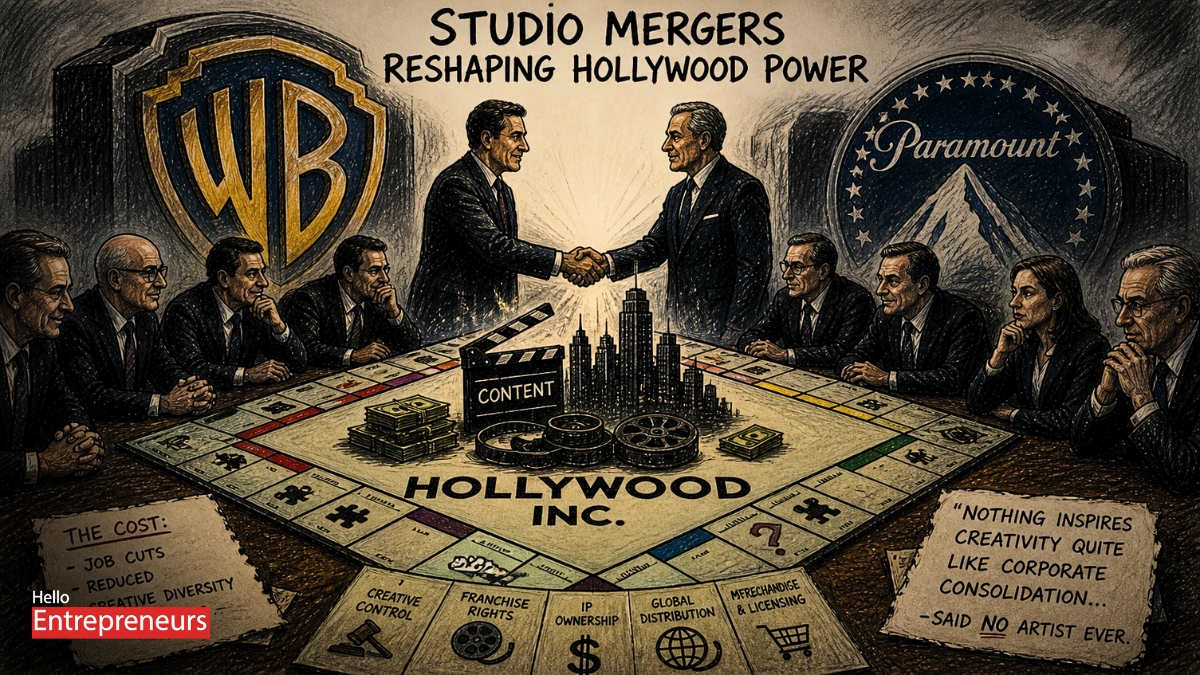
The Innovation Trade-Off
Every consolidation comes with a balance sheet—both financial and creative.
Pros:
- Stronger financial backing
- Expanded distribution networks
- Increased production capabilities
Cons:
- Reduced competition
- Potential job losses
- Limited creative diversity
It’s not a collapse.
It’s a recalibration.
The Industry Reality: Survival Over Sentiment
At its core, this shift reflects a simple truth.
Entertainment is a business.
- Revenue models are evolving
- Costs are rising
- Competition is intensifying
For companies like Paramount Global, consolidation isn’t about ambition.
It’s about survival.
And survival rarely prioritizes sentiment.
The Bigger Pattern: Concentration Of Influence
What we’re witnessing isn’t unique to entertainment.
Across industries:
- Power is concentrating
- Platforms are expanding
- Ecosystems are forming
Hollywood is simply reflecting a broader trend.
Where scale determines relevance.
And relevance determines longevity.
So, What Comes Next?
The trajectory is… predictable.
- Further consolidation is likely
- Regulatory scrutiny may increase
- Independent creators will seek alternative platforms
The system won’t collapse.
It will adapt.
As it always does.
The Final Thought: When Creativity Learns To Share The Stage
The merging of major studios represents more than a financial strategy.
It’s a philosophical shift.
From an industry driven by many voices…
To one guided by fewer, louder ones.
Creativity won’t disappear.
It rarely does.
But it will evolve, finding new spaces, new platforms, new ways to exist outside traditional structures.
Because if there’s one thing storytelling has proven repeatedly, it’s this:
It doesn’t depend on who owns the stage.
It depends on who finds a way to perform anyway.
Read More: The Internet Quietly Rewrote Hollywood

