



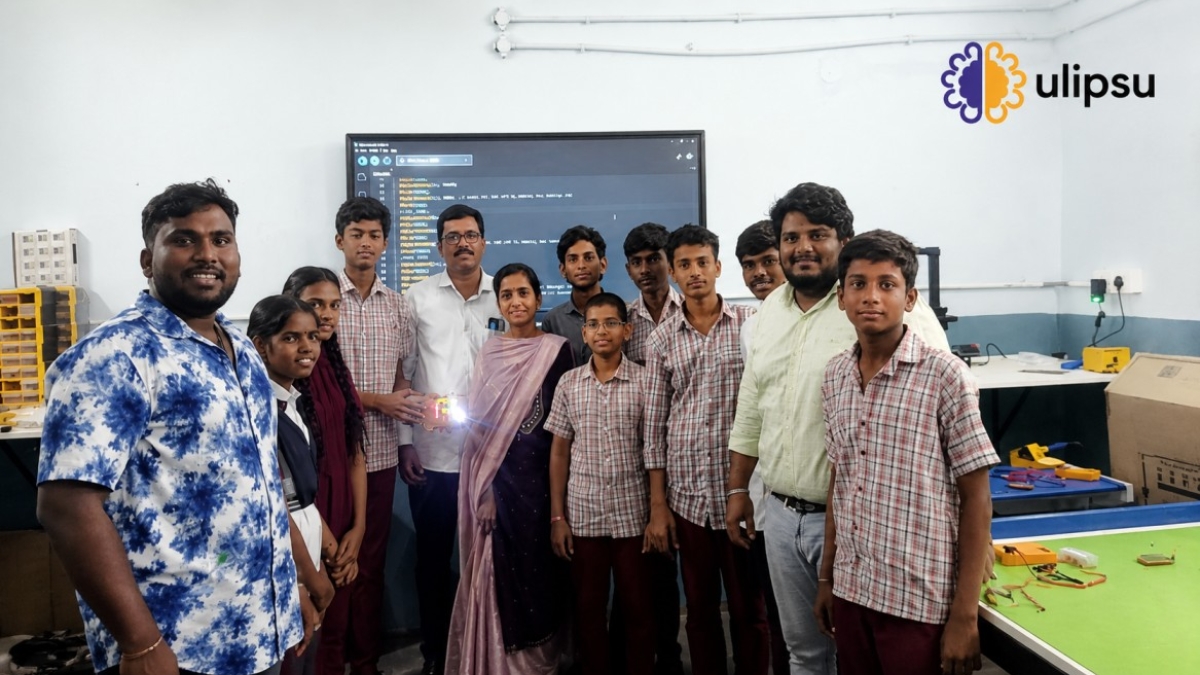
Bengaluru: India’s skill education gap is loudly debated in conference rooms. In two rural Telangana schools, Kidvento’s programmes are doing something rarer — actually closing it.
Zilla Parishad High School and ZPHS Model High School in Gundmal, Narayanpet district, sit at the kind of remove from urban infrastructure that makes most edtech interventions turn back at the gate. PM SHRI TGWREIS High School in Marikal, Nagarkurnool district, is another such school. Limited connectivity, minimal exposure to modern tools, classrooms where a breadboard had never been used for anything practical. These are not peripheral details. They are the conditions under which every lesson in the following account was delivered.
During the 2025–26 academic year, students in Grades 8 and 9 at the Gundmal schools built Arduino circuits, worked with sensors and motors, and constructed a line-following robot. At Marikal, students in Grades 7 and 8 applied design thinking frameworks to problems from their own lives, practised household budgeting, and understood how a business functions as a system. These were not exceptional students selected for a special programme. What happened in these classrooms happened because Kidvento had spent the better part of a decade building programmes specifically capable of functioning in places like these — not around their limitations, but through them.
Why Government Schools Keep Getting Left Behind
The gap between what NEP 2020 promises on skill education and what students in government schools actually receive is not, at its core, a funding problem. It is a design problem. Most skill education interventions are built for schools that already have infrastructure, trained teachers, and reliable connectivity. When they encounter a school that has none of these things — which describes a significant share of India’s government schools — they either retreat or produce the appearance of delivery without its substance.
Kidvento’s founders Sumanth Prabhu MG and Nikhil Bhaskar understood this when they established the company in Mysuru in 2017. If skill education is going to work inside Indian government schools, the programme has to be designed for the actual conditions of those schools. That means offline capability, minimal dependence on individual teacher expertise, assessment that tracks individual students rather than reporting aggregate satisfaction scores, and a curriculum that lives inside the school timetable rather than competing with it.
What Happened in Gundmal
Across November 2025, January 2026, and February 2026, Kidvento conducted the Atal Tinkering Lab Training Programme at the two Gundmal schools, under NITI Aayog’s ATL initiative, in association with y-hub and Inqui-Lab Foundation. Students from Grades 8 and 9 participated in six days of structured hands-on sessions across three batches.
The starting point was genuinely foundational. Most students had never handled an Arduino board. The first session began with voltage, current, resistance, and LED circuit assembly — and built from there in a deliberate and measured progression. By the third session, students were working with IR and ultrasonic sensors, assembling circuits for smart automation projects, programming motor control, and constructing a line-following robot.
Initial hesitation in handling hardware was real. Unfamiliarity with electronic tools required additional time on basics. Each challenge was resolved through methodology rather than resources — step-by-step demonstrations, small collaborative teams, and pacing that allowed hesitant students to observe before they participated. By the final session, the same students who had been uncertain about picking up a sensor were assembling circuits and writing simple programmes with growing confidence.
Teacher feedback noted that students showed genuine interest once they began working directly with the components. One student described building circuits and learning how sensors work with Arduino as something she genuinely enjoyed. ‘Kidvento has set up over 450 Atal Tinkering Labs so far and possesses rich experience in building and delivering curriculums. That experience has been reflected in the training programs conducted.’
What Happened in Marikal
The programme at PM SHRI TGWREIS High School in Marikal covered students from Grades 7 and 8 through the Ulipsu platform’s vocational curriculum, in structured sessions held twice a month. The skill domains were Design Thinking and Innovation, and Finance and Entrepreneurship.
The Design Thinking track introduced students to a framework most of them had no prior language for. By the end of the programme, students were applying the five-step process — Empathise, Define, Ideate, Prototype, Test — to problems they had identified themselves. The capstone projects made this visible. One student, Mamata, had surveyed households on the difficulty of managing cleaning alongside work, and designed a remotely controllable robotic vacuum cleaner as her proposed solution. She was clear-eyed about where the project stood. “Today I just designed that project,” she said. “But tomorrow I will definitely develop that project.”
The Finance and Entrepreneurship track worked in similar territory. Students learned the logic of budgeting applied directly to their own household contexts, differentiated between fixed and variable expenses, constructed mock budgets, and understood how a business functions as a system. Monika described the difference between credit and debit, needs and wants, and the mechanics of a marketing strategy with clarity.
The assessment data supports what the testimonials suggest. S Jagruthi from Grade 8 moved from a Design Thinking beginning score of 33.33 to an end score of 90.90. P Suhani moved from 36.36 to 98.68 in Finance and Entrepreneurship. Ms. Nagamanimala, Head Mistress of PM SHRI TGWREIS, observed that students had not merely acquired theoretical knowledge but had actively engaged in projects requiring practical implementation, and noted a meaningful transformation in student confidence and problem-solving ability. The programme’s feedback summary noted that teachers and school leaders expressed interest in longer duration and broader skill coverage in subsequent cycles.
That collective school observation is the most important signal in the feedback record.
Evidence of Learning, Not Evidence of Attendance
Most education programmes produce outputs: completion certificates, attendance records, aggregate satisfaction scores. These are easy to generate and genuinely difficult to distinguish from real impact. The distinction that matters is between evidence that a student attended something and evidence that a student can now do something they could not do before.
What Kidvento produces in schools like ZPHS Gundmal and PM SHRI TGWREIS Marikal is different in kind. Beginning of Skill and End of Skill assessments create an evidence trail that can be examined, compared, and challenged. Training reports document challenges and resolutions with the same attention as highlights. Capstone projects are assessed, not just celebrated.
Mamata’s robotic vacuum cleaner is still a design. She acknowledged that herself. She also said she will build it. That sentence — honest about where she is now and confident about where she is going — is not the product of a single session. It is the product of a programme that gave a student in a government school in Nagarkurnool the tools to identify a real problem, design a real solution, and understand exactly what remains to be done.
India has no shortage of schools where that sentence has not yet been spoken. The Telangana programmes are the product of a curriculum eight years in development.
Kidvento Education and Research Pvt. Ltd. is headquartered in Bengaluru, Karnataka. Both programmes were conducted in the 2025–26 academic year in association with y-hub and Inqui-Lab Foundation.

