



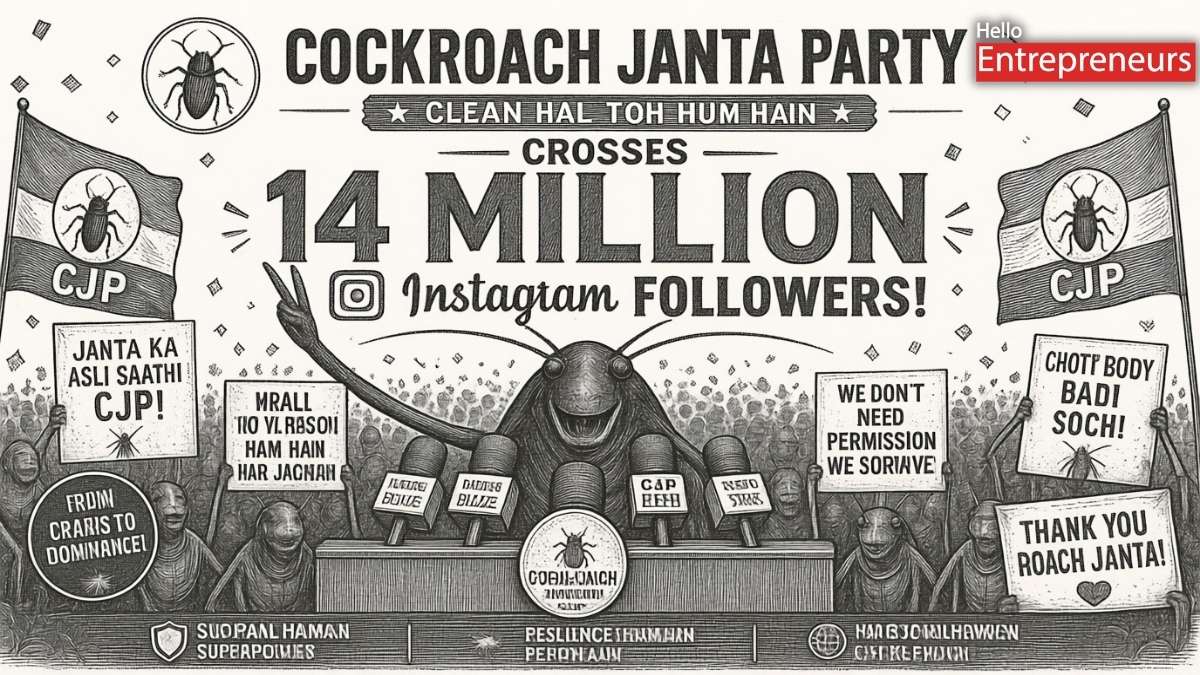
New Delhi: India’s social media landscape is increasingly shaped by meme pages, satirical accounts, and creator-led communities rather than by traditional institutions alone. Political parties, media organisations, and even brands are now competing for attention in the same digital spaces where humour and short-form content often travel faster than formal messaging.
That shift became especially visible after the Instagram page “Cockroach Janta Party” reportedly crossed nearly 14 million followers, overtaking the official Instagram followings of major national political parties such as the BJP and Congress. The page, known for political satire, parody videos, and meme-driven commentary, reflects how rapidly online influence in India is changing.
The rise is not happening in isolation. India has become one of the world’s largest digital markets, with social media usage expanding steadily across urban and smaller-town audiences. According to DataReportal, India had close to 500 million social media users by early 2026, while Instagram alone accounted for more than 500 million users in the country. Most of that audience falls within the 18–34 age group, the same demographic that consumes large amounts of reels, memes, creator videos, and commentary-led content.
In many ways, Instagram has evolved into far more than a photo-sharing platform. For younger users, it now functions as a mix of an entertainment feed, a news source, a shopping platform, and a discussion space. Political content is increasingly competing with stand-up comedy clips, influencer reels, celebrity gossip, and sports highlights in the same scrolling environment.
That change has altered how political conversations spread online.
The Cockroach Janta Party’s content style is built around internet humour rather than structured political commentary. The page uses parody speeches, edited visuals, fictional characters, and exaggerated reactions to current events. The tone is intentionally informal, which is part of why it resonates strongly with younger audiences who are more accustomed to creator-led communication than traditional political messaging.
What stands out is how closely this aligns with the mechanics of modern social media platforms. Instagram’s algorithm rewards fast engagement, shares, comments, replay value, and short watch times. Meme-led content naturally performs well in that system because it is quick to consume and easy to circulate across groups and feeds.
Traditional political communication, by contrast, tends to remain slower and more formal.
The shift is visible on other online platforms as well. X, formerly Twitter, continues to influence political discourse and media narratives, but its Indian user base remains far smaller than Instagram’s. Industry estimates place X’s Indian audience at roughly 25–30 million users, compared with Instagram’s several hundred million users.
At the same time, platforms such as Reddit and Threads are gaining traction among younger urban audiences looking for discussion-led communities and alternative online spaces. YouTube also continues to dominate long-form political commentary, podcasts, and creator-driven news analysis in India.
This broader creator ecosystem is becoming commercially significant as well. India’s influencer economy has expanded rapidly alongside cheaper mobile data, wider smartphone access, and rising internet penetration. Reuters estimates India now has more than one billion internet users and around 750 million smartphone users, making it one of the world’s largest online consumer markets.
As audiences spend more time on social platforms, advertising budgets are gradually shifting toward creators, meme pages, and short-form video communities. Brands increasingly collaborate with digital creators because engagement levels are often higher than those seen through conventional advertising formats.
Meme-led political pages occupy an unusual position within that ecosystem. They are not formal media organisations, yet they shape online conversations and cultural reactions in real time. Their influence comes less from authority and more from relatability and speed.
A trending political event can become a viral reel or meme within minutes.
At the same time, the growth of satire-led political content raises difficult questions around misinformation and moderation. Humour-based pages often operate in a grey zone where parody, commentary, and opinion overlap. Even when users recognise the exaggerated nature of the content, repeated viral narratives can still shape perception and public discussion.
Social media companies are already facing increasing scrutiny in India over misinformation, deepfakes, and politically sensitive content. Platforms such as Instagram, X, and YouTube are under pressure to strengthen moderation systems while also balancing creator freedom and audience engagement.
Still, the larger direction appears clear. Political engagement in India is becoming increasingly creator-led, entertainment-driven, and platform-native. Younger audiences are less likely to consume politics through television debates or official press conferences alone. Instead, much of that engagement now happens through reels, memes, satire videos, podcasts, and creator commentary.
For traditional political parties and institutional media, that presents both a challenge and a lesson. Large organisations may still dominate offline visibility, but online attention increasingly belongs to creators who understand the language, rhythm, and speed of internet culture.

