



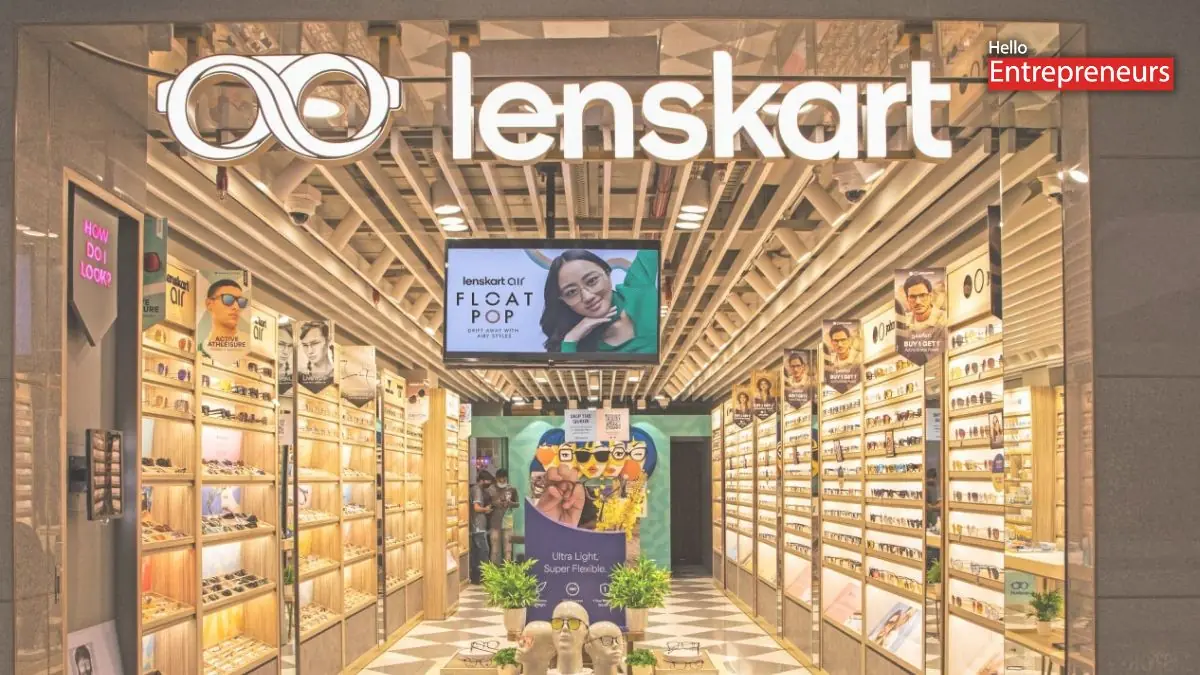
Mumbai: After much anticipation and interest, India’s biggest eyewear brand Lenskat’s public issue opens today. The company aims to raise Rs.7,278 crore, of which just Rs.2,150 crore are fresh equity shares. The rest is an offer for sale (OFS), where Peyush Bansal and other existing promoters are selling their stakes.
After the IPO, the promoters stakes will drop from 20% to 17.5%, even as all kinds of investors- retail, Mutual Funds, Insurance companies, FIIs jump into the fray to grab a pie of one of India’s most successful startups.
The fine print
Lenskart’s IPO’s price band is set between Rs.382-402 per share, valuing the company at around Rs.1.05 lakh crore ($8 billion). Retail investors can bid for 10% or 1.81 crore of the shares, while the institutional investors (FIIs/DIIs) can bid for 75% of the issue and the rest for Non-Institutional Investors (NIIs). This is over and above the Rs.68,000 crore Lenskart raised from institutional investors a day before- nearly 10 times the issue size. The minimum lot size is 37 shares and its multiples, which translates to a minimum investment of Rs.14,874
As per the latest data from IPO tracker InvestorGain, the Grey Market Premium (GMP), an unofficial indicator of investor’s interest, is currently at Rs.66 above the listing price. The IPO will close on November 4, with the stock getting listed on the bourses on November 10.
What makes Lenskart different?
Lenskart has been one of India’s most admired startups, following Peyush Bansal’s Shark Tank appearances. The company managed to eke out its first profit only in 2020, more than a decade after its inception in 2008.
Despite that, the company has become more than just an eyewear retailer- it has moved up the value chain- setting up manufacturing plants for lenses and frames, while reducing its dependence on imports. Currently, the company imports more than 50% of its frames from China, and it now aims to shift the manufacturing to India, in partnership with a Chinese firm.
Besides that, the company is one of the few customer-facing startups that has successfully expanded abroad, with almost 40% of its revenues coming from abroad, while also successfully expanding its reach with acquisitions including Japanese eyewear brand Owndays and Spanish brand Meller- all thanks to venture capital funds.
Reasons to cheer
Lenskart has, indeed disrupted the eyewear market, which has traditionally been rather unorganized. Its nearest competitors are nowhere close to it- the company’s revenues are more than twice that of rivals like Titan Eye+, GKB or Vision Express.
These may be reasons for investors to cheer, but there is always the danger of hype, especially since this IPO comes in the middle of the IPO mania that has gripped the country. For all practical purposes, Peyush Bansal does not need the Rs.2,150 crore from the markets, as he has already raised more than 31 times that a day before. Peyush seems to be riding on the hype wave, and some investors have smelled a rat.
Will hype win?
Netizens have been debating the feasibility of investing in this IPO, with many believing it is just an extension of Peyush’s PR efforts.
“Prior to this, they were continuously a loss-making entity and moreover that they closed more then 100 stores alone in FY 2425 yet they are in profit this year. TLDR, save your hard-earned money, this is going to be the next Paytm,” one user commented in a recently viral Reddit thread.
“It’s the Indian emotional retail investor – who wants big bucks quick quick quick! You keep posting this educational and data-backed stuff, and what should sane people do? Hear this and let the IPO be under-subscribed! But lo and behold! Our guys will make it a banger! You’ll get to see the manifold subscription numbers, that’s why the application window is so so long,” another cautioned.
Many even said that the Mutual Funds and Institutional Investors are risking investors money by buying into the hype, especially since the company’s profits are mainly through their investments, while operational profits remained negative.
“There is a lot of opaqueness in the eyewear space. No pun intended. There is only 5-10% reality, and 90% is just showcasing and marketing. I think that needs to be disrupted, and we are disrupting it in every sense. We are saying that, yes, there is an element of storytelling and marketing, but it cannot be to the tune of 90%,” Peyush Bansal himself said in an interview with The Arc.
“If you look at our unit economics, whether it is the LTV to CAC that we have been operating with or the gross margin that we have been operating with, if that is on the right trajectory – firstly at the base level, and then in its growth I feel great about where we are, both in India and internationally, on our gross margins. And I think there’s obviously more opportunity there to continue improving.
Profitability is not inversely correlated to growth. What that means is, the more growth happens, the more profitability happens. And at Lenskart, hand on heart, profitability didn’t come as a forced metric it came as a matter of scale,” he further clarified.
What will this mean for the retail investors who pour in their life savings into the issue? Will they live to see consistent profits and sustained capital appreciation in the long term? Only time will tell.
Disclaimer: This article is for informational purposes only and does not constitute financial advice. Readers should conduct their own research or consult with a qualified financial advisor before making any investment decisions.

