



This week marked a development that could signal the start of a stock market trend that came a quarter of a century ago. The Asian markets, particularly South Korea and Japan, known for their tech-focused stocks, saw a sudden fall after weeks of sustained rally.
For the global stock markets, this comes as an ominous sign that something could go wrong, or may go wrong, the way it did twenty-six years ago when a similar technology trend influenced investor sentiments.
That same trend has repeated again, with a whole new generation of investors getting into it, many of them having a firm faith in the promise of a game-changing technology that has changed the way we work: AI
The Dotcom bubble phenomenon
Before the dawn of the twenty-first century, the internet was a fairly novel technology, and its rapid adoption meant the world was looking at it as a new source of wealth, commerce and the next phase of opportunity.
Starting in the late 1990s, investors increasingly saw internet-based companies as the next big growth story, with the release of popular web browsers like Internet Explorer and Netscape Navigator making the internet more popular than ever, with computer ownership becoming widespread across households.
During this time, many people aimed to spend on companies based on the internet, including online shopping sites, communication-based companies, and networking companies as well.
At the time, a decline in interest rates encouraged investors to take risky bets, and many investors preferred to put their money in any company having a .com suffix in their name.
Investment banks profited from the trend with IPOs that listed on Nasdaq, with fuelled speculations encouraging investments in technology stocks. So much that the Nasdaq Composite stock market index rose 400% with a price to earnings ratio of 200.
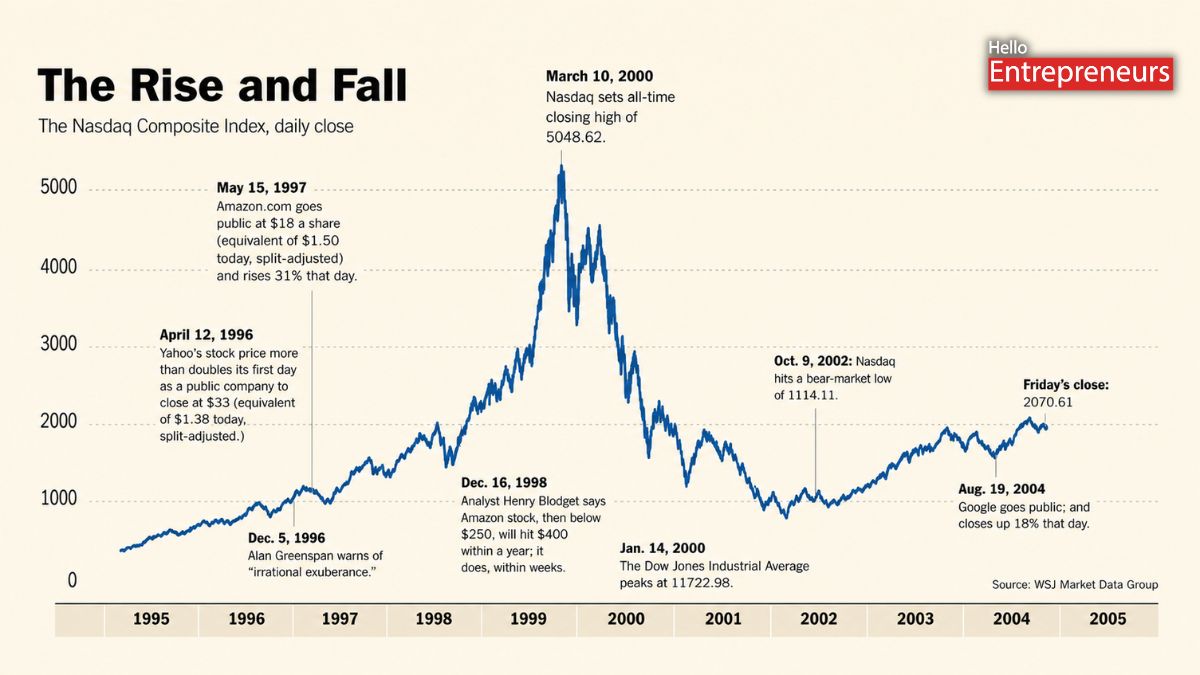
Despite warnings from some analysts, many investors chose to invest in overvalued companies, with 12 large-cap companies seeing their stock values rise by over 1000% in value by 1999.
At the time, companies that had raised money through the markets were so high on hype that they missed the whole idea of the core intent of a company- to earn profits. They started to spend heavily on marketing, without caring for profitability, as they sed the ‘get large or get lost’ motto to grow first and then think of earning profits after scaling up.
But that all came to a bust in the year 2000, after the NASDAQ composite index peaked at 5,048. Within days, after news about Japan entering a recession broke, various internet companies saw their revenues erode as it was revealed that they were running out of cash.
After a string of bankruptcies and a stock market downturn, the NASDAQ-100 had dropped almost 78% of its peak by October 9, 2002.
Is AI different this time?
The echoes of the dotcom era are hard to ignore. Investors are once again pouring money into a transformative technology before its profitability has been proven at scale. Valuations have surged on the strength of expectations rather than earnings, and a new generation of retail investors, many of who don’t know anything about the 2000 crash, are betting heavily on the promise of what AI could become.
Nowhere is this more visible than in the semiconductor sector. Nvidia, whose chips underpin the vast majority of AI model training, saw its market capitalisation cross $3 trillion in 2024 — a figure that would have seemed implausible just three years prior. SK Hynix and Samsung Electronics have similarly surged on demand for high-bandwidth memory, the specialised chips that feed AI systems data at speed. TSMC, which manufactures chips for nearly every major AI player, has become a proxy bet on the entire sector. For investors, these companies represent the core infrastructure of the AI boom. This was similar to that of Cisco during the dotcom boom, where this networking hardware company saw its valuation explode on the same logic, only to slow down and crater during recessionary periods.
Yet the AI story is not simply history repeating itself. The most important distinction is that the foundational companies of the AI boom have real, and in some cases substantial, revenues. Unlike the dotcom era’s most notorious casualties — firms that burned through investor capital without ever turning a meaningful profit — today’s AI infrastructure players are generating significant income. Nvidia posted revenues of over $60 billion in its fiscal year 2024. TSMC’s margins have remained formidable even as it invests heavily in new capacity. These are not companies built on speculation alone.
The Takeaway
Though investors continue to look at AI-led stocks as the leading hype of the markets, many institutional investors are now forcing these companies to prove their financial worth, with a keener eye on the overall market and its expected potential. Though there are opportunities and risks in the AI wave, it could become a bubble if you continue to believe the hype and don’t do your own research.

