



Key Takeaways
- Upcoming Price Hike: Major appliance brands like Daikin, Haier, Godrej, and Blue Star are raising prices on ACs, TVs, and washing machines by up to 8% starting October 1, marking their third price hike this year.
- Driven by the EV Surge: An electric vehicle requires nearly four times as much copper (~83 kg) as a standard combustion engine vehicle (~23 kg), placing unprecedented pressure on global copper reserves.
- Supply-Demand Deficit: Coupled with rising consumption from AI data centers and renewable grids, copper prices on the LME have surged nearly 48% year-over-year amid mining disruptions in major producing regions like Chile.
- Cross-Industry Impact: As automakers and industrial sectors compete for shared raw materials and manufacturing capacity, rising production costs are spilling over to everyday consumer electronics.
From October 1, prices of air conditioners, televisions and washing machines are expected to rise about 8% and the culprit lies in something that’s increasingly being popular these days, your Electric Vehicle.
Electric vehicles are transforming transportation, mostly out of necessity, as petrol prices rise and the EV tech stack matures. But this rising demand has strained the supply of a crucial, common input: copper.
And the consequences are being seen. Diakin, Haier, Godrej Appliances and Blue Star have been forced to raise prices of its appliances from October 1, citing higher copper prices besides other inputs, even moving toward the crucial Diwali season. Worse, this would be the third time the white goods industry has raised prices during the year.
Though EVs are not solely responsible, they are represent the most important part of the demand equation.
Copper’s role in electronics
Copper remains indispensable to electronics given its high thermal and electrical conductivity. Copper has, for years, remained relatively affordable, with consistent supplies meeting demand. The recent surge in copper demand has affected supplies, with a report by the International Copper Study Group estimating a deficit of 1.5 lakh tonnes, forcing prices upwards.
In fact, copper prices have crossed the $14.500 per tonne mark on the London Metal Exchange, almost 48% in a year.
And this is only going to rise. Mostly because EVs require almost 83 kilos of copper for its motor, battery connections, writing, power electronics and charging systems as against just 23 kg for standard internal combustion vehicles.
Multiply this over millions of EVs and the change becomes highly significant.
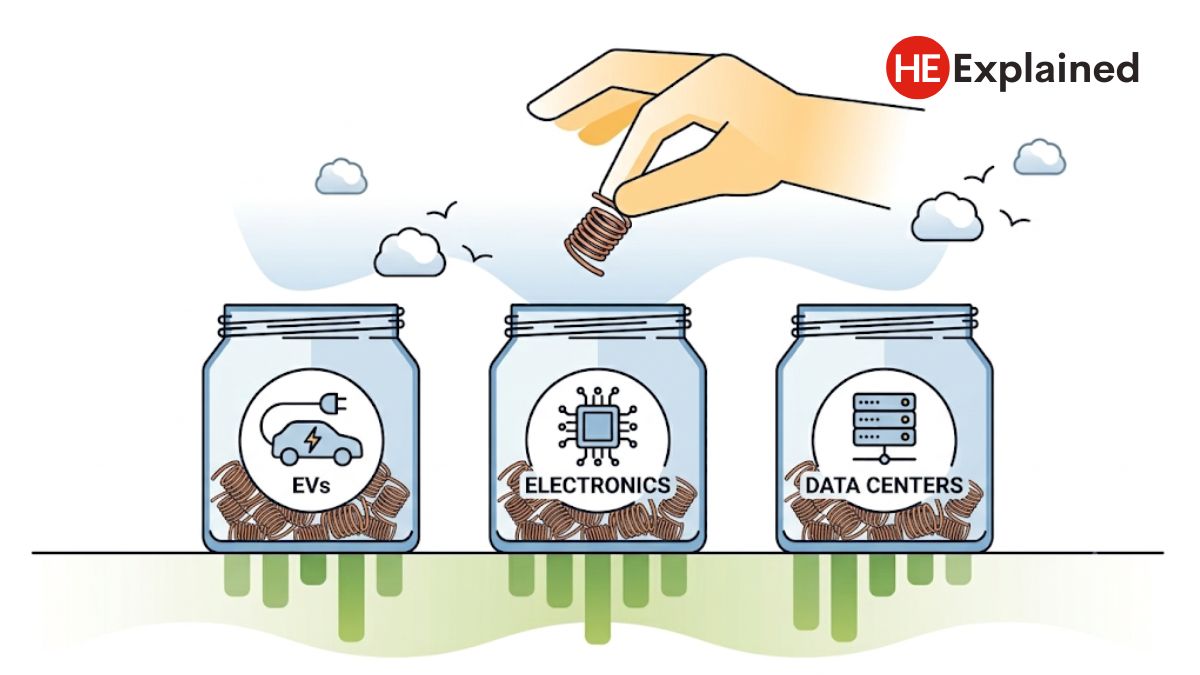
Beyond this, copper demand has surged as the world adopts AI and this has had a spillover copper demand for wiring in data centers, renewable energy equipment, telecom networks and much more, with the demand expected to reach 31.3 million tonnes by 2030.
Despite this, increasing copper production remains insanely difficult. Chile, the world’s largest copper producer has had challenges with accidents in its mines and declining ore quality. Beyond that, supplies of sulphuric acid required to extract copper from its ore have been disrupted as China has prioritized domestic demand.
Demand for electronics surge
The pressure goes beyond metals.
But the price rise is going beyond copper. To compete in an increasingly crowded market, carmakers are adding a variety of sensors, controllers and other devices to boost performance and for other uses, making the car an electronic product as well.
Beyond this, India’s power electronics industry is expanding with EVs, renewable energy and energy storage. Industry representatives are describing these sectors as major drivers of demand, which include semiconductor manufacturing, smart grids and advanced electronic systems.
This does not mean a chip intended for an electric car can simply be diverted into a television. Different products use different components. The broader effect is that enormous new industries are competing for investment, factory capacity, engineering talent and raw materials across overlapping supply chains.
The challenge with electronics manufacturing comes from major economic shifts occurring simultaneously: surging demand from EVs, renewable energy and electric grids require more copper while geopolitical disruptions, limited supply and currency movements are increasingly forcing manufacturers to foot elevated raw material bills.
The Price of Electrification
There is a paradox here.
EVs, renewable energy, AI infrastructure and smarter electrical products promise greater efficiency and technological progress. But building all of them simultaneously requires huge quantities of physical materials.
Copper mines take years to develop. Semiconductor factories require enormous investment. Processing capacity cannot double simply because demand suddenly does.
That leaves manufacturers with three choices: absorb higher costs, redesign products to use cheaper alternatives, or pass part of the increase to buyers. Solar and data-centre operators are already examining greater use of aluminium where technically possible as copper prices climb.
For consumers, the lesson is that the EV revolution does not end at the charging station.
As cars become more electronic and the economy becomes more electrified, industries that once appeared unrelated are increasingly competing for the same materials and manufacturing capacity.
The cost of that competition is beginning to appear on price tags well beyond the automobile showroom.

