



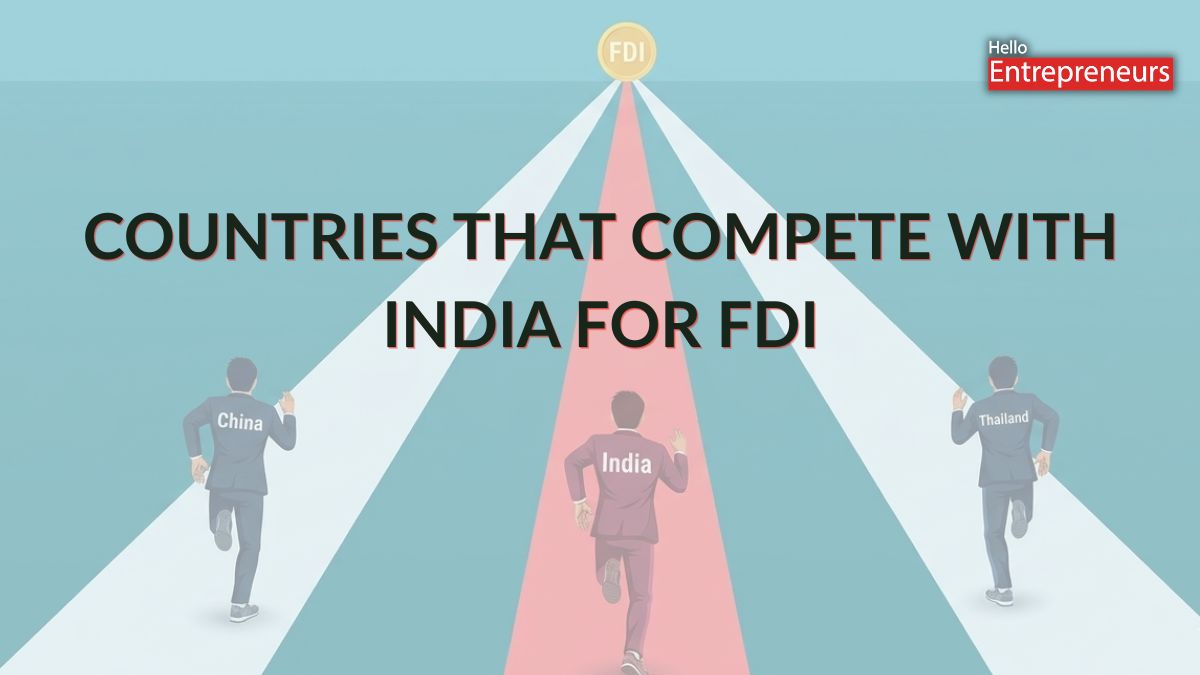
India gets about 2.5% of the total FDI worldwide, according to a report by the United Nations Trade and Development (UNTAD) Council. India has come a long way from being considered an afterthought by investors due to the License Raj and its restrictive bureaucracy.
Today, India remains a favourable location attracting FDI, as investors look to India to produce goods at a cheaper rate, closer to their target markets and increasingly, depending on its technological prowess to become an invaluable part of the global supply chain.
But India is not alone here; it competes with various developing countries to attract this FDI. Each of these countries has its own strengths, sometimes stronger than India’s, that make investors choose them over India. Here are the countries that India competes with for FDI, and the challenges they face to attract investors.
China
FDI Received in 2025: About $105 billion
Why Investors Prefer It
China offers multinational corporations a mature industrial ecosystem, clustered as per the industry, with world class physical infrastructure and a massive internal market. China has moved up the industrial value chain, attracting high value added investments in corporate research and development, advanced pharmaceutical manufacturing, precision machinery and specialised chemicals being a part of it. A strong network of domestic suppliers with a vast pool of technical engineering talent has allowed foreign enterprises to gain operating efficiencies that remain unmatched across emerging markets.
Challenges Faced in Attracting Investments
China faces escalating geopolitical challenges with the West, with a trade war with the US forcing investors to rethink their Chinese investments. Due to this, many multinational firms are seeking to diversify their manufacturing away from China as the tariff war could affect their global plans. Beyond that, domestic real estate sector adjustments and regulations governing cross border data security have also discouraged investors to bet on China, forcing them to move to other destinations as per a ‘China+1’ strategy.
Vietnam
FDI Received in 2025: About $225 billion
Why Investors Prefer It
Vietnam wins for its proximity to China, allowing investors to diversify their supply chains under the ‘China+1’ strategy. The country offers competitive wages, strong industrial supply hubs and an extensive network of multilateral and bilateral free trade agreements. Foreign investors prefer Vietnam for its low tariff access to major global markets, allowing them to supply high volume equipment and manufactured components to international technology firms.
Challenges Faced in Attracting Investments
Despite high growth in the manufacturing sector, Vietnam has faced challenges with logistics and utility supplies. Rapid industrial growth has strained its seaports, resulting in freight bottlenecks and administrative delays. Its national electrical grid remains vulnerable to localised blackouts during peak demand, posing risks to power-dependent semiconductor and electronics manufacturing. The Southeast Asian country also faces a shortage of specialized engineering talent, hampering its transition to higher-value research and advanced manufacturing.
Thailand
FDI Received in 2025: About USD 60 billion
Why Investors Prefer It
Thailand offers investors advanced industrial infrastructure through its specialised industrial estates and fully developed logistics networks. It has remained a regional hub for automotive manufacturing, further emerging as the principal sector for electric vehicle (EV) and battery component manufacturing. Additionally, Thailand’s strong power infrastructure and centralised location within South East Asia makes it a preferred destination for data centers.
Challenges Faced in Attracting Investments
Thailand has been constrained by a rapidly ageing society, resulting in a contracting workforce that has resulted in talent shortages for software engineering, advanced robotics, and other specialised technical fields. Moreover, political uncertainties and high household debt have hampered domestic consumption, forcing foreign investors to rethink their investments.
Brazil
FDI Received in 2025: About USD 77 billion
Why Investors Prefer It
With abundant agricultural resources and vast mineral reserves, Brazil offers investors a gateway to opportunities, strengthened by a population of more than 200 million. The country has a relatively clean energy grid, with over 80% of its power derived from renewable sources, while attracting cross-border investments in energy transition manufacturing, bio economy initiatives and sustainable digital infrastructure. It remains Latin America’s leading hub for cloud and artificial intelligence infrastructure.
Challenges Faced in Attracting Investments
Foreign investors face operational challenges with an intricate corporate tax system, complex labour regulations and high domestic borrowing costs. The country’s logistics infrastructure is also not well developed, leading to elevated logistics costs. The country’s currency remains volatile as against the dollar, forcing investors to rethink long-term projects.
Mexico
FDI Received in 2025: About USD 41 billion
Why Investors Prefer It
The proximity to the US and the preferential duty free market access to the US and Canada attract investments to Mexico as a nearshoring destination. Global manufacturing firms have expanded industrial operations in Mexico to take advantage of this, strengthened by established manufacturing ecosystems across automotive engineering, aerospace components, electronics, and medical devices.
Challenges Faced in Attracting Investments
The rapid pace of industrial nearshoring has stressed Mexico’s utility and freight infrastructure. Industrial zones along the border with the US face supply deficits for water and electricity. Beyond that, regulatory uncertainty with private power generation and energy market access has constrained infrastructure expansions.
Indonesia
FDI Received in 2025: About USD 24 billion
Why Investors Prefer It
Blessed with vast natural resources, Indonesia has been successful in building localized mineral processing plants, attracting investments for smelters, EV battery production and other upstream industries. It has an expanding consumer market, with investors attracted to its large diversified economy.
Challenges Faced in Attracting Investments
As the world’s largest archipelago, the country has faced challenges with logistics movements, and its heavy reliance on captive coal power plants for mineral processing smelters. Also, its complex regulatory frameworks and bureaucratic inefficiencies have forced investors to rethink.
Malaysia
FDI Received in 2025: About USD 15.9 billion
Why Investors Prefer It
Malaysia has been an investor favourite for its established industrial ecosystems in Penang and Kulim, along with strong intellectual property legal frameworks and widespread English fluency. The country accounts for almost 13% of the world’s semiconductor supply chain- especially in the semiconductor assembly, testing, and packaging market.
Challenges Faced in Attracting Investments
The increasing demand for water and electricity by data centers has burdened Malaysia’s utility infrastructure. These energy-intensive facilities require vast amounts of electricity generation capacity and high industrial water supply, creating shortages for domestic and other uses. Also, the country has witnessed talent migration to higher wage markets, requiring state support to train its students on vocational training and technical education to maintain its competitive edge.
The Philippines

FDI Received in 2025: About USD 7.8 billion
Why Investors Prefer It
With a young, English-speaking workforce, the Phillippines has built a strong market position in the Business Process Management (BPM), customer experience services and corporate shared services sectors. It has recently allowed complete foreign ownership in key public utilities, allowing foreign investments in renewable energy, maritime logistics and telecommunications.
Challenges Faced in Attracting Investments
The Philippines has the highest industrial electricity tariffs in Southeast Asia, discouraging energy-intensive manufacturing and semiconductor fabrication, thereby concentrating most FDI inflows in the service sector. Its vulnerability to severe weather events requires additional expenditure on physical infrastructure. Beyond that, administrative delays and inadequate transport infrastructure hamper investments.

