



It’s been 12 years since PM Modi launched the Make in India initiative during his first term, as he sought to boost India’s manufacturing capabilities. A lot of water has flowed under the bridge since then, with the scheme boosting manufacturing capabilities in India, with the sector now accounting for about 25% of India’s GDP, boosted by a strong 12-14% industrial growth rate and generating 100 million jobs in the manufacturing sector.
Though the government has always highlighted these numbers, the initiative hasn’t met the targets set forth by the government, as various challenges- both internal and external, continue to persist, with the scheme failing to boost India’s share in the global supply chain, growing to up to 3.2% in global manufacturing value addition, from 1.5% from 2014, according to the NITI Aayog.
Lets see how the Make In India initiative has worked for the past 12 years, in 6 positive and negative ways.
Positive Developments
Mobile Handsets Production Ramp Up
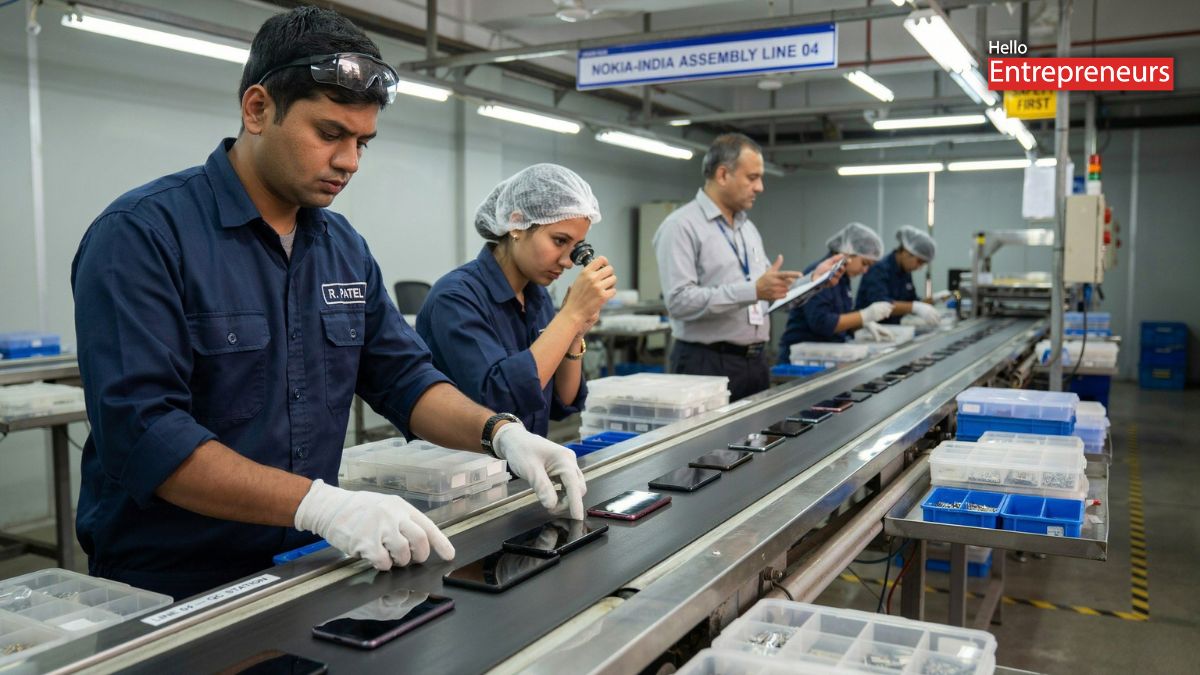
Since the launch of Make In India, India’s domestic electronics manufacturing sector has strengthened to a level where it now exports finished smartphones to leading global markets. Strengthened by the need to diversify supply chains, India’s mobile phone production output value has expanded from Rs.18,000 crore in FY2014-15 to Rs.5.45 lakh crore by FY2024-25, a 28 fold expansion.
Today, India has gone from an import dependent mobile market to one where almost 99% of all phones are made domestically, manufacturing 300 million smartphones and becoming the world’s second largest smartphone producer by volume. Today, India exports $24 billion worth of mobile phones, with brands like Samsung, Apple and others making India a manufacturing hub for their global operations.
Aatmanirbharta in Defence Production
India was amongst the world’s largest importers of military hardware until the government pushed for indigenous production under the Make in India scheme. Today, the defense-industrial ecosystem has been strengthened to a level where many necessary defence equipment, including armored vehicles, sensor platforms and weapons systems, are now made domestically.
The government has also increased the Foreign Direct Investment (FDI) cap to 74% from 26% earlier, while allowing advanced technology transfer to boost domestic production. This has allowed defence manufacturing to reach Rs.1,51,339 crore with the private sector being encouraged to participate in defence contracts, integrating them into the global supply chains of prime Western defence contractors and boosting Indian defence exports to record levels across aviation, artillery and maritime components.
Encouragement from the Production Linked Incentive (PLI) scheme
The Production Linked Incentive (PLI) introduced in 2020 has encouraged Original Equipment Manufacturers (OEMs) to set up manufacturing plants in the country, with the government committing to spend Rs.1.97 lakh crore for incentivizing this.
By December 2025, the program had approved 836 industrial plant applications, and has helped generate over than Rs.20.4 lakh crore in realised manufacturing production and sales. The policy has been effective for industries in the telecom infrastructure, consumer electronics, pharmaceuticals and food processing industries to achieve economies of scale and boost exports.
Pharmaceuticals supply chain consolidation
Through the Make In India framework, the domestic pharmaceuticals sector is actively moving beyond its role as the ‘pharmacy of the world’. With encouragement from the PLI scheme, domestic manufacturers are now making their own Active Pharmaceutical Ingredients (APIs) themselves, cutting their reliance on China.
India now makes 70% of its APIs in-house, up from almost 70% which was imported earlier from China.
With India now having more than 3,000 US FDA-approved manufacturing plants, India’s manufacturing growth has expanded enough to sustain itself without worrying about supply chain disruptions.
Infrastructure Upgrades and Logistics Streamlining
India’s manufacturing sector suffered from a foundational bottleneck in the absence of an inefficient inland logistics network. This made exports expensive, to the equivalent of almost 14% of national GDP. To address this, the government fast-tracked the Dedicated Freight Corridors and enhanced highways and rail freight infrastructure to cut logistics costs. Unnecessary red tape was also eliminated with paperless customs clearance mechanisms, digital port integrations and automated container handling, to bring domestic logistics management closer to international benchmarks.
Automotive and Electric Mobility Systems Modernization
The Indian automotive manufacturing sector has worked to boost advanced technology development and manufacturing through the PLI scheme. It has localised production of traction motors, battery management controllers and electronic control units rather than relying on imported completely knocked down (CKD) kits to boost domestic automotive supply chains as the industry shifts towards electric vehicles. The PLI scheme and the demand side incentives under the Faster Adoption and Manufacturing of Electric Vehicles (FAME) initiative has also helped here, with domestic automakers working with global OEMs to localise advanced technologies.
Negative Developments
Stagnant Manufacturing Share of National Economic Output
The government hoped to boost manufacturing capacity from 16% of GDP in 2014 to 25% in 2022, a target that was extended to 2025. However, this hasn’t happened, with the total manufacturing gross value added has remained roughly at 14-17% of GDP, remaining essentially flat to its 2014 baseline. Though manufacturing output grew, it did not grow in the proportion expected, leaving India’s economic output relatively unchanged.
Acknowledging this shortfall, the NITI Aayog has now deferred the target to 2035, a 13 year delay from the original timeline.
Missed employment targets
Though the Make In India initiative aimed to create mass employment, it feel substantially short of its targets. Over the decade between 2014-2024, the manufacturing sector added up to 40 million jobs, though most of them remained low productivity, informal or contractural arrangements without social security benefits.
The PLI framework aimed to generate about 14.4 lakh direct and indirect formal jobs across 14 sectors up to December 2025. Because modern advanced manufacturing relies heavily on automated assembly lines, robotic surface mounting, and automated logistics systems, the demand for low productivity labour remains low, with manufacturers prioritizing highly efficient technology over manual labour.
Persistent Import Dependencies and Low Domestic Value Addition
Despite the rapid scale up in manufacturing, domestic value addition remains an industrial challenge. In the consumer electronics sector, the domestic value addition of assembled smartphones hovers between 18% and 25%, with the remaining 75% to 82% of component value consisting of imported sub-assemblies. Though Apple’s decision to move manufacturing to India made India the second largest smartphone exporter, it mostly meant assembling smartphones, a low productivity job compared to manufacturing advanced sub assemblies.
High-value components—including semiconductor processors, memory arrays, display panels, multi-layer printed circuit board substrates, and camera modules—are still being imported, with the value addition to the final product remaining low.
Uneven Implementation of the PLI Framework
While the PLI framework delivered notable results in electronics and pharmaceuticals, its execution across other sectors remains uneven. Out of the total Rs. 1.97 lakh crore for incentive disbursements, nearly 70% have come from these two sectors, with the government spending about Rs.28,748 crore or about 14.6% of the total.
The textile and garment, Advanced Battery Storage have been amongst those sectors that haven’t met the production capacity, mostly due to technological execution bottlenechsk and restrictive eligibility thresholds. Also the delay to meet strict Advanced Automotive Technology (AAT) compliance certifications has also played a role, especially for the automobile and auto components sector.
Red Tape adding to compliance costs
While India has made strong progress in the Ease of Doing Business rankings, the reality remains far different across states. Industrial land acquisition remains a common source of project delays, with opaque local registration processes and red tape affecting the ease of doing business.
The average compliance cost for an operational MSME ranges between Rs.13-17 lakh annually, with overlapping environmental clearances, municipal approvals and red tape delaying the set up.
Domestic Research Underinvestment, Skilled Labor Shortages, and External Trade Competition
The lack of domestic research and development (R&D) expenditure in India, which is just under 0.70% of GDP has been a challenge in strengthening India’s role in the international supply chain. The private sector contributes less than 40% of this total spend, with the majority of manufacturing enterprises prioritizing build to print contracting as against developing its own intellectual property.
Beyond that, a workforce skills gap has also worsened the situation, with high technology manufacturers facing shortages of skilled automation technicians, precision tooling engineers and quality controllers.
Along with that, India faces competition from Vietnam and Mexico in particular in the ‘China+1’ initiative where these countries offer better gains than Make In India with Vietnam’s proximity to China’s manufacturing base and Mexico’s proximity to the US being their biggest strengths.

