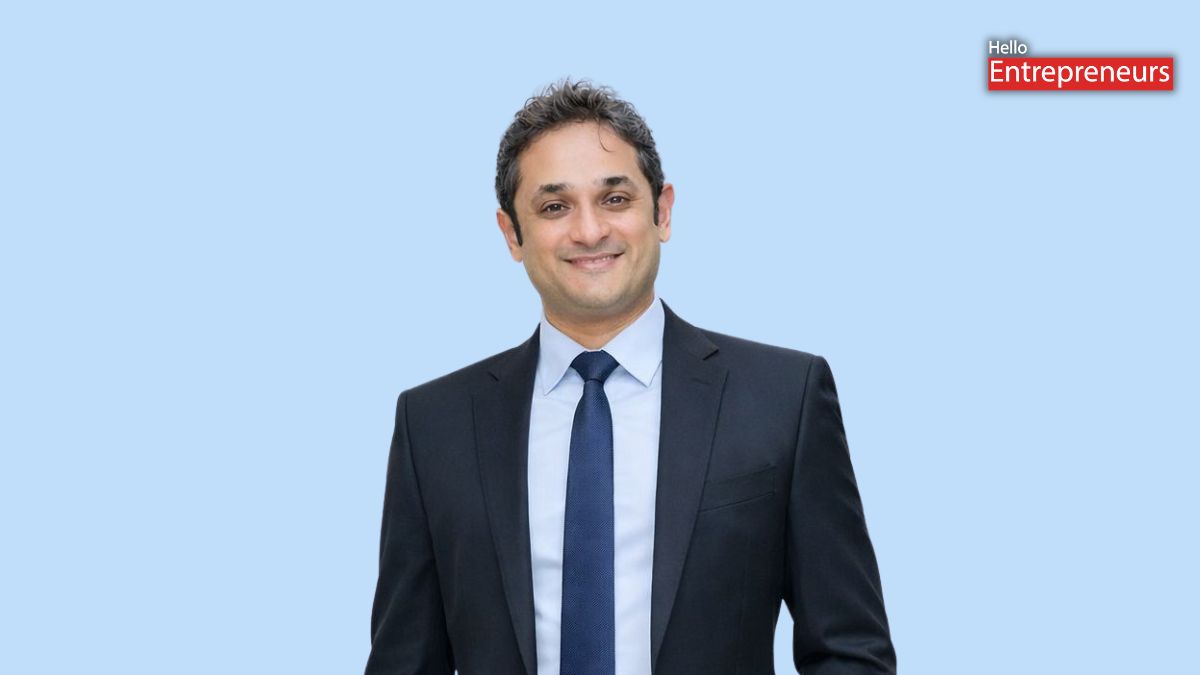








India’s defence manufacturing sector has been quite buoyant given the emphasis on Aatmanirbharta in defence production. For Ankur Shah, the Managing Director of Krishna Defence and Allied Industries Limited (KDAIL), this represents a strong growth opportunity, though meeting stringent expectations and specifications while dealing with long procurement cycles remains a constant challenge.
“The biggest adjustment has been learning to balance patience with decisiveness,” Shah explains. “In defence, a commercial discussion can involve detailed qualification, testing, and evolving specifications before it translates into an order. Short-term signals do not always reflect long-term opportunity. I have therefore focused on building capabilities that remain valuable across programs, rather than making decisions only around immediate order visibility.”
For Shah, this approach came early in his career.
“Our approach to business has been shaped by a strong foundation in manufacturing systems and engineering,” he notes. “Earlier experience at Godrej & Boyce provided valuable exposure to process discipline, quality, and operational efficiency.”
As KDAIL evolved, Shah recognized that deep competencies in metallurgy, special-grade steels, and precision engineering can support far more sophisticated applications than basic fabrication. Today, the company operates over 1,00,000 square feet of dedicated defence manufacturing infrastructure at Halol, Gujarat, complemented by an advanced electronics manufacturing and testing facility in Bengaluru.
Moving Up the Value Chain
Under Shah’s leadership, KDAIL has steadily moved beyond traditional build-to-print component supply, transitioning into a full-spectrum solutions provider.
“Our relationship with customers increasingly begins with understanding the operational requirement rather than simply the manufacturing specification,” says Shah. “Defence products need to deliver reliability, consistency, and performance in demanding environments, often over long lifecycles. This has encouraged us to improve our design, development, testing, and quality assurance skills in addition to our manufacturing skills.”
Rather than pursuing contracts solely for top-line expansion, Shah maintains a strict filter on capital deployment and project selection.
“We evaluate opportunities on their strategic relevance rather than looking only at immediate revenue potential,” he says. “We consider whether an opportunity strengthens our technology capabilities, builds intellectual property, creates repeat or lifecycle demand, or allows us to move higher in the value chain.”
This strategy is reflected in KDAIL’s corporate investments and joint ventures. The company has acquired a 20% stake in Conceptia Software Technologies, bringing specialized marine and offshore engineering expertise directly into its fold. Along with that, KDAIL has forged a joint venture with Planys Technologies and Conceptia to engineer Autonomous Underwater Vehicles (AUVs)—a critical technology for modern naval warfare and unmanned underwater systems.
“First may not always be the priority when reliability and performance are essential,” Shah explains regarding innovation. “We assess innovation based on whether it solves a problem, enhances performance, minimizes reliance on imports, and develops a capability that can be applied to future programmes. This is why our emphasis on indigenization is well in sync with the overall vision of ‘Make in India’ and ‘Atmanirbhar Bharat’.”
People, Precision, and Public Markets
Behind the heavy machinery and advanced metallurgy lies a highly specialized human element. In an industry where tolerances are measured in microns and failures are not an option, workforce competence is an indispensable moat.
“One of the biggest challenges is building talent that is not only soundly grounded in engineering fundamentals but also understands defence-related applications,” Shah observes. “Manufacturing of defence products calls for special expertise in metallurgy, design, automation, quality engineering, and system engineering, with a special emphasis on reliability and compliance.” KDAIL tackles this gap through active continuous training and immersion across its 193-strong workforce, which includes 28 dedicated engineers across its Halol and Bengaluru sites.
As the head of a publicly listed entity, Shah balances long gestation programs with investor accountability. “We are more focused on transparency, disciplined capital allocation, and long-term value creation now that we are a publicly traded company,” he remarks. “When we make things for the military, we have to think about the long term, especially since buying timelines can affect when orders are fulfilled and when revenue is recognized. Our plan is to strike a balance between short-term tasks and investments that build the skills we’ll need for future growth.”
The results of this discipline are visible on the order book, which stood at ₹268.6 crore as of March 31, 2025.
The Road Ahead
With the government encouraging private participation in India’s defence ecosystem, Shah is convinced that the opportunity will belong to those who build genuine in-house muscle rather than those merely riding sectoral tailwinds.
“We believe enduring defence businesses will be built by companies that invest in capabilities, quality, and technology rather than simply respond to the current sectoral opportunity,” Shah concludes. “Over the next five to ten years, we want KDAIL to be recognised for building strong, globally relevant capabilities from India and for consistently delivering on complex requirements. Beyond this, the entrepreneurial opportunities that interest us are those where engineering, technology, and manufacturing can come together to solve meaningful problems.The larger objective is to build businesses that create lasting value rather than pursue short-term opportunities.”