



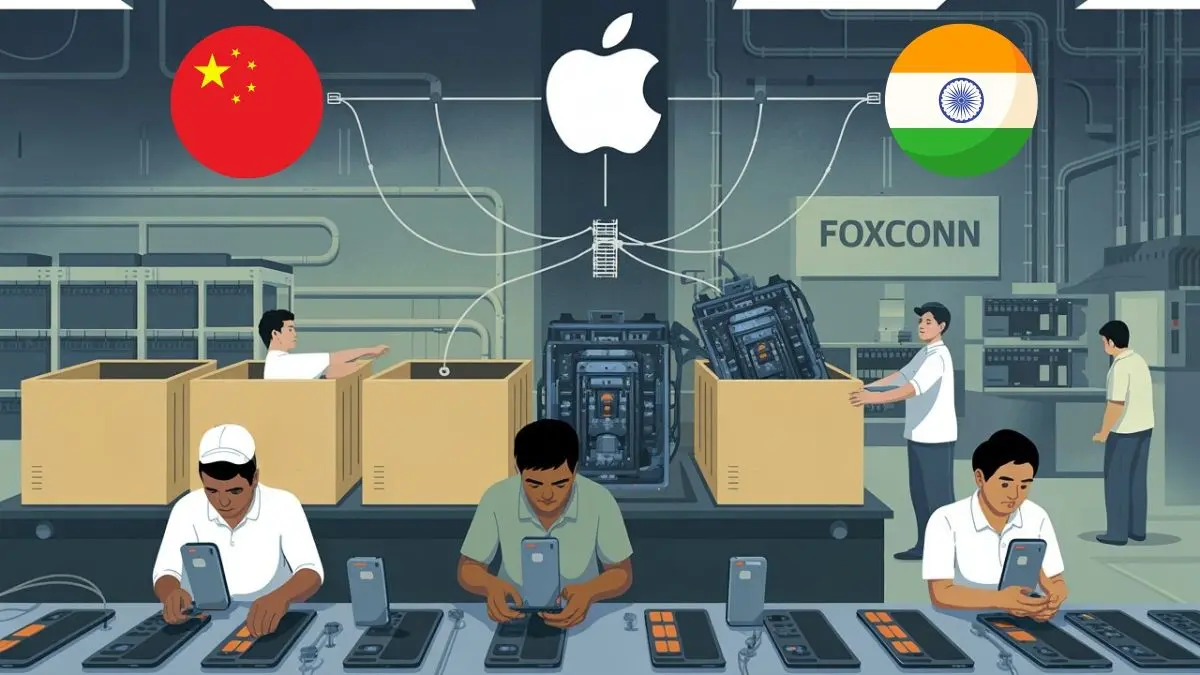
Taiwanese contract manufacturer Foxconn has had to recall hundreds of its Chinese employees from its India operations after the Chinese authorities allegedly indulged in pressure tactics to hamper Foxconn’s India operations, according to various news reports.
Foxconn assembles the iPhone 16 in India, although most of the equipment and high-end expertise needed to do so come from China. Indian engineers aren’t skilled enough to handle these, and Foxconn had brought in these Chinese employees to aid its India operations.
Though Apple and the government have downplayed the development, the reality is far more concerning. India may have become the ‘world’s second largest smartphone exporter’ but we’re merely a hedge for Foxxcon against the US and China’s geopolitical tensions.
Why China is firmly entrenched in the smartphone ecosystem
China has developed, and still remains, the preferred destination for manufacturing and assembling high-end electronics and smartphones, mostly due to its highly skilled workforce and the entire equipment manufacturing ecosystem that it has built over the decades.
In Foxconn’s India operations, most of the almost 40,000 employees are assembling iPhones from components imported from China, or by component makers who have themselves set up shop in the vicinity of Foxconn’s factories in Tamil Nadu, Karnataka and Andhra Pradesh.
With their help, Foxconn has manufactured phones worth $49 billion and a cumulative average of 66.5 million phones. Currently, almost 20% of all iPhones shipped worldwide originate from India.
What drove Foxconn to India?
Assembling phones is a labour-intensive process, and setting up its operations in China made sense due to abundant skilled labour, a maturing and reliable components ecosystem and strong state support. Apple was happy with everything Foxconn was doing, but the geopolitical tensions between China and the US changed all of that. Apple and Foxconn were forced to adapt to a ‘China + 1’ strategy, where an increasingly larger portion of the manufacturing process is moved to India and Southeast Asia.
India had to go to great lengths to woo Foxconn, just as China did decades ago. The company secured acres of land at throwaway prices. The government then imposed tariffs on imported phones and eased its sourcing rules to attract Foxconn to set up here.
Even though the results have shown since Foxconn set up in 2017, there are still many challenges that are yet to be addressed.
Production Ramp Up Challenges
“From 2016-23, iPhone’s production capacity in India grew to 15 million units from zero, accounting for 7% of all global shipments, in an earlier 8-year period between 2006-13, China ramped up production to 153 million units from zero. That means India can ramp up capacity at only 1/10th of the capacity of China from an earlier period.” Former Financial Times journalist Patrick McGee explained in his book, Apple in China- The capture of the world’s greatest company.
Challenges with component supplies
The bigger problem here is that all operations here depend on a steady supply of components from China, and any kind of disruption there could hamper the entire production capacity here, even though Foxconn and Apple are encouraging their component makers to set up shop in India.
During the Covid pandemic, Apple couldn’t sustain its shipping targets due to China’s strictly enforced factory closures, giving them another reason to diversify its operations to India.
Even though India has become a smartphone exporter, it is still being seen as an alternative to China, as India has much better diplomatic relations with the West than China. India has a lot of catching up to do and it needs years of efforts and investments in R&D to match the level of owning intellectual assets, and not just labour-intensive work that can be automated as required.

