



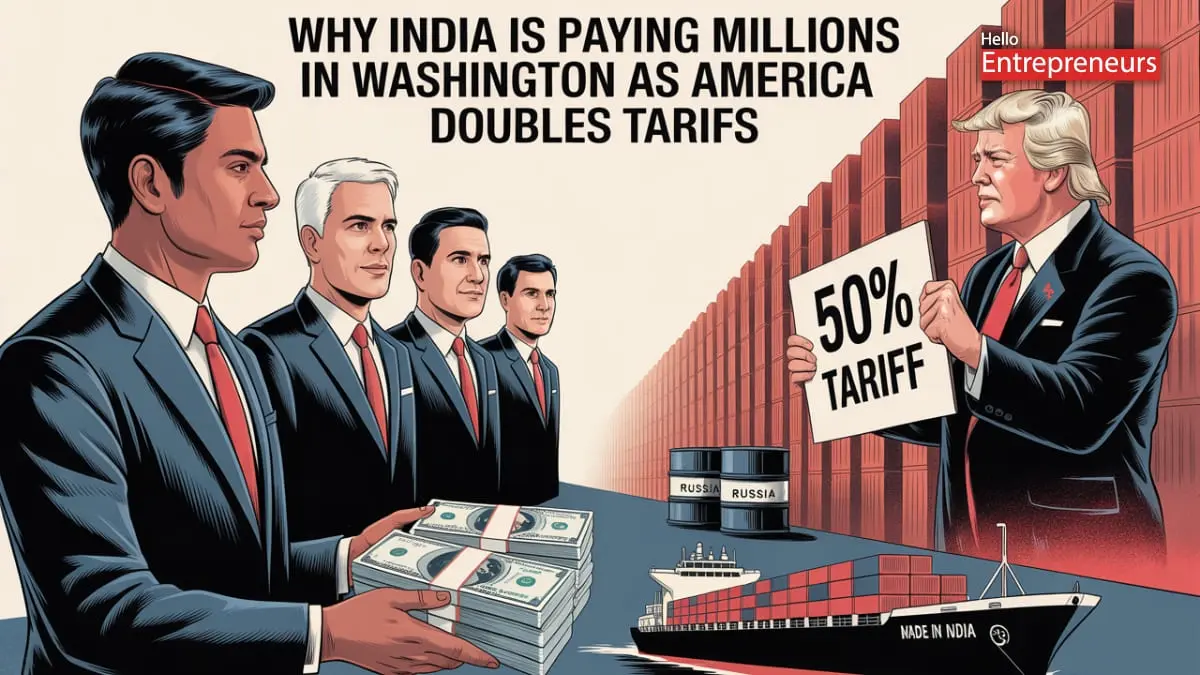
New Delhi: India recently made headlines by hiring a second American lobbying firm just days before the United States announced a tough new 50% tariff on Indian exports. According to sources, the Embassy of India signed a three-month contract with Mercury Public Affairs, paying a monthly retainer of $75,000 starting from August 15. Mercury has some prominent partners like David Vitter, a former Louisiana Republican Senator, and Bryan Lanza, who worked closely with the Trump administration as a communications director. Their team for India even includes Kevin Thomas, noted for being the first Indian-American elected to the New York State Senate.
This move unfolds against the backdrop of President Trump doubling tariffs on Indian goods, with the hike reaching a massive 50%, including an extra 25% duty on Indian purchases of Russian oil, which starts on August 27. India has stuck to its stance that its crude oil procurement from Russia is based on national interest and market economics, especially since Western sanctions on Moscow led to discounted Russian oil in the global market.
Interestingly, it’s not uncommon for countries to engage several lobbying firms in Washington. Some nations employ up to six agencies, each handling a different role or angle. India recently drew criticism for allegedly being outmaneuvered by Pakistan in this diplomatic tug-of-war. Reportedly, Pakistan hired Keith Schiller’s firm, Schiller was formerly President Trump’s bodyguard, to get ahead of India in the US, while India’s earlier contract this year was with SHW Partners LLC, led by former Trump aide Jason Miller; this deal is estimated at $1.8 million for the year (around $150,000 per month).
The hiring of Mercury came soon after comments in the media suggesting New Delhi wasn’t matching Pakistan’s lobbying efforts. Pakistan, according to a recent report, has roped in as many as seven firms in the US to promote its interests. These agencies specialize in building connections within D.C., arranging meetings, and influencing policies on Capitol Hill. In fact, a report points out that nearly 30 countries have recently updated or expanded their roster of lobbyists just to keep pace with the changing White House administration.
Mercury’s connections in US politics run deep. Susie Wiles, Trump’s Chief of Staff, was associated with Mercury as a registered lobbyist until November 2024. Bryan Lanza, part of Mercury’s India team, played important roles in Trump’s 2016 campaign and assisted notable Republicans like J.D. Vance. With lobbying often shaping trade and diplomatic outcomes, both India and Pakistan seem keen to have experienced operatives working for them, especially with tough decisions looming over tariffs and oil purchases.
India’s energy decisions have faced criticism, but foreign policy experts argue that importing Russian oil at discounted rates fits India’s strategic needs amid global pressure. This pragmatic approach, however, has triggered friction in India-US relations and prompted Washington’s tariff response. Both nations are now relying on skilled lobbyists to smoothen the rocky path and resolve disputes.
It’s also notable that major global players frequently switch or add lobbying firms to adapt to evolving geopolitical dynamics. The US capital is always buzzing with activity when trade policy changes are announced, and countries often feel the need to bolster their presence. For instance, Pakistan’s decision to bring in seven separate lobbyists signals a big push to safeguard its interests. India’s response, hiring two major firms within months, shows a determination to ensure its voice is heard as well.
Each country tries to get the best players (lobbyists) and coaches just before the big game, hoping their team can swing the result their way. For India, the game means not just defending its trade, but also standing firm about its right to choose where it buys oil from, even if that’s Russia. Sometimes, countries have to pay a lot (like millions of dollars!) for experts who understand America’s rules and can help with the tricky business of trade and diplomacy.

