



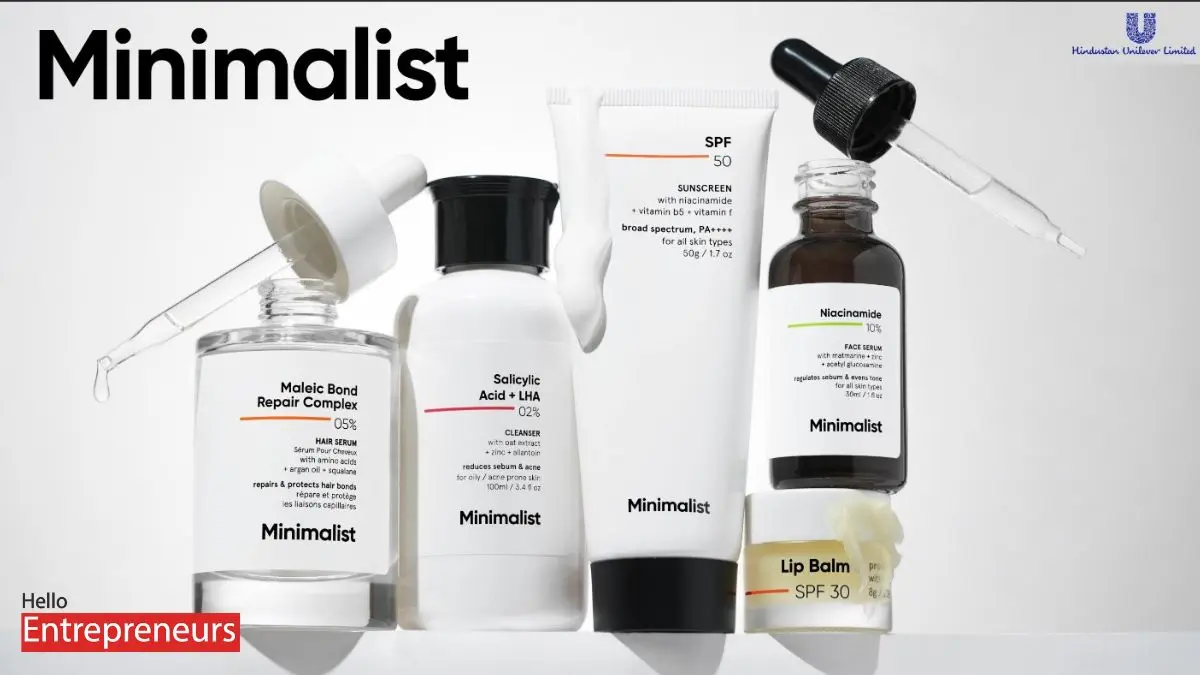
In May 2025, Hindustan Unilever Limited (HUL) has made a shocking headline by acquiring skincare startup Minimalist for ₹3,000 crore in an all-cash deal, marking the largest direct-to-consumer (D2C) exit in Indian history. This Minimalist was founded by two brothers which was founded in 2020 by Rahul Yadav and Mohit Yadav, these two brothers from Jaipur, Minimalist disrupted the Indian beauty industry with their transparent, science-backed skincare products that stood in stark contrast to the marketing-heavy, “natural and organic” claims of legacy brands. The deal not only hurdle for the founders into the spotlight, with an estimated ₹1,700 crore payout, thanks to their 60% of equity, but also signaled a transformative shift in how beauty brands can be built and scaled from Tier 2 India these startups is only prove that beauty brand startup can also make much more payout from consumers in the name of skincare.
What makes Minimalist’s story remarkable?
Unlike most of the startups born in India’s metro cities, Minimalist was built entirely out of Jaipur, employing over 600 people locally. Firstly, these Yadav brothers initially started with a custom haircare brand called Freewill in 2018, but after realizing that personalized beauty products were hard to scale, and after this these two brothers decided to make their entry into skincare. Drawing inspiration from The Ordinary, a Canadian skincare brand known for its ingredient-first approach, after these Canadian skincare brand they decided to launch Minimalist during the pandemic time with a simple Instagram post and just 1,000 bottles of face serum. Without any influencer campaigns or paid promotions, those 1,000 bottles are been sold out in just 3 days, they have just sell these product by recording videos in front camera and provide the details of the product and by providing some of the details through Instagram post.
Minimalist has been rejected by the traditional marketing playbooks. Instead of celebrity endorsements or exaggerated claims, it relied on real customers to spread the word. While most of the D2C brands spend up to 50% of their revenue on marketing for their product to spread on internet widely by this they wanted to spread their identity to the consumers, Minimalist kept this at just 25%, thanks to a 60% repeat purchase rate, which is nearly 3x the industry average.
This allowed the brand to reach ₹100 crore in revenue in just 8 months, which was far faster than peers like Mamaearth. The company’s Return on Ad Spend (ROAS) stood at 4x, outperforming most of the competitors in the space. More importantly, Minimalist achieved this growth with just 66 products which was launched by them in their official page and website, keeping its inventory tight and focused, unlike other brands that flooded the market with hundreds of SKUs.
A key factor in their success was owning their manufacturing infrastructure. While most of the brands for outsourcing production to cut costs, Minimalist invested in house facilities to ensure high product quality, strict R&D, and transparency. This decision led to slightly lower profit margins, around 3% in FY24 compared to 20% in FY21, but it built strong customer loyalty with them. Their Cost of Goods Sold (COGS) was around 35%, higher than the brands like Mamaearth or Sugar Cosmetics, but the trade-off allowed them to maintain quality and control, but they focus on the strategy like the Tesla does: spend less on ads, more on innovation.
Initially, Minimalist remains a digital-first brand, with 90% of sales coming online from their official website and on the social media pages. This was strategic, selling online allowed for better customer education and guidance, critical for science-based products. Entering offline markets prematurely would have risked misinformed purchases and bad experiences. However, to scale beyond ₹500 crore and compete with the likes of Unilever, Nestlé, or ITC, offline distribution was essential. That’s where HUL stepped in. With access to over 9 million retail outlets across India, HUL offers Minimalist the infrastructure it needs to become a mass-market brand while maintaining its premium positioning in the skincare market in India.
There’s another reason the acquisition came at the right time was the entry of The Ordinary into India in 2022 via Nykaa and Estée Lauder. While Minimalist once dominated the niche of science-based skincare, competition from a global leader made it necessary to partner with a giant like HUL to continue innovating and defending market share. This move not only strengthens Minimalist’s offline ambitions but also arms it with deeper financial and R&D muscle.
This acquisition is not just a win for the founders but it was an prove that the validation of India’s growing D2C sector and consumer maturity. It demonstrates that a brand built on transparency, quality, and education, without any celebrity hype or heavy ad spend, can scale rapidly and challenge incumbents. The deal will likely encourage other founders across Tier 2 and Tier 3 India to think bigger, and the Yadav brothers also prove that anyone doesn’t need to be based in Mumbai or Bengaluru to build a ₹3,000 crore brand, they just wanted have an perfect strategy to build an huge amount of brand in India, just needed to have perfect marketing strategy for the growth.

