



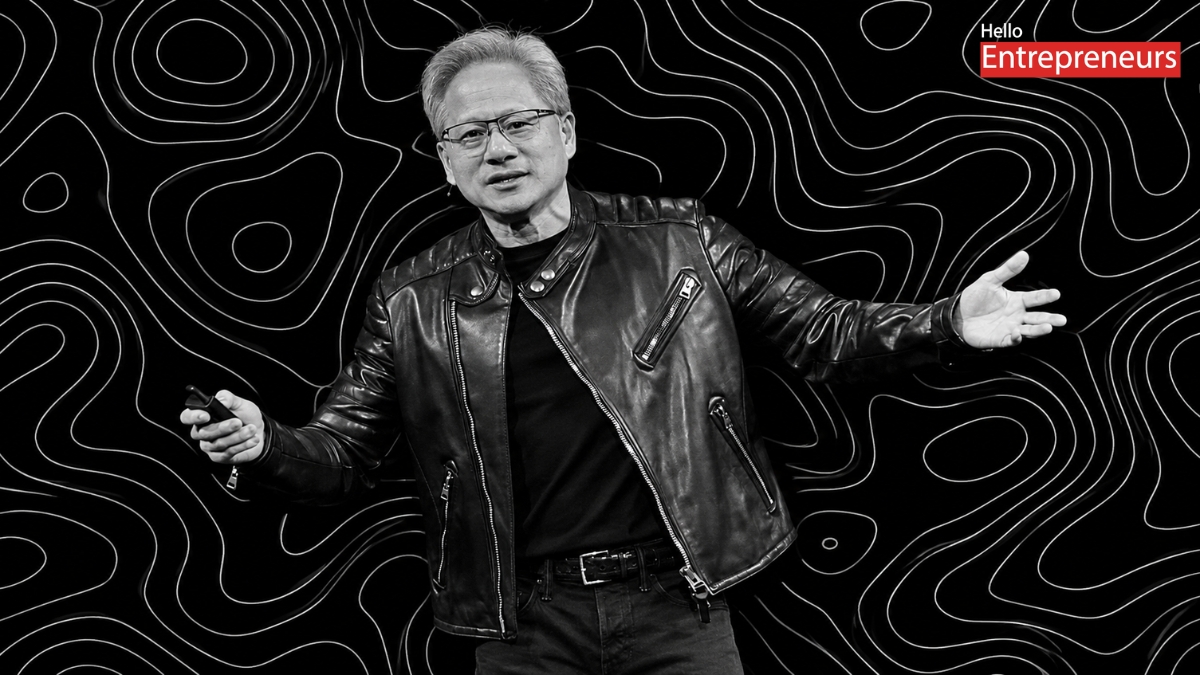
New Delhi: Nvidia is facing its biggest management challenge in 30 years. According to recent reports, Jensen Huang had a second alleged affair, with the company’s vice president of healthcare, Kimberly Powell, who reports to him. Nvidia, Huang and Powell haven’t vouchsafed the claims. Huang admitted to another relationship in the report days later. In a letter to staff on Sunday he acknowledged that he had had an affair and the board subsequently stated that it was to be investigated by a third party as to whether he had been the victim of a foreign intelligence operation.
A company built around one person
The big question is: to what extent does Nvidia rely on one leader? More than 30 years ago, Huang co-founded the company and has a handful of 60 executives reporting straight to him. Such a structure has enabled Nvidia to move quickly, and it does little to allow for a fall-back. The company has no obvious succession plan for its replacements, wrote Axios. A founder’s company of this size has, “frequently” no real succession process, said one of the investors there.
The gaps do not seem to be ‘jumps’. Huang refused to consider succession planning because he didn’t like the idea of having executives competing against each other, Arm CEO Rene Haas told The New York Times.
Who could take over?
There has been a lot of speculation about a short list. There have been a number of names that have been mentioned, including Chief Financial Officer Colette Kress, and co-founder Chris Malachowsky. An investor relations man said Kress was a natural interim pick to lead the company but the bigger question was who would be in charge of the tech vision going forward at Nvidia. Kress has worked the financial side her entire career, and is not necessarily a natural successor as a technical visionary to Huang, analysts note.
Huang’s predilection is inward looking. He said that he wishes he hopes that the next CEO is already at the company. He has also been quoted as saying that one of his children would like him to be succeeded by Nvidia one day, but no plans for the succession have been made public.
The board under scrutiny
The crisis also calls into question the independence of the board. There are 11 directors at Nvidia, with all of them being independent of Huang. Critics are not convinced. Experts say since Huang has been in power since 1993, it is likely that directors may be too close to judge him, Fortune reported. A professor of business ethics at Georgetown said the lack of a succession plan “shows the board [was] asleep at the wheel.”
The board’s attitude has been fast changing. It issued statements on Sunday ruling Huang and his staff to be confident, but on Wednesday, the Wall Street Journal reported it was readying to remove Huang. Nvidia’s bylaws give a majority of its directors the capacity to oust him “with or without cause.” That aligns with a sentiment some experts have for the board to stick with him on a more limited basis. This may involve designating a trustworthy second-in-command, as well as changing seats on the board.
The China question
This affair is not the only concern at stake. The problem with the intelligence angle is that it might be more destructive. Huang’s alleged relationship with Alice Huang, a Chinese executive at Megaspeed, a Singapore business that provides data centers and buys Nvidia’s AI chips, seems to contravene Nvidia’s code of conduct, said governance experts. According to the Financial Times and The New York Times, she is believed to work for China’s Minister of State Security (MSS), an intelligence agency. According to the Financial Times and The New York Times, she is thought to be working for the Chinese Ministry of State Security (MSS), which is an intelligence agency.
Political repercussions are gathering. Legislators have started to seek more restrictive chip export restrictions to China. While a personal scandal may die with the person involved, an investigation into the diversion of the chips and espionage may result in regulatory repercussions for a longer time.
Investor confidence and the wider industry
The markets have responded with strong reactions. The second report made Nvidia decline 8.3% in after-hours trading on Wednesday. With those losses assumed, the company will still have lost about $600 billion in market value since the board’s investigation announcement. There are investors who are waiting for a sell. Founder ETFs that are invested in the founder-led firms will sell Nvidia if Huang walks out.
The impact might spread beyond Nvidia. The ouster announcement “pushed investors to other stocks like Broadcom and AMD,” said one report. The chip giant Nvidia is behind much of the AI boom, and its leadership and trajectory would impact customers and competitors. On the engineering side there is some reassurance. Huang oversees several high-level technologists, so there would probably be no disruption in chip development.
What comes next
Huang’s fate was up for discussion late Wednesday at the board meeting. The episode has raised a question that Nvidia has never had to face: what if the billion-dollar, trillions-pound company had no founder remaining? The response will impact investor, regulatory and competitor perceptions of the company.

