



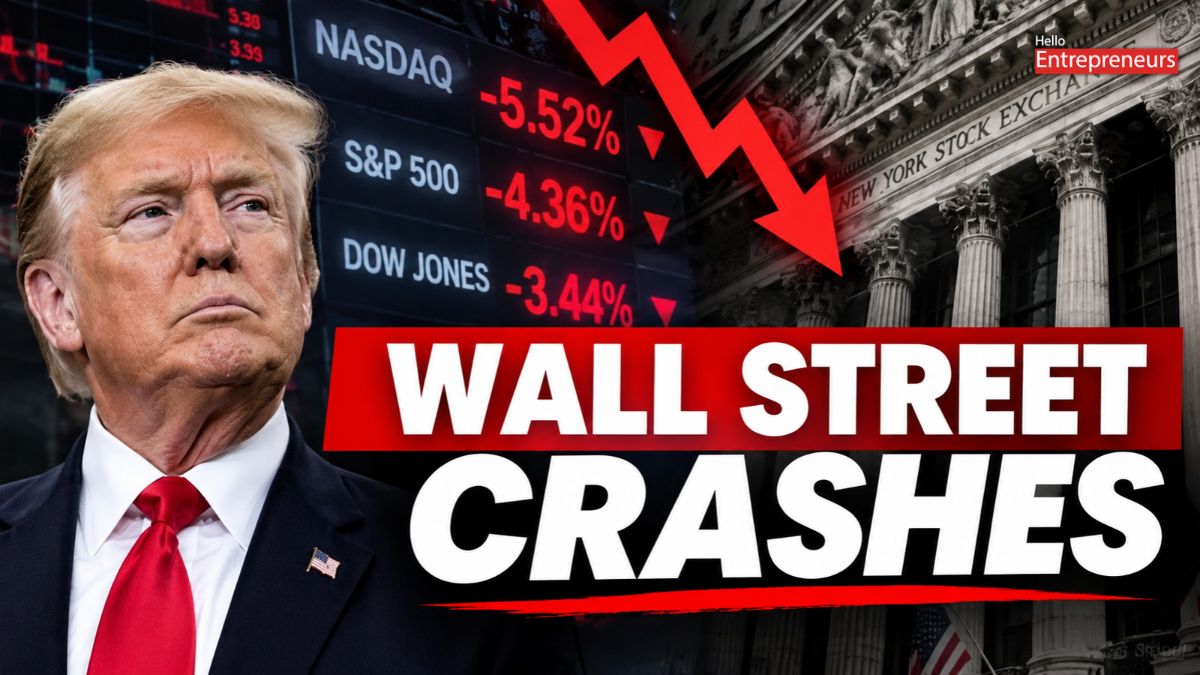
New York: Wall Street witnessed a massive sell-off on Thursday, November 5, 2026, as technology stocks came under heavy selling pressure, wiping out approximately $2.5 trillion in market value from Nasdaq-listed companies in a single trading session. The Nasdaq Composite plunged 5.52%, marking its worst single-day performance in 18 months, while the Dow Jones Industrial Average and S&P 500 also recorded significant losses.
The sharp decline came just a day after US markets rallied following the Democratic Party’s strong performance in the November 3 midterm elections. However, investors quickly shifted their focus towards the possible impact of changing political leadership on artificial intelligence (AI) investments, data centre expansion and technology regulations.
Nasdaq Leads Wall Street’s Market Decline
The technology-heavy Nasdaq Composite closed at 24,315 points, falling 5.52% during Thursday’s trading session. The S&P 500 declined 4.36% to close at 7,353.73, recording its steepest single-day fall since April 2025.
Meanwhile, the Dow Jones Industrial Average dropped 1,833 points, or 3.44%, to settle at 51,523.06. The decline also wiped out the index’s previous day’s gains, when it had surged approximately 1,569 points following the election results.
According to market reports, the sell-off particularly affected semiconductor manufacturers, software companies and businesses associated with AI infrastructure. The combined market value of the seven largest technology companies, commonly known as the Magnificent Seven, also declined by approximately $1.04 trillion.
Nvidia alone lost around $374 billion in market capitalisation. Shares of Tesla and Microsoft also witnessed substantial declines, losing approximately $161 billion and $117 billion in market value, respectively.
Why Did the US Stock Market Crash?
One of the major reasons behind the market decline was growing uncertainty surrounding the future of AI investments in the United States.
Over the past few years, technology companies have committed hundreds of billions of dollars towards building data centres, purchasing advanced semiconductor chips and expanding computing infrastructure to support generative AI and other emerging technologies.
However, investors are increasingly questioning whether these enormous investments will generate sufficient returns. Concerns over rising infrastructure costs, borrowing expenses and the profitability of AI businesses have started affecting technology stock valuations.
Political developments have added another layer of uncertainty. Following the Democratic Party’s victories in the midterm elections, investors began assessing whether the incoming political leadership could introduce stricter regulations on data centre construction and AI infrastructure development.
Several communities and local authorities in the US have also raised concerns about the electricity consumption, water requirements and environmental impact of large-scale data centres.
This has created uncertainty for companies that depend on the continued expansion of AI infrastructure.
Trump Blames Democrats for Market Crash
US President Donald Trump blamed the Democratic Party’s election victories for Thursday’s stock market decline.
In a post on his Truth Social platform, Trump wrote, “The Stock Market crashed today because the Dumocrats had a big Tuesday.”
He also warned that Americans’ retirement savings, particularly investments held through 401(k) accounts, had been affected by the market decline.
However, market analysts have pointed towards broader concerns surrounding technology stock valuations, AI spending and regulatory uncertainty rather than attributing the entire decline to the election results.
What Lies Ahead for Global Markets?
The Wall Street sell-off could have implications beyond the United States, particularly for international investors exposed to technology stocks and global equity markets.
Asian markets also came under pressure as concerns surrounding AI investments spread across global financial markets.
Investors will now closely monitor upcoming US inflation data, Federal Reserve interest rate expectations and corporate earnings to assess whether technology companies can justify their substantial AI infrastructure investments.
For now, the sharp correction highlights a growing concern among investors: while artificial intelligence continues to attract enormous investments, the market is increasingly demanding clearer evidence of profitability and sustainable business returns.
Tags: Wall Street, Nasdaq, Dow Jones, S&P 500, Donald Trump, US Stock Market, Artificial Intelligence, AI Investments, Global Markets, Technology Stocks.

