



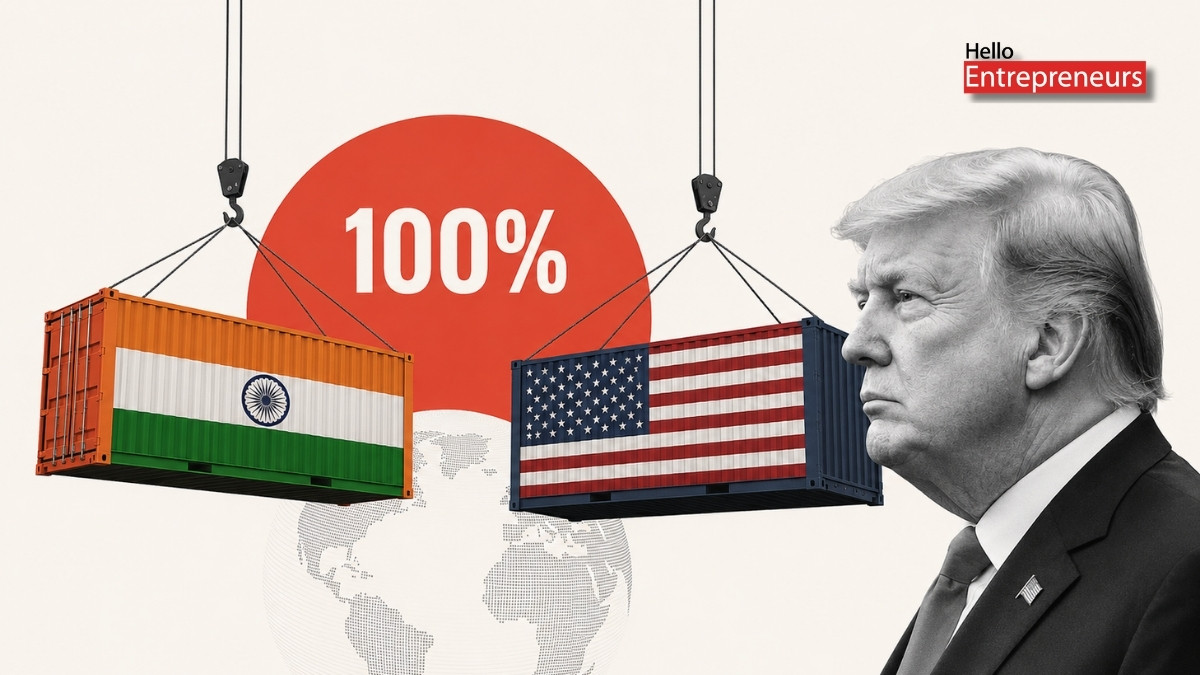
New Delhi: For Indian exporters, the latest US trade development comes at an interesting time. The country has just recorded its highest-ever annual exports, while companies are also finding more markets outside their traditional destinations.
That makes the latest US tariff risk less about one market alone and more about how Indian businesses manage their global customer base.
The US Senate on Friday passed a Russia sanctions bill by an 86-11 vote that could allow the US President to impose tariffs of up to 100% on countries that continue to buy significant amounts of Russian oil and gas. India is among the countries that could potentially be affected. However, the measure is not an automatic tariff, and the legislation still has to move through the US House of Representatives.
For exporters, that distinction matters. The immediate question is not whether a 100% tariff has arrived, but how companies prepare when access to a major market becomes less predictable.
India’s export base is getting wider
India enters this situation with a much larger export base than before.
The country recorded $863.1 billion in total exports in FY2025-26, the highest ever. Merchandise exports stood at $441.8 billion, while services exports reached $421.3 billion.
The latest numbers also show that India’s export growth is not coming from just one region.
North America remained India’s largest merchandise export region in FY26, with exports of $97.7 billion, accounting for 22.1% of merchandise exports. But exports to Northeast Asia jumped 21.6% to $41.6 billion, while Latin America recorded 7.8% growth to $16.4 billion. Together, North America, Northeast Asia and Latin America accounted for more than 35% of India’s merchandise exports.
That wider spread could become increasingly important for businesses if trade conditions in one major market change.
The US is still a major market
None of this means Indian companies can easily replace the US market.
The US remains India’s biggest export destination. Government trade data shows that India exported about $92.3 billion of goods to the US in calendar 2025, giving the country a 20.74% share of India’s merchandise exports.
Even in June 2026, India exported $8.17 billion of merchandise to the US, although that was down 1.21% from $8.27 billion a year earlier.
So for many exporters, the US cannot simply be replaced overnight.
This is particularly relevant for sectors such as engineering goods, electronics, pharmaceuticals, textiles, marine products and gems and jewellery, where American buyers are an important part of the customer base.
Where can exporters look next?
The good news for businesses is that new markets are already becoming more important.
India’s merchandise exports in April-June 2026 rose 15.92% to $129.32 billion, while total exports of goods and services increased 11.37% to $232.73 billion. Engineering goods exports alone rose 20.74% in June to $11.48 billion, while electronic goods exports increased 18.93% to $4.93 billion.
India’s recent trade agreements also give exporters more options. The India-UAE CEPA generated $37.36 billion of merchandise exports in FY26, while the India-UK CETA came into effect in July 2026. The new India-Oman CEPA also provides duty-free access for 99.38% of India’s exports to Oman by value.
That gives companies a practical route to diversify sales rather than depend too heavily on one destination.
The bigger business question
For Indian exporters, the latest US development may therefore accelerate a strategy that is already taking shape: sell to more markets, build more customers and reduce dependence on any single destination.
That does not mean moving away from the US. It means making the US one important market among several.
For companies, diversification can take time. New buyers need to be found, certifications may differ, logistics need to be worked out and pricing has to remain competitive. But India’s recent export numbers suggest that businesses are already building a broader global footprint.
The 100% tariff provision is still a possibility, not a tariff currently imposed on Indian goods.
For exporters, then, the more useful question may not be “What happens if the US market becomes difficult?” It may be “How many other markets can an Indian company build before that happens?”
That could become one of the most important business stories to watch as India’s export economy enters its next phase.

