



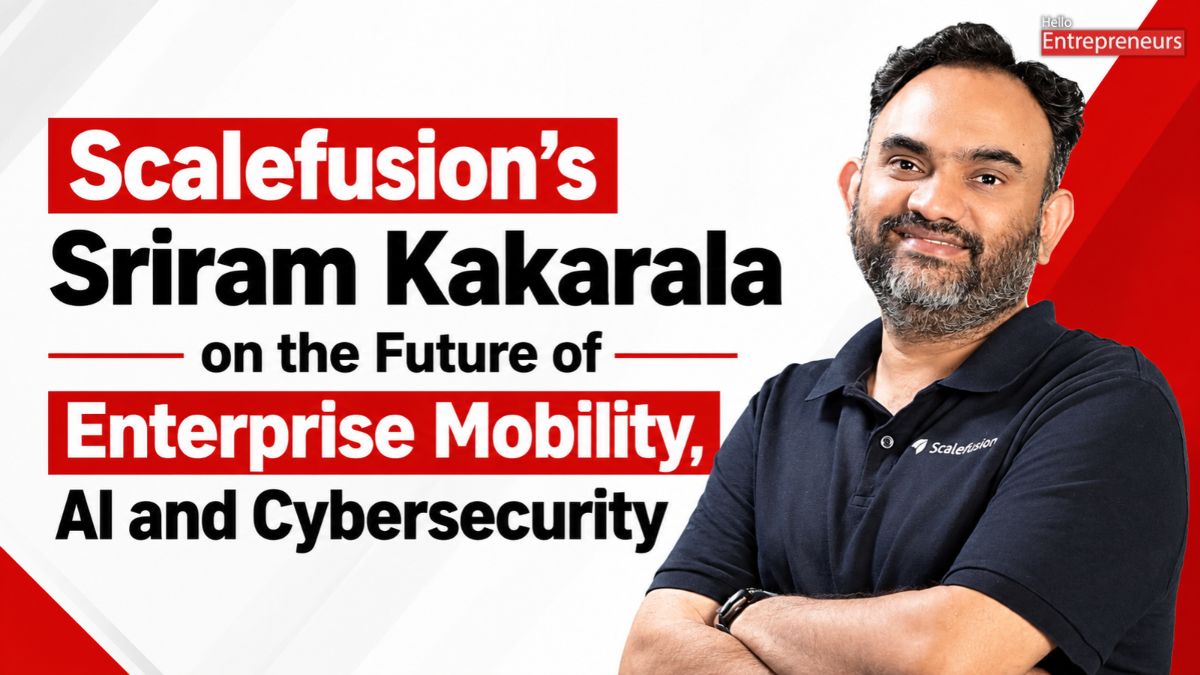
New Delhi: As businesses adopt cloud-based applications, remote working and AI-powered tools, managing and securing enterprise devices has become increasingly complex. For software companies operating in this space, the challenge is no longer limited to managing devices but also ensuring that users, applications and data remain secure.
Sriram Kakarala, Chief Product Officer (CPO) at Scalefusion, believes the next phase of enterprise technology will be shaped by integrated platforms that combine device management, identity, access and security.
In an interaction with Hello Entrepreneurs, Kakarala discussed how product development has evolved over the past two decades, the role of artificial intelligence in enterprise mobility and the challenges of building products for large organisations.
Reflecting on more than two decades of building enterprise products, Kakarala said the biggest shift has been in how product leaders define value. While the industry has evolved from mobile-first to cloud-native and now AI-first platforms, he believes the challenge today is no longer about what technology can make possible, but what is truly worth building for customers. According to him, successful product development is as much about restraint as ambition, with long-term customer value taking precedence over simply adding more features.
From device management to enterprise security
Founded in 2015 and headquartered in Pune, Scalefusion is a product of ProMobi Technologies. The company initially focused on mobile device management before expanding into unified endpoint management (UEM), zero-trust access and endpoint security.
According to the company, its platform is trusted by more than 12,000 businesses across over 120 countries. Its product portfolio includes Scalefusion UEM, OneIdP for secure identity and access management, and Veltar for endpoint security.
Kakarala said the expansion reflects the changing needs of enterprise IT teams. Device management, identity, access and security are increasingly interconnected, creating an opportunity to address them through an integrated platform rather than separate products.
The company’s broader vision is to account for device context when making access decisions and bring security capabilities into the same environment as device management.
Kakarala also believes that while new technologies generate excitement, product roadmaps should not be dictated by trends alone. Instead, he described industry trends as market signals that help identify evolving customer expectations, while product leaders must determine whether those expectations represent lasting customer needs or temporary market enthusiasm. According to him, balancing immediate customer requirements with long-term product strategy is one of the most important responsibilities of enterprise product leadership.
Looking ahead, he said he wants Scalefusion to help define how enterprises manage and secure their digital environments over the next decade by bringing together device management, identity, access and security into a single, integrated ecosystem rather than treating them as standalone solutions.
AI to make enterprise IT more proactive
Artificial intelligence is another area expected to influence enterprise mobility and security.
Kakarala said AI could help organisations identify threats earlier, prioritise issues and automate decisions that are currently handled manually.
However, he believes the real opportunity lies in redesigning processes rather than simply adding AI features to existing products.
For enterprise applications, reliability remains critical. AI-driven actions must be controlled, dependable and proportionate to the level of risk, particularly when they involve security-related decisions.
His comments come as enterprises increasingly explore AI to improve IT operations and strengthen visibility across devices and applications.
Beyond AI, Kakarala said product leadership also requires making difficult decisions about where to invest engineering resources. While teams may advocate for new capabilities, every feature carries an opportunity cost, and not every promising idea aligns with a product’s long-term direction. He said leadership involves listening to different perspectives, evaluating evidence and ultimately taking responsibility for decisions that best serve customers over time.
Why product simplicity remains important
Managing a large product development team also requires a clear understanding of customer needs, according to Kakarala.
He said Scalefusion has more than 150 product developers, engineers and product managers working across its teams. For him, the responsibility of a product leader is to ensure that employees understand the customer problem and the broader direction of the product.
He also highlighted the importance of balancing enterprise requirements with product simplicity.
While large organisations may require sophisticated capabilities, adding features without considering usability can make products difficult to manage.
Kakarala said the focus should be on solving complex problems without transferring that complexity to customers.
He also emphasised the importance of building teams capable of making sound decisions independently. Rather than encouraging employees to depend on constant approvals, he believes they should be empowered to challenge assumptions, understand the reasoning behind product decisions and take ownership of outcomes. According to him, the success of a leader is measured not by how often teams seek guidance, but by how confidently they can navigate complex decisions on their own.
Looking back on his own journey from engineering to becoming Chief Product Officer, Kakarala said one of the biggest lessons he learned was that finding the right solution is only part of effective product leadership. Equally important is ensuring that teams understand and support the reasoning behind those decisions.

