



New Delhi: A short clip showing Perplexity AI’s Comet browser finishing a Coursera assignment in a flash has started a loud debate about how people should, or shouldn’t, use AI in learning. The post, shared on X by a user who says he is a web developer, shows Comet answering a set of course questions after the prompt “Complete the assignment,” and the author then claimed he had “just completed my Coursera course.” Ironically, the course was on “AI Ethics, Responsibility and Creativity.”
Different outlets reported different engagement figures for the clip. A report noted the tweet had gathered more than three lakh views, while another report said the CEO’s repost, which read “Absolutely don’t do this”, drew roughly 50 lakh views and tens of thousands of reactions in under a day. Whatever the exact number, the post clearly went viral and stirred many reactions online.
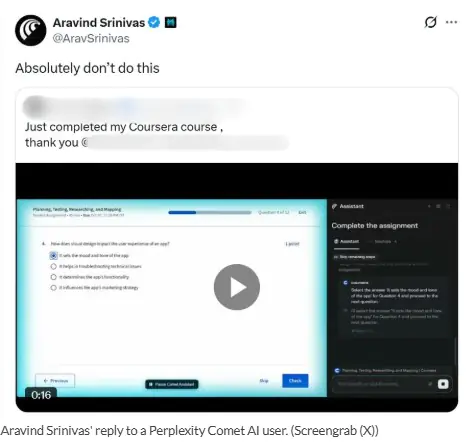
Perplexity’s co-founder and chief executive, Aravind Srinivas, replied directly to the clip and warned users against the practice. Srinivas’ blunt reaction, “Absolutely don’t do this”, underlined the company line: AI can help, but using it to automate formal assessments crosses ethical and educational lines. His reply itself became a focal point and amplified the conversation about AI and integrity.
According to the reports video shows Comet answering 12 questions from a 45-minute training assignment, with the whole automation appearing in about 16 seconds. The user named in Mint’s coverage is Amrit Nigam, who shared the clip and thanked Perplexity and Srinivas. The scene, an AI finishing an ethics course instantly, struck many as darkly funny and worrying at the same time.
Social media reactions mixed humour with concern. Some users joked about creating a “Frankenstein’s monster” of tools and asked when they could run it locally, others worried that companies may end up hiring candidates who inflate resumes using AI shortcuts rather than real skills. A common thread in the comments was a call for platforms and course providers to rethink assessment methods. Several voices suggested this moment should push educators toward more robust, skills-based evaluation.
Who is Aravind Srinivas?
He’s an IIT Madras alumnus and a co-founder of Perplexity AI, he previously worked at OpenAI, Google and DeepMind. The Hurun India Rich List 2025 lists him among India’s youngest billionaires, underlining how quickly foundational AI companies have climbed in value. His high profile made his reaction to the video extra newsworthy.
What should students and employers take from this? As an Indian student and reporter, my view is simple: AI tools are powerful assistants, not legit substitutes for learning. Using Comet to speed through assessments might look clever, but it erodes the point of education, to build understanding and judgment. Platforms like Coursera, and employers who rely on certificates, must update their checks, students should treat AI like a study partner, not a cheat code.
This episode is a reminder that technology moves faster than rules. Public conversations like these, and clear guidance from founders such as Srinivas, matter. They won’t stop misuse overnight, but they can push institutions and users to create better, fairer ways to combine human learning with AI speed.

