



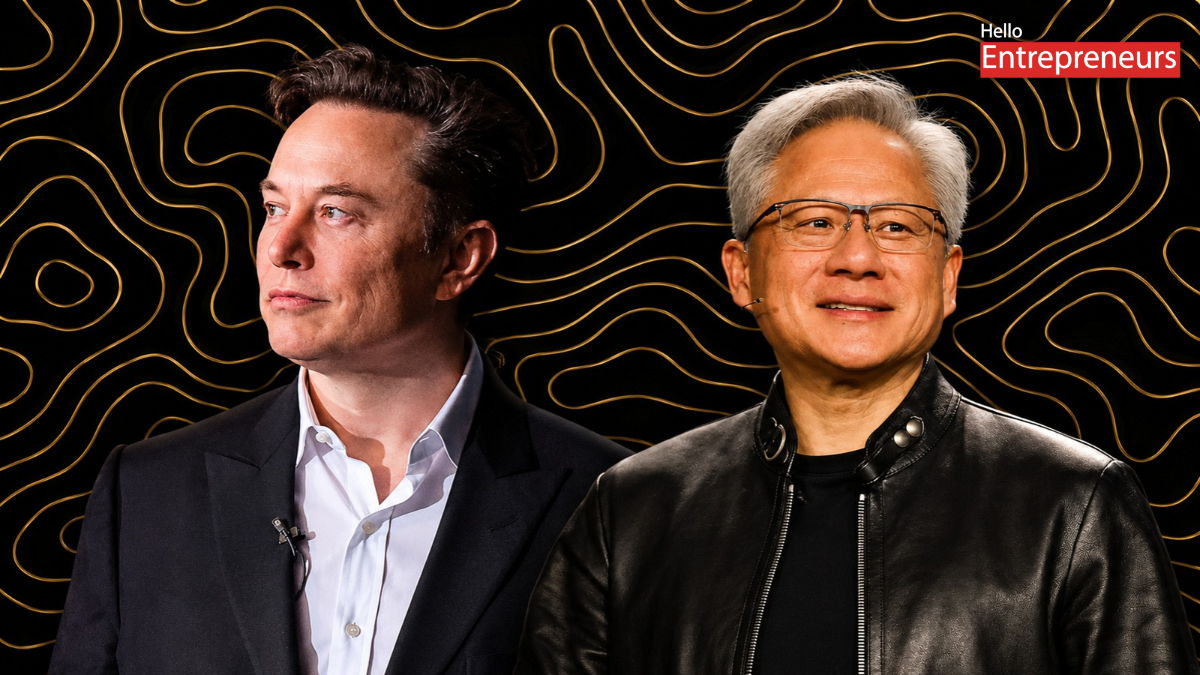
New Delhi: The chip industry has never had to ask itself the question, “What if Nvidia’s founder turns into the company’s biggest competitor?” and it may have to ask it now, as the company’s founder, Jensen Huang, is in the middle.
What is confirmed
Huang will no longer serve as CEO and on Nvidia’s board following a transition that the company announced on Thursday, Nov. 12. CFO Colette Kress is acting as the interim CEO. The departure followed a public statement by the board that it had absolute confidence in him four days ago. The resignation is reported to be connected with Huang’s admission that he had had an affair with a former executive at Singapore-based Nvidia cloud partner Megaspeed.
The reaction since has been unique. Elon Musk is one of about 177,000 people who have signed a petition to have Huang re-elected. In the interim, the board is reportedly busy with its investigation of Huang’s behavior and on a search for a permanent replacement.
What is not confirmed
The rival-company story dates back to a viral post that Huang is thinking about launching another semiconductor venture. Even an article by Townhall, in an article sympathetic to Huang, described it as one prediction for him to raise $50 billion using his relationship with investors and customers. No filing, company statement or named source supports it. That’s also an unconfirmed claim, as is the suggestion that Musk has provided up to $50 billion in support. No job offer or employment talks have been announced, as has been stated publicly by Musk that he would be honored to hire Huang.
Could Huang actually do it?
The case appears on paper to be reasonable. Huang remains the company’s fourth largest shareholder with approximately 3.6% of Nvidia’s shares. He’s seen his fortune go down, but his name is still among the most storied names in tech, and his investors and customers have benefited greatly from his hardware.
If we could raise $50 billion, that would be a different story. It is the volume of transactions that most countries’ venture markets manage in a few years. But the numbers in this industry have grown to the astronomical, as Huang himself has noted: A 1-gigawatt AI data center costs approximately $50 billion. A founder who had Huang’s credibility could get a lot of committals from sovereign funds and hyperscalers looking for other alternatives to Nvidia’s prices.
The real threat is people, not capital
The money might be the simplest aspect. Nvidia’s moat is the software ecosystem and the supply chain and thousands of engineers that have been working with Huang for years. More than 8,800 Nvidia employees reportedly signed the petition, about one in five workers. The impact of even a small percentage of the following could be worse than any product launch. Without Huang, analysts cited by Al Jazeera have said Nvidia could see a 30% drop in value.
Would SpaceX be the first customer?
The Musk “speculation” has already woken up markets. One outlet goes so far as to say that SpaceX are going strong with speculation that Huang is getting into a relationship with Musk, but the history between the two lends more credence to the rumour than a social media conversation. Anchors in Tesla, xAI and SpaceX would be a prerequisite for a chip startup with ties to Musk to ship anything. This is the “customer base lining up” situation with the viral posts. It is a scenario only, but it is very possible.
Chips, not factories
If Huang did start again, he would almost certainly not build fabs, but rather design AI chips. Nvidia has always been a fabless designer and taking the time to create a leading-edge manufacturing from scratch is much more time-consuming and costly than $50 billion and a couple of years. Intel would likely manufacture the components from foundry partners like TSMC, which already does for Nvidia. A new company would come in to compete against the other company in terms of architecture, software, and speed to market.
Legal and practical hurdles
There are a number of challenges to overcome. Huang’s severance and any non-compete or confidentiality terms are unknown, and Nvidia’s board investigation is still open. A company built on Nvidia technology is also likely to be subject to scrutiny of trade secrets. The security issues that have been raised regarding the incident may make it more difficult to work with U.S. regulators and export-sensitive customers.
Bottom line
Nvidia still has plenty of steam, as Huang had estimated that Rubin and Blackwell would generate sales of $1 trillion by 2027 before he would leave. The company is not without defenses. But the notion that its founder might become its biggest competitor is not as crazy as it sounds. Musk or other reliable sources will confirm it or deny it, until then, it is a rumour and investors should treat it as one.

