



At first glance the latest quarter’s earnings for ITC Limited are downright disastrous. A stark 74% fall in standalone net profit for Q4FY26 is the kind of headline number that will cling to news feeds, make investors nervous and prompt speculation that there are deeper, structural weaknesses at play.
The company’s standalone net profit for Q4FY26 was a mere ₹5,113 crore, versus ₹19,562 crore for the same period last year. It seems to be one of the biggest earnings collapse among the country’s big conglomerates this season.
But numbers, which are often the closest thing to truth in corporate finance, can be very misleading.
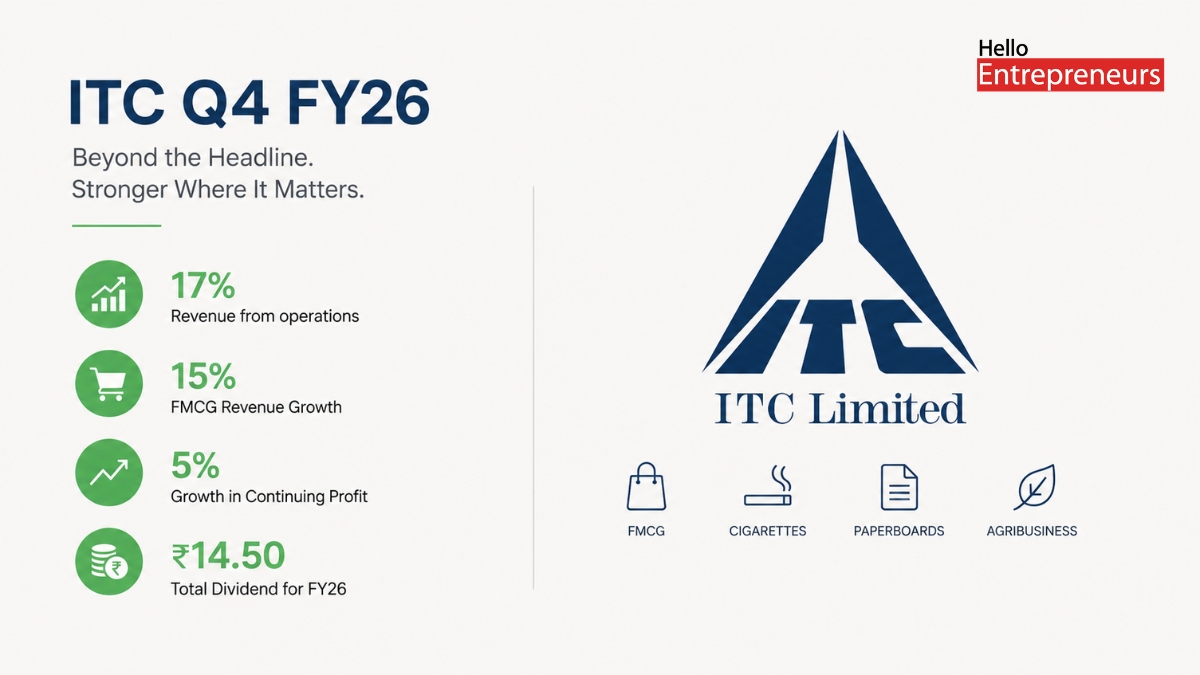
A more nuanced reading of ITC’s earnings tells a very different story. The headline figures are heavily footloose, inflated by one-off exceptional items and accounting adjustments. Take those away and the underlying business looks much more robust, and indeed surprisingly resilient. In fact earnings from continuing operations actually increased by nearly 5% YoY and the company’s revenues were also performing well in its core verticals.
The reality of ITC’s earnings is not collapse but rather resilient, controlled performance in a very volatile global economy.
Revenue Growth Tells a Different Story
Though profit headlines stole the limelight in early market reactions, a company’s operational numbers are far more telling.
Operational revenues grew 17% YoY to ₹21,695 crore as demand momentum came across FMCG, cigarettes, paperboards and a few Agri business segments. And given the backdrop of geopolitical tensions, volatile commodity price swings and tax shocks, this sort of topline growth is a large one for a diversified conglomerate.
Strong demand growth, slowing consumption or weak topline growth are common to companies under stress. ITC was an exception.
It proved once again in Q4FY26 that the institution’s diversified structure still had a defensive depth cushion against sector specific volatility. The impact of pressure on one facet can be withstood by a positive segment. That historic institutional balance has been one of ITC’s biggest strengths and this quarter bore the same testimony.
FMCG Shows Promising Growth
And the real underlying story of the quarter was the performance of the ITC FMCG business.
The business grew revenue by almost 15% while battling massive cost pressure from the global supply chain disruptions. The price hike in edible oil, packaging material, soap noodles and other raw materials hamstrung many consumer goods companies across the globe.
Compounding the challenge was the continuing instability in the West Asia region, which continued to upset shipping lines and logistics channels.
However ITC was able to maintain the tempo by performing agile sourcing initiatives, reading pricing moves, and making tighter operational margins. The showing showcases how the large consumer access oriented Indian conglomerates are quite often shifting into supply chain management beasts rather than just brand connoisseurs.
ITC’s FMCG economy ranging from packaged food to personal care and household staples seems to be growing its depth in both urban as well as semi-urban markets.
For many senses the FMCG division is no more only an “emerging growth engine” for ITC but is becoming the linchpin of the company’s evolution beyond tobacco concentration.
Cigarette Business Remains ITC’s Cash Engine
Despite years of portfolio expansion, cigarettes remain ITC’s biggest profit driver.
And this quarter was a rock-solid test of that business model.
An unprecedented tax hike introduced in February 2026, compounded by the transition to a new taxation regime, put immediate and significant pressure on tobacco’s margins and pricing models.
Normally such policy shocks depress consumption and erode profitability. ITC’s cigarette business was still registering 8.2% YoY revenue growth.
This is significant for two reasons.
Firstly, ITC’s portfolio design is now so great that it can handle tax transitions better than the smaller players in the market. Secondly, ITC’s cigarette business still has got huge pricing power and market resilience even in the present regulatory pressure environment.
Thus for investors, this is massive because the cigarettes business is the cash engine that fuels ITC’s broader diversification strategy in FMCG, hospitality, packaging and agribusiness.
Paperboards and Agribusiness Still Show earnings stability
Shifting the focus elsewhere, ITC’s paperboard and packaging division ran another very strong quarter.
The division’s profits surged 21% due to operational efficiencies and continued demand across industrial and packaging applications.
This is significant because it again shows how ITC’s more under-the-radar verticals quietly contribute to earnings stability.
ITC’s agribusiness division also suffered a hurt due to the geopolitical tension in West Asia which when unfolded prevented export shipments to move and delayed the sales cycle for its products.
However, this was not enough to completely disrupt the division’s performance.
Overall EBITDA surged 7% nonetheless indicating that core business profitability is still wide open even with the external volatility.
This is significant because today’s investors are less concerned with the growth in peak earnings during buoyant cycles and more concerned with stability of earnings through political and macroeconomic crises.
By that measure, ITC’s quarter was much stronger than what governing body numbers indicated.
Dividend Signals Confidence
We are all quick to respond to management commentary. But the dividend decision is what you really want to see.
ITC’s board approved a ₹8 final dividend, bringing the FY26 total dividend to ₹14.50.
That sends an easy message to investors: The company is cash rich, well-run and confident of its long-term earnings path.
A firm that is truly in distress does not make such a big gesture to its shareholders. ITC’s payout signals that the past couple of years’ headwinds are not existential, but rather manageable.
Not Just Sensational Headlines
The key take-away from ITC’s Q4 FY26 performance is that a single headline can leave a lot to be desired.
Sure, it is shocking to read the 74% drop in standalone net profit. But that number masks a firm that grew revenue by 17%, expanded aggressively in FMCG, bokked up the body of tax-hit cigarettes, improved the profitability of paperboard and maintained healthy EBITDA growth in a bruised global landscape.
In a world increasingly defined by geopolitical instability, commodity volatility, fragmented supply chains and regulatory uncertainty, resilience has become a valuable corporate asset.
ITC’s latest quarter shows that the company still has plenty of it.

