


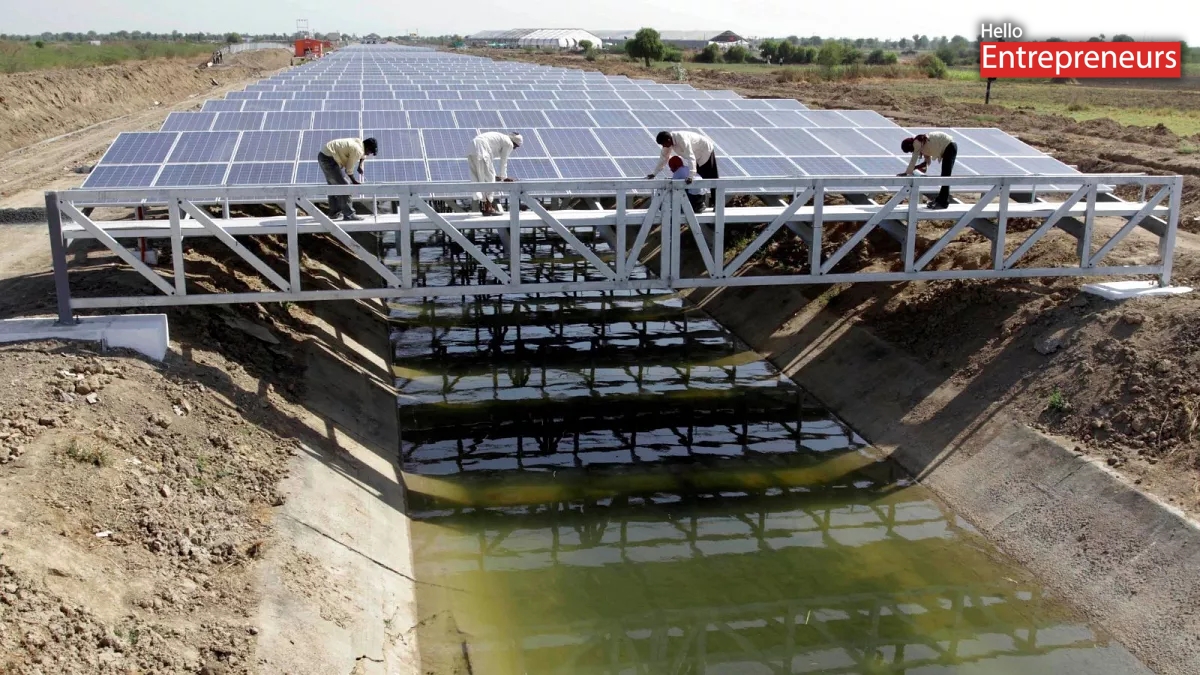
New Delhi: Growing up, India would always face a problem a shortage of land, and this time it’s for solar power, as the nation looks to the country’s canal network, which ranks as one of the world’s largest, as an unlikely resource.
Canal-top solar gains ground
The Central government has given approval for PM Surya Sarovar Yojana to create 5,000 MW floating solar power on reservoirs and inland water bodies. For engineers, though, there’s another avenue of potential, namely canals. Canal-top photovoltaics (CTPV) is different from floating solar in that the solar panels are placed on structures constructed above irrigation and water-supply canals. The designs to be executed depend on a canal’s width and orientation but all must leave water flow unobstructed.
It’s a technology with a key selling point: It requires hardly any additional land. An estimated of 20 MW installed on canals have saved nearly 100 acres in Punjab. The canal sections provide an additional measure of evaporation savings (especially important in water scarce areas) and the water under the panels can cool the panels, thereby improving their performance in warm weather. A 1-MW system has been operating at Narmada Canal since 2012, and is said to be saving almost 9 million litres of water per year, in return for yielding 1.6 million units of electricity.
India was a pioneer in this segment, implementing the initial canal-top project in Mehsana in 2012, and a 10MW scheme in Vadodara along with 20MW projects in Punjab in a span of four years beginning from 2014. Since then, Punjab has called for bids for a further 40 MW while Haryana is considering the option on six canals. The technical potential for the year 2024 is estimated to be in the range of about 131 GW, of which Uttar Pradesh, Bihar, Karnataka, Andhra Pradesh and Punjab are considered suitable states.
That early start didn’t last long though, as deployment has been sluggish for more than a decade. The compensation for the higher cost of building and operating elevated structures is not as great as that of installing ground-mounted structures, and canals that curve or land a long distance from substations provide an additional expense. A national scheme in 2014 to provide financial support did not bring about significant roll out alone.
Restarting momentum will need to be achieved through the provision of standardised technical guidelines, targeted funding like viability gap funding, and enhanced coordination between energy departments and irrigation authorities, according to industry representatives. Even for the assumed potential of one-fifth of the total potential, they observe, it would have a significant impact on India’s renewable energy capacity without requiring additional land.

