



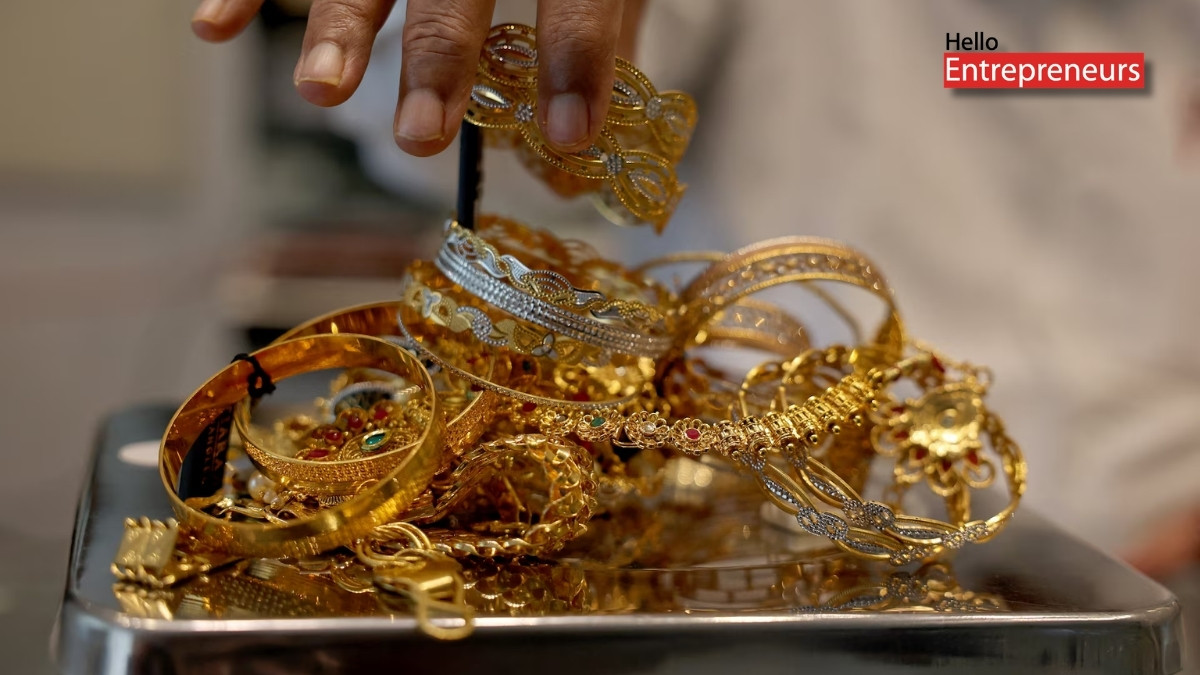
NEW DELHI: Gold has become expensive enough to make many buyers think twice. Yet Indians have not walked away from the yellow metal.
Instead, something more interesting is happening. People are changing what they buy, how much they buy and where they put their money.
That makes India’s gold market less about a simple question of whether people are buying or not, and more about how Indian households are adapting to higher prices.
Indians Are Buying Less Gold, But Spending More
The latest data from the World Gold Council shows just how sharply gold prices have changed the equation.
In the first quarter of 2026, India’s total gold demand rose 10% year-on-year to 151 tonnes. But the value of that demand almost doubled, rising 99% to a record ₹2.275 lakh crore.
The reason is straightforward: gold became much more expensive.
The average domestic gold price in Q1 was ₹1,51,108 per 10 grams, up 81% from a year earlier.
So even when people buy fewer grams, the amount they spend can still be much higher.
This is particularly visible in jewellery. Jewellery demand by volume fell 19% year-on-year to 66 tonnes in Q1. Yet spending on jewellery still increased because of higher gold prices.
The Way Indians Buy Gold Is Changing
High prices are forcing consumers to become more selective.
Jewellers have reported stronger interest in lighter jewellery, while buyers are also looking at different designs and price points to keep purchases affordable.
The shift is not limited to jewellery.
In Q1, Indian demand for gold bars and coins jumped 34% year-on-year to 62 tonnes, its strongest first quarter since 2013. For the first time in a long time, investment demand for bars and coins came close to jewellery demand.
That is important because it shows that Indians are increasingly looking at gold not only as something to wear, but also as something to hold.
Gold ETFs Are Becoming Part of the Story
There is also a new generation of Indian gold buyers who do not necessarily want physical gold at home.
Gold exchange-traded funds, or ETFs, are becoming another way to invest in the metal.
The World Gold Council said Indian gold ETFs added 2.2 tonnes in June, taking total holdings to 119 tonnes. June also saw net inflows of around ₹3,440 crore, the highest monthly inflow since February.
The number of gold ETF accounts also reached 12.5 million after 135,000 new accounts were added during June.
That suggests India’s relationship with gold is slowly moving beyond jewellery shops.
Even Digital Gold Is Finding Buyers
Digital gold is another part of this change.
According to the World Gold Council, purchases of digital gold through UPI increased in June. Transaction value rose 4% month-on-month to ₹2,550 crore, while estimated buying volume rose 9% to 1.7 tonnes.
For younger buyers, buying a small amount of gold digitally can feel very different from spending a large amount on jewellery.
But the basic idea remains the same: gold is still being treated as something worth owning.
Why Indians Keep Holding On to Gold
There is also a deeper reason behind this behaviour.
For Indian households, gold has never been only about its market price. It has been linked to weddings, family savings, gifts and wealth passed from one generation to another.
That makes gold different from many other investments.
And recent data shows that investors are also becoming more comfortable holding gold in financial forms such as ETFs and bars and coins.
The result is a market that is changing, not disappearing.
Gold may be expensive, but Indians are adapting. Some are buying lighter jewellery. Others are choosing coins, bars or ETFs. Some are simply buying smaller amounts.
The common thread is clear: when gold becomes expensive, Indians may buy less of it, but they do not necessarily stop wanting to own it.
That is perhaps the most important thing happening in India’s gold market right now.