



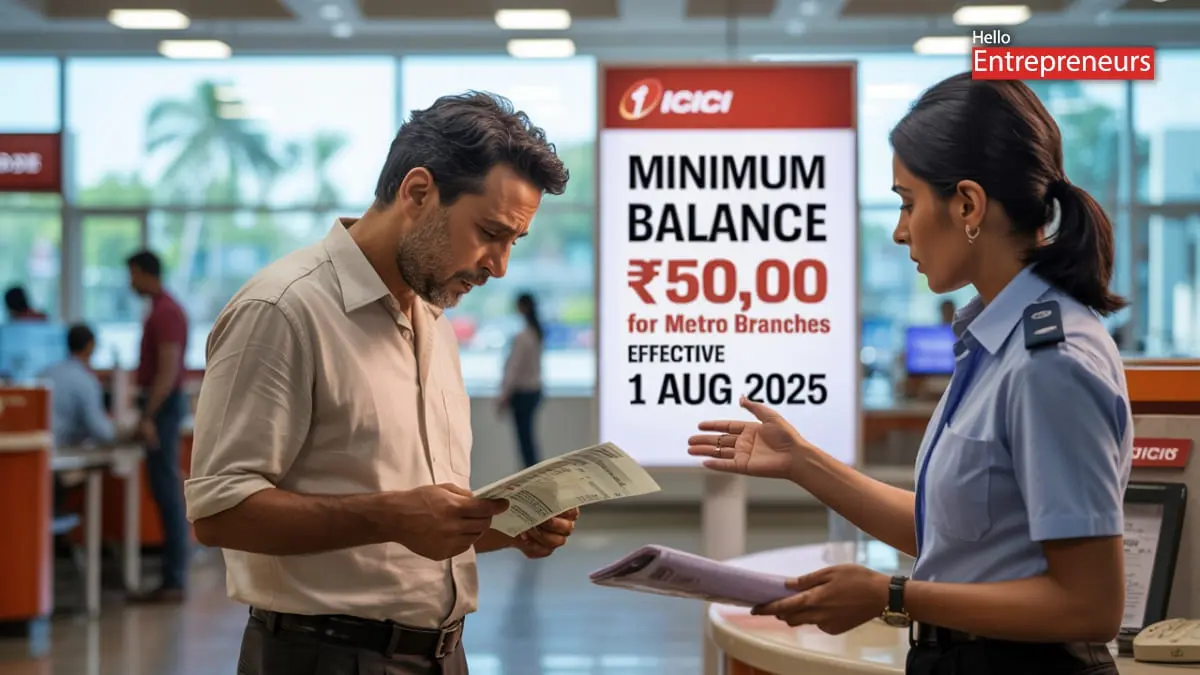
New Delhi: ICICI Bank has made headlines after announcing a steep increase in the minimum average balance (MAB) for its savings accounts. This change, effective August 1, 2025, has set off debates among customers, civil rights groups, and finance watchers across India.
The bank’s new rule means if you open a savings account in a metro city branch, you’ll now need to keep ₹50,000 as your minimum average balance—up from the earlier ₹10,000. Semi-urban branches will require ₹25,000 (earlier ₹5,000), and rural branches will need ₹10,000 (earlier ₹2,500).
For many Indians, this isn’t just a number change, it’s a shift that could decide who feels welcome in the formal banking system, and who feels pushed out.
RBI’s take, banks are on their own here
RBI Governor Sanjay Malhotra made it clear: the Reserve Bank of India doesn’t set the minimum balance rules for banks. It’s completely up to the bank to decide the limit.
Some banks have kept it at ₹2,000, some at ₹10,000, and some have even removed it altogether. So, ICICI’s decision is purely their own call, no RBI pressure here.
From one angle, that’s fair, banks should have the freedom to run their business. But from another, it also means that nothing stops a bank from setting a balance so high that only a certain class of customers can afford to stay.
What happens if you don’t maintain the balance?
If you fail to keep the required balance in your account, ICICI will charge 6% of the shortfall or ₹500, whichever is lower. That’s not a one-time charge, it can keep adding up every time your balance falls short.
And remember, there are also ATM charges if you use more than your monthly free limit, especially at other banks’ ATMs in major cities.
Why civil rights groups are angry
The Bank Bachao Desh Bachao Manch has written to the Finance Ministry asking for this decision to be rolled back.
Their argument is simple, most Indians earn less than ₹25,000 a month. If you ask them to keep ₹25,000 or ₹50,000 locked up in a bank just to avoid penalties, you’re basically asking them to freeze their monthly income.
As Biswaranjan Ray and Soumya Datta, the group’s conveners, put it, this is not inclusive banking. Instead, it’s like building a gate that only certain income groups can walk through.
How other banks are doing it?
This is where ICICI stands apart from many public sector banks like State Bank of India, Punjab National Bank, Canara Bank, and Indian Bank.
These banks either have much lower requirements or no penalties at all for certain accounts, especially Jan Dhan accounts, which are made for financial inclusion.
While public sector banks are going wider to reach more people, ICICI’s move feels like they are going narrower, targeting customers who can afford to park larger sums without touching them. Who Will Feel This the Most?
If you’re an established professional or a business owner in a metro city, ₹50,000 may not seem huge. But for:
- Students managing small monthly allowances
- Daily wage workers or gig workers with irregular income
- Small shopkeepers juggling multiple bank accounts
- Rural residents for whom even ₹10,000 is a lot
…this rule is going to hurt.
It’s also worth noting that small entrepreneurs who keep accounts in multiple banks now need to keep bigger sums spread out—money that could otherwise be used to grow their business.
On social media, many people are openly criticising the decision, calling it “anti-common man” and “against the spirit of financial inclusion.”
Even the stock market seemed unsure, ICICI Bank’s shares stayed mostly flat after the announcement, but they’ve fallen around 3.5% in the last two weeks, underperforming compared to other bank stocks.

