



Back in the day, we had to wait for TV shows to air, can you imagine? It’s all instant entertainment now. The future is here, with everything and movies and games right there on your fingertips, the future is also here, Video games, the Video games have also gotten to the next level, bringing you off the pixels and into virtual reality.
The gaming industry has increased significantly in the recent years to reach the highest ever figure of 282.30 billion in 2024. The industry is supporting the economy and enhancing such aspects as animation, e-sports, and entertainment.
And who has been taking literal control of the actual gaming world? Nintendo, yes, this small corporation has managed to take over the competition and form an almost monopoly, starting with playing cards.
Nintendo is a global giant in the field of game development, and it is on the forefront in terms of new concepts. By March 2024, it had sold $11 billion of game related Software and Hardware making it the highest selling company in the globe, but Nintendo has always been pegged in its success based on the performance of its gaming console. What began as a massive success has experienced good and bad times since then. Along with such huge hits as Super Mario Brothers, the DS, Nintendo Switch, and the Wii, Nintendo also experienced its amount of failures such as the Wii U and the mobile gaming services.
But how did they do it? How Nintendo continues to demolish the competition? How Nintendo conquered the world of games? Their mastermind plans and game changers are an art of success. Their secret? Smarter ideas, classics that are classic and knowing what gamers like best. It is as though they possessed a crystal ball of gaming trends. You have played their gamings, teach you their secrets.
History of Nintendo:
Let us discuss the origin of Nintendo. It began in 1889, but it did not begin with video games, but with cards. It Wasn’t Mario then, It Was Hanuta, these were homemade Hanuta hand-drawn cards, symbolizing the 12 months of the year. It is so, the history of Nintendo traces back to the 19 th century when Fusajiro Yamauchi made a decision to begin doing business. What did he do? He sold playing cards and fortunately the Japanese government had just legalized the playing cards the same year. Told you, right time, huh? Even in Japanese kanji, the name Nintendo means: leave luck to heaven but Fusajiro was not leaving it to luck and he worked hard, making his cards out of mulberry wood and making a business which brought his decks to the hands of everyone in Japan making him king of the cards the other 40 Years.
Nintendo was then handed over to Hiroshi Yamauchi in about 1977. Not much before that, in fact, he dismissed all the leftover managers and appointed by his grandfather. “Thanks, granddad; we’re making some changes.” He recruited younger managers because he believed they needed to move beyond playing cards to a more innovative future. He said, “No wait a minute; what are our core competencies?” He recognized that their core competence was knowing how to distribute things and having relationships with an extensive pipeline of stores and distributors and sub-distributors. The question was what they would distribute through there because that was the strength of Nintendo.
One of their main strengths, playing cards, wasn’t a wild innovation, but they had learned how to distribute things everywhere. So he sought out a product category, and the one that he discovered that really appealed to him was the emergence of the very early video game market. He stated that Nintendo was moving into video games, and they were going to leverage their distribution so that they had a way of getting those video games into every store because remember, playing cards had been working with toy stores, variety stores, and little stores that had sold little pieces of entertainment, just the ticket if he could get video games up and running; he could approach those same customers and push them through.
They had this small shoebox-sized orange console in 1977 that was the Color TV-Game 6, which stood for something you played on a color TV, and it contained six games and all of them were different variations of tennis in one form or another. Then later on, they increased it with the TV-Game 15 with 15 games in 1977. They operated that; they sold that, they sold 1 million units, and then they tallied all their dollars, or pardon me, they tallied their yen, and they made a loss. But they learned something: people loved playing games and were willing to pay for them, and they could sell them through their distribution.
He then made a pivotal choice: “They love these things, but where is the largest marketplace in the world for video games? The United States! I must be in the United States.” They examined the market for games and found two segments: these small baby video game machines that had arrived like ones they produced but also full-sized video games that would appear in arcades, the huge big square cases the size of a small refrigerator where you played things like Pac-Man.
Market assessment of Nintendo:
Before Pac-Man was famous, they started innovating their way into big-frame video games. He was looking for someone who could assist him in entering the American market in particular with these bigger-size video games. He had a cousin residing in Vancouver, Canada, who just happened to be married to his daughter Yoko, and his name was Arakawa. He traveled to Arakawa and told him, “You are just the person to open Nintendo up in the United States; you already reside in North America.” In 1980, Nintendo of America was established.
Cut to 80 years later, and they swapped cards for consoles, releasing the Famicom in 1983, and boom, Nintendo was the name in home gaming. Who would have known trading cards would level up like that?
As this happened during early ’80s there was also bubble being created within videogames as everybody rushed into producing them, even companies like Purina (pet food), that created a market eventually leading towards market meltdown where companies like Atari went under and Sega sold for pennies on dollar as this market imploded.
In all this chaos however Nintendo endured on the back of Donkey Kong revenue while releasing its console, the NES, to America after successfully launching Famicom in Japan earlier! In 1984 at Consumer Electronics Show NES was met with skepticism but marketing consultant Sam Boroff envisioned potential believing American consumers would accept video games if handled properly.
Ultimately releasing NES became one of the most successful consoles in history selling 61 million units throughout America propelling towards phenomenal penetration, one console for every 30 American households.
Nintendo shifted 6 million consoles alone in 1988 while at the same time branching out into handheld units like Game Boy selling 118 million units as kids who played Super Mario wanted gaming on the move!
Nintendo’s business model
Nintendo’s USP:
Nintendo, not once has it been Individually solely a video game company. It creates both hardware platforms and the software to go along with them and in the current market, most firms do either one or the other. Like Microsoft and Sony, who mostly make hardware and count big on outside studios through partnership deals and money agreements to make their first-party material. Nintendo does both.
This matters for two reasons. Firstly, Nintendo established its reputation as a company that blends hardware and software together. Consumers anticipate not only excellent systems from Nintendo but also outstanding, finely crafted first-party software to accompany them. When you hear the word “Nintendo,” you probably envision this harmony.
How Nintendo Marketed the Switch and how it changed the game?
Nintendo used two marketing strategies that were crucial in the promotion of the Switch: branding and integrated marketing communications. On October 2016, the Nintendo Switch was released via a brief three-minute video announcement. This clip highlighted children’s skill at switching anywhere and playing whatever they desired, which enabled Nintendo to engage immediately in showing the ways the console might be utilized when teasing the Switch’s announcement of its release date and pricing in January, which created even more hype for its launch.
Nintendo subsequently invested four million dollars for a commercial during the Super Bowl featuring the Switch together with its flagship launch title, The Legend of Zelda: Breath of the Wild. The commercial was to be seen by millions of individuals and heightened visibility for the Switch as it drew near its launch. In addition, Nintendo created a campaign known as “Nintendo Switch in Unexpected Places,” which saw it construct kiosks in three vastly different locations to demonstrate how the Switch can be taken anywhere. The kiosks were set up at a desert in California, a ski resort in Aspen, and a park in New York City.
Nintendo also leveraged Best Buy and Target partnerships to establish in-store marketing for the Switch and its titles. For instance, when Mario Kart 8 Deluxe released on the Switch, Target had Mario Kart branding all over its stores to assist in promoting it. Last but not least, Nintendo worked with influencers like John Cena and Jimmy Fallon to market the Switch. John Cena was at the surprise desert kiosk party and played the Switch with fans to get attention for the console, and Jimmy Fallon played the Switch on The Tonight Show and seemed excited to be among the first to play the console before its release.
From a branding perspective, Nintendo used different things to make its products stand out in the marketplace. The logo of the Switch had a clear design shift that brought into focus its prominent features. Additionally, the color palette of Nintendo’s logo also went back to the original red and white it had in the past, which also aligned with the color palette of the Switch’s logo. The two elements created a cohesive brand image between the company and its products. The Switch’s packaging was made to appeal more to young adults than their earlier consoles, which were geared towards children. This framed the Switch as a high-tech gadget instead of a toy.
To keep up with the market pace, Nintendo needs to explore ways to even more effectively engage customers through a smooth omni-channel marketing strategy. Omni-channel marketing is all about unifying all physical and digital channels in order to deliver a seamless and unified customer experience. With this approach, companies need to see their marketing from the customers’ point of view.
One way that Nintendo can do this is by incorporating its shop in future smartphone communication apps, where the integration aims to make online products more visible and push special offers through reminders and push notifications. Nintendo should also look into building relationships with additional third-party game developers so that there are more games on the Switch and that it gains new gamers.
The Blue Ocean Strategy:
Blue Ocean Strategy, developed by W. Chan Kim and René Mauborgne, is the creation of new markets in which there is minimal competition (Blue Oceans) rather than struggling for existing markets (Red Oceans).
Red Ocean: Competing in a dense market with numerous players, resulting in less profit.
Blue Ocean: Discovering a new, unexplored market with minimal players, resulting in greater profit.
Key Concepts:
Value Innovation: Providing something new and valuable to customers, with low costs.
Strategy Canvas: A tool used to identify market gaps and where you can differentiate.
Nintendo and Blue Ocean Strategy
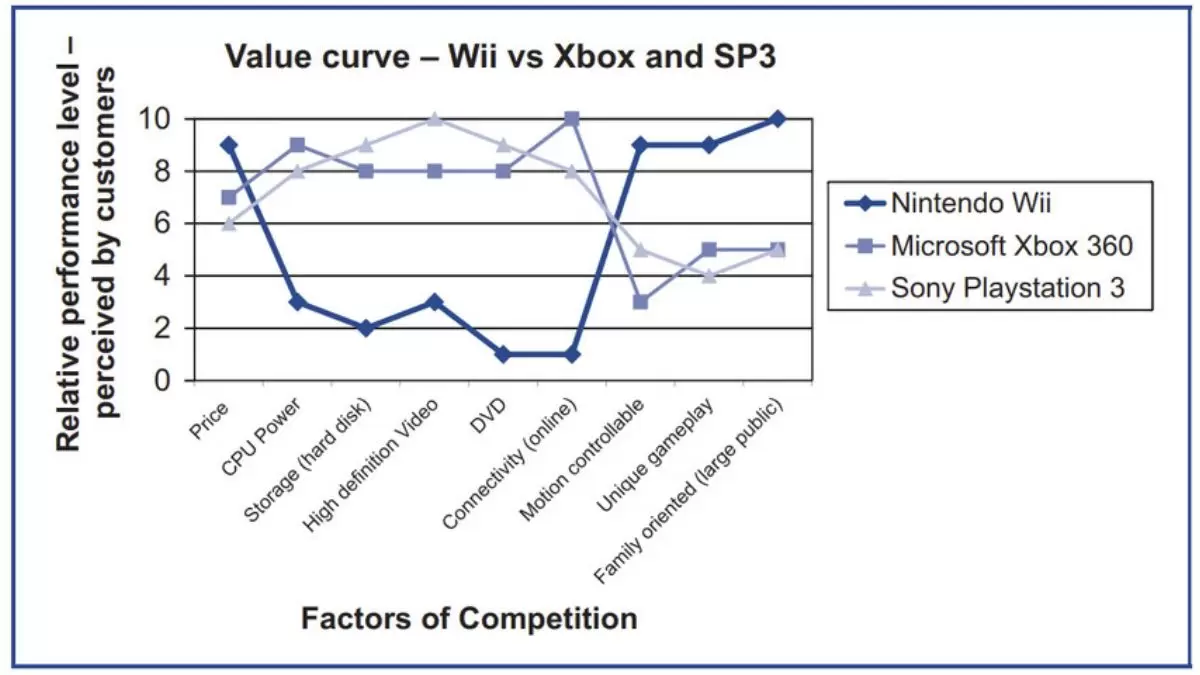
The best example of Blue Ocean Strategy is Nintendo’s Wii. Rather than competing head-on with Sony’s PlayStation and Microsoft’s Xbox based on graphics and power, Nintendo revolutionized the gaming experience. The Wii made gaming fun and easy for anyone, casual gamers, families, and seniors.
Nintendo didn’t compete with its rivals in terms of power. Instead, they did the following:
- Eliminated emphasis on high-end graphics.
- Lowered the cost and sophistication of playing games.
- Increased user engagement through the use of motion controls.
- Developed a new gaming experience for all.
This enabled Nintendo to create a new market with minimal competition initially and made the Wii a massive success. Nevertheless, when other firms observed the demand, they began supplying similar attributes, transforming the Blue Ocean into a Red Ocean.
Yet, Nintendo’s Wii demonstrates the ability of Blue Ocean Strategy to shatter competition and create new opportunities.
Issues that Nintendo is struggling with:
Nintendo’s policy of both designing the hardware and software in-house is a huge plus for them. They can do with both as they please, so their games provide a distinctive, high-level gaming experience. How well their games do depends heavily on how well their consoles do. If a console performs well, the games on it can be successful as well, but if a game is based on a less successful system such as the Wii U, its success is restricted.
There were a couple of issues with that, though. Nintendo didn’t utilize its IP in the Wii U era. There wasn’t an original Zelda game, for instance, and not a lot of new titles came out.
Mobile games are also a challenge. With 3 billion mobile consumers and the smaller Wii U and DS consumer base, Nintendo is up against stiff competition. Although Nintendo specializes in casual games, mobile games tend to be perceived as lower-priced choices, which takes Nintendo’s attention away.
Finally, Nintendo was having trouble with both handheld and home systems. The Wii U and DS did not exactly cooperate, which caused problems for developers. The Nintendo Switch fixed this by putting the two systems together into one.
SWOT Analysis:
A SWOT analysis is traditionally used in business cases to help visualize the most important elements of an organization the strengths of Nintendo are as follows, a globally accepted brand Nintendo is synonymous with gaming Nintendo has a lot of consumer loyalty Nintendo has the bestselling AAA IP they’ve got multiple revenue streams both in the mobile and console sectors they’ve got innovative product offerings and their recent consoles occupy a very unique Niche lastly they’ve got affordability in their game architecture. With strengths come weaknesses and they are plenty, Nintendo has a lack of third-party relationship development for one they also have low-end technology when compared to other consoles Nintendo holds a Casual Image in the market that could be a bad thing they also have a lack of a centralized gaming Avenue as do all companies who focus on many different things their online functionality it’s definitely behind the times they’ve also got a high dependency on a few gaming titles and a lack of diversification in its AAA offerings.
Now let’s talk about the opportunities for Nintendo because there are a lot link the bridge between mobile and Casual gaming with the switch that’s a big one online subscription paid DLC the season pass market and microtransactions those streams remain unexplored for the most part Indie Market expansion and of course the technological advancements will come at reduced cost to catch up.
Now the threats mobile games can be substituted for Nintendo’s handheld and future console design and its first-party software the hardcore Market demanding State of the art technology the changing gaming environment resulting from the virtual reality boom and lastly YouTube’s platform and concessions to automatic copyright claiming reduce awareness for Nintendo’s offerings because they quite often just piss a lot of people off.
The life cycle of a video game can lead an organization to focus too heavily on the future of its Hardware capacity consoles that focus on the present support their Hardware develop the third-party relationships and at the same time set aside resources for R&D for their new systems are the consoles that will be successful the future for Nintendo will be decided with it support for its new system the Nintendo switch.
Finally, We’ve prepared a simple checklist of my recommendations to Nintendo in light of all of this objective information:
- Number one explore the possibilities with your existing successful intellectual property.
- Number two allow third-party companies the flexibility and support to develop great games.
- Number three develop a robust and fairly priced online platform where competitive play modding and community development can coexist.
- Number four communicate clearly and consistently what the switch does how it works who it’s for and more importantly how we will be using it
- Number five continue the development of amiibo based toyis system interfaces to supplement the consoles in the future as an additional Revenue Source
- Number six understand the importance of the system life cycle and how it is necessary to continually support the Nintendo switch as New Economic phases occur
- Number seven and finally Implement a long-term plan to be a major ball player in the mobile gaming Market.

