



Five years ago, if you do remember, two Boeing aircraft collided and this resulted in one of the greatest controversies of the decade. The Indonesian passenger airplane crashed in the sea a few minutes after takeoff, and another five months after this, an Ethiopian Airlines flight crashed as well. The same model Boeing 737 Max was involved in these crashes that killed 346 people and it was caused by flaws in the design of the plane.
Although these crashes were perceived to be enormous tragedies, what people do not know is that Boeing planes have been experiencing more severe problems. Taking the example: in January, a door plug flew off during one of the flights, and some loose bolts were detected on other door plugs. One month after that, one of their planes had the tire falling off and another Boeing plane had a fuel leak. It is like being 30,000 feet in the air and your pilot informs you that there is a leak in the fuel tank, would you be okay with it? Regrettably, that has been the actual situation Boeing has been experiencing.
Over the past ten years, Boeing has had 970 safety issues, putting one of the greatest companies in history dangerously close to bankruptcy.
It’s hard to believe that Boeing was once the most trusted, reliable, and innovative brand in the world for nearly 80 years. People used to say, “If it’s not Boeing then probably I’m not going,” because they had so much confidence in the company’s planes.
However, after doing so well for 80 years, the business leaders of Boeing made one significant mistake that changed the company’s fortunes from a dream run to a nightmare. This case study is crucial for us because it highlights a common mistake that entrepreneurs and Business person must avoid.
Every time it seemed like Boeing was just around the corner from recovery, a new issue just cropped up. Now there are passengers who avoid or are scared to board Boeing airplanes. The name “Boeing” has become dreaded in the aviation world nowadays.
But the key question, the multi-billion-dollar question is when will it be all clear? When will things get sorted? How did Boeing become the most successful company on Earth only to become the biggest failure of the century? Most importantly, what lessons can we learn from Boeing’s disastrous fall?
Product Driven or Business Driven:
To understand Boeing’s fall, we first need to recognize that there are two philosophies for running a business, you could either be a product-driven business or a business-driven business.
In contrast, when leaders prioritize revenue growth over product quality, what defines a business-driven company, they often neglect how good or average their products are.
This difference explains the case with Boeing. Boeing was at one point in time one of the most revolutionary companies in history, since its establishment in 1916 they had supplied aircrafts to the U.S. Navy during the world wars-I and made it rich through military contracts.
Boeing had become so ahead of its rivals to a point that, in the 1970s when Airbus A300 was capable of transporting 247 passengers on non-stop flights of 4,600 miles. Boeing 747 was able to accommodate up to 460 passengers in a distance of 9200 miles without any stopovers. The key success factor of Boeing is its leadership that was engineering-based and had the interest of developing superior products rather than maximizing profits at the expense of bankruptcy.
In 1965, they put a lot of money in designing, over a billion dollars in developing their famous wide-body jet, the Boeing 747, even though they had made 2 billion dollars in revenue at that time. Yes, a gamble stretching technology to its limit which ultimately became one of aviation’s most recognized aircraft.
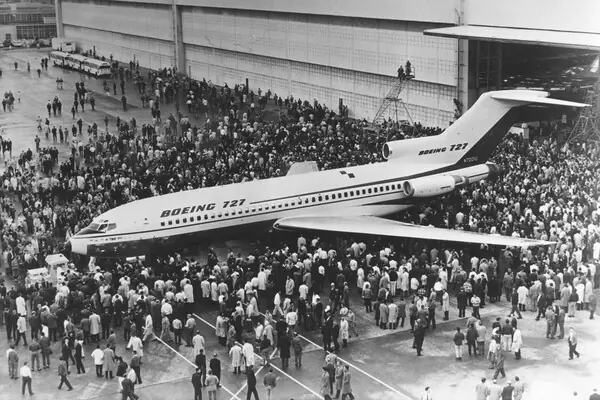
Unlike phone or car manufacturers where R&D investments provides quicker returns and are also known as Liquid returns but in the case of aviation, even spending billions offers no guarantee of success within reasonable timelines a single innovation might take a minimum time frame of 5 to 10 years.
Despite these challenges, Boeing spent over half of its revenue developing their flagship model, their commitment paid off: from its introduction until 2007, their flagship remained largest passenger aircraft ever built.
For decades, Boeing thrived under engineering leadership prioritizing product quality above all else, yielding record stock prices soaring from $0.40 per share (1975) reaching $18 per share (1995) alongside revenues increasing dramatically during this period demonstrating extraordinary innovation within commercial aviation!
The turning point:
However, the turning point arrived during consolidation efforts beginning around mid-1996 when three major players existed: Airbus (18% market share), McDonnell Douglas (19% market share), and Boeing (53%). To consolidate power further, Boeing acquired McDonnell Douglas for $13 billion, a decision that marked significant shifts within corporate strategy, ultimately leading to its downfall.
This acquisition initiated a transformation in Boeing’s operational philosophy.
The company started focusing on the profit margin and shareholder value rather than the engineering-based culture that had been the hallmark of its success in the past. This reorientation became the emphasis on the reduction of costs and efficiency at the cost of the quality and safety of products.
When Boeing acquired McDonnell Douglas, it was under pressure to realize the financial outcomes as soon as possible. The focus on immediate profitability resulted in the making of choices which undermined the high safety standards which had been a trademark of the prior Boeing reputation. As the engineering teams were empowered to focus on the excellence of the products, they were limited by the corporate directives that encouraged the financial performance as compared to the innovation.
Boeing was so successful with a duration of more than 80 years since it was not run by business leaders but engineers. These engineers made the ultimate decision when it came to plane design and quality and safety were the highest priority. Even the Boeing leaders were the most qualified, they were patented, had drawn aircraft wings, and never prioritized profits, or shareholder satisfaction.
This attention to developing great products did not go to waste. The stock price of Boeing scaled by an incredible 4,400 per cent between 1975 and 1995 when the company increased its price by a wide margin between 0.40 and 18 per share. They also expanded their revenue to $19.52 billion as compared to a previous revenue of 3.9 billion.
Boeing turned out to be one of the most successful and innovative companies in the globe. It was a leader in jet technology and commercial aviation having got record orders of its Dreamliner 300 planes worth over 42 billion. Through collaborating with other firms, smart acquisitions, and global competition, Boeing assisted in making air travel cheap and affordable to all people worldwide.
Then the question here is:
When Boeing was so successful and so profitable, what exactly went wrong?
Well, the story of the fall of Boeing started in 1996. This is when there were three players in the market: Airbus, Boeing, and McDonnell Douglas. To consolidate the market, Boeing acquired this company called McDonnell Douglas for $13 billion, and this is where the problem started. When they acquired the company, the CEO of McDonnell was a man named Harry Stonecipher, and somehow Mr. Stonecipher negotiated a merger with Boeing in such a way that he became the president and CEO of the merged entity and a member of Boeing’s board. So, you see what happened: a big company bought a small company, but the small company’s CEO became the head of the large company.
So, you know what happened next?
Well, all the McDonnell Douglas teams started to take charge of the production and design departments of Boeing. After taking over, they started breaking down the teams of Boeing into separate outsourced teams in Japan, Malaysia, and Italy. For example, in Boeing’s 787 Dreamliner program, Boeing outsourced its operation to Japanese companies like Mitsubishi, Kawasaki, and Fuji Heavy, these companies made 35% of the aircraft structure. Similarly, Italian companies like Alenia Aeronautica were tasked with assembling the midsection and rear section of the fuselage, for 787s, they started to have operations in Malaysia where they had more supplier relations.
So, what’s Next? Boring decided outsource 70% of its design engineering and manufacturing of entire modules to over 50 strategic partners all across the world. Looks fantastic, right? But guess what? Instead of making operations simpler, this outsourcing complicated matters to such an extent that there were too many faults in procedures, too many engineering problems occurred, eventually, the budget allocated for 787 shot up from $8 billion to $32 billion. So, because of some poor business outsourcing strategy, Boeing had to spend another $12 billion extra.
At the same time from 1999 to 2003, Boeing laid off more than 50,000 employees for cost-cutting measures. Boeing announced on Wednesday it’s cutting over 12,000 U.S. jobs with more on the way. Boeing employees are expected to be back on the job after The Machinists Union overwhelmingly ratifies a deal to end an eight-week strike. The labor group says the new contract protects more than 5,000 factory jobs while preventing the outsourcing of certain positions and preserving health care benefits.
To make matters worse instead of using existing money to build better and newer products, Boeing engaged in another unhealthy business practice. You know what they did? Between 1998 and 2018, Boeing bought back shares worth $61 billion, which was literally 81.8% of their profits! Why did they do that? Because Boeing wanted to increase their earnings per share.
Let’s understand this with Example: let’s say If you have $100 in profit and you have 100 outstanding shares then your earnings per share is $1 per share, but if you buy back 50 of these shares then the outstanding shares would be 50 and profit would still be $100, right? So now the earnings per outstanding share would be $2 per share, right? So, in the stock market when earnings per share goes up investors would see stock as more valuable.
And to make situation even worse while they were taking these business decisions Boeing’s entire headquarters and senior management were moved 20 thousand miles away from the commercial aircraft division! So now management and engineering teams were far away from each other! This is how Boeing’s business leaders used unhealthy business practices to lay the foundation for Boeing’s failure.
And guess what? The story doesn’t end here while Boeing was occupied somewhere else, something crazy was happening with Airbus! American Airlines until 2011, for 15 long years, had bought only from Boeing! But because Airbus was coming up with more efficient aircrafts they placed an order with Airbus! This is when Boeing got a wakeup call! They knew that they were falling behind and their planes were no longer of best quality or of best efficiency.
But Instead of cutting down on buybacks and investing that money into building new products they took a shortcut! Instead of spending $20 billion on a new project they spent just $2.5 billion to tweak their existing design of 737 and called it 737 Max! Do you see the difference? A few decades back this same company did not think twice before pumping in 50% of its revenue into building a new product but now this same company spent 81% of its profits into buybacks while cutting costs on product development.
Since they were operating out of FOMO (fear of missing out), Boeing decided to fast-track this entire process, in this fast-tracking they made one big mistake! To tell you about it: when you build a new product in aircraft industry it takes five to nine years just for certification! Obviously, Boeing could not wait that long. So, in their way to hack certification process they used same parts from existing 737s and just attached new engines.
This change in engine placement affected aerodynamics, so to counter this, they introduced something called Maneuvering Characteristics Augmentation System (MCAS). In short if nose went too high MCAS would automatically push nose down! And guess what? In both flights that crashed, as soon as flight took off, this MCAS system pushed nose down.
In fact report on Lion Air showed that sensor made plane’s nose go downwards twenty-six times during ten minutes while pilots struggled to pull nose up but eventually lost control, and flight crashed! And most shocking fact is that pilots could have switched off MCAS systems right? Well guess what? Pilots didn’t even know this system existed in first place!

Why? Because Boeing thought they were not making any major changes, As result no training was given pilots dealing with MCAS, didn’t even inform them about MCAS in manual, this is how those two aircrafts crashed eventually leading full-blown investigation into Boeing!
This is the sad story of Boeing, a company which once held the greatest reputation in terms of aircraft production but has gone off track due to its executives having too much emphasis on profits. We can learn a lot about this.
Lesson 1: It is not only about profits, it is about products
As an Entrepreneur or a owner of a business, you must make the decision as whether you want to make great products and not only to make the money. History teaches that a one-sided approach to profits is usually a failure. Rather, invest your efforts in producing fantastic products and success and money will be earned accordingly.
Lesson 2: Culture of the Company Matters
Business culture is extremely vital. When the leaders and the employees do not see eye to eye, the situation may be ruined. Ensure that the management team collaborates with the creators of the product and not their opponents. There is a break and the issues begin.

